
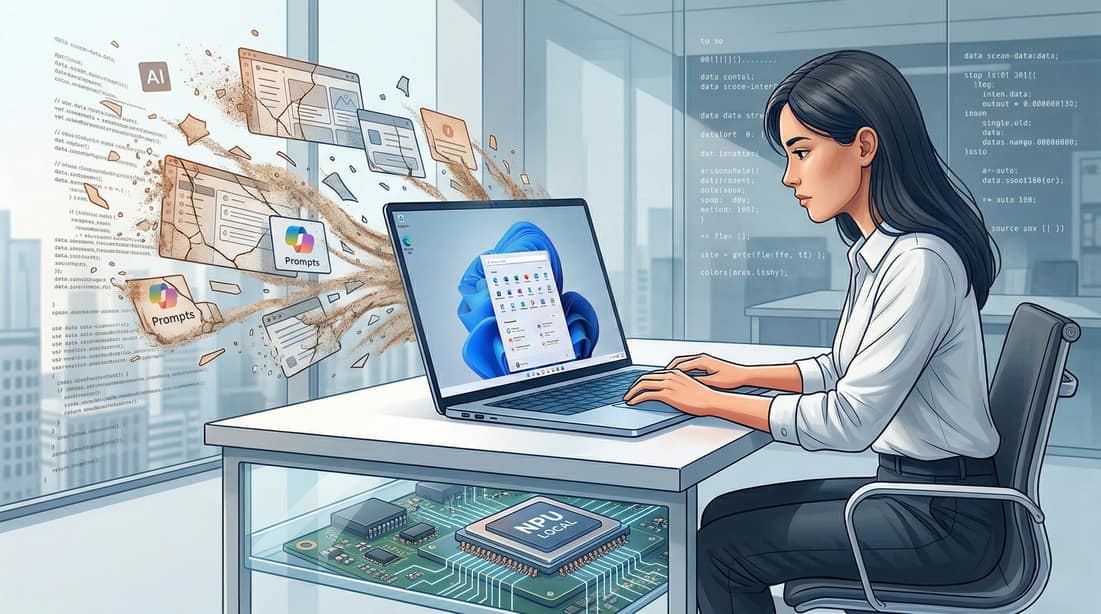
If you are regular readers of ComunicaGenia, you will surely remember that article where we asked ourselves if it is worth investing in a computer with AI. In that distant 2024 we were talking about the hardware revolution, about those processors with dedicated NPUs that were coming to change the way we work.
However, in the world of marketing and product development, having the best technology under the hood does absolutely no good if the user experience (UX) behind the wheel is a disaster.
And that, precisely, is what today’s topic is about. On March 20, 2026, Microsoft made an announcement that has shaken the industry, but not because of a novelty, but rather because of taking a notable step back. They have decided to apply a “rollback” and drastically reduce the presence of their AI assistant, Copilot, in Windows 11.
What does this movement teach us about product design, technological adoption and marketing? Sit back, because we are going to analyze why the “shoehorning in AI” strategy almost cost Microsoft the trust of its users.
The “ubiquitous AI” mistake: When innovation becomes Bloatware
When the famous AI PCs (Copilot+ PCs) hit the market, Microsoft adopted an aggressive launch strategy. From the marketing and product department, the directive seemed clear: “We want the user to know that they have AI, so we are going to put AI everywhere.”
We started to see Copilot buds sprouting like mushrooms after the rain. It was integrated into the Snipping Tool, the Photos app, Widgets, Notepad, and there were even plans to force it into System Settings and File Explorer.
From a UX design perspective, this is what we call an unnecessary increase in cognitive load. Instead of being a silent assisting tool, Copilot became that pushy salesperson who chases you around the store asking if you need help when you just want to look.
The response from users was immediate, and was not what Microsoft had projected. Complaints began to pour in. The community began to perceive these integrations not as premium features, but as bloatware (that bloated and annoying software that slows down computers).
The forums were filled with criticism of an operating system that dirty an interface that should be designed for productivity and concentration.
The course correction: Listen to the user above the corporate ego
This is where the first big marketing lesson of this case comes in: knowing how to read the room and rectify in time. On March 20, through its official blog, Microsoft announced a series of quality improvements for Windows 11. The central message was an implicit admission of its design error.
They literally stated that they were going to be “more intentional about how and where Copilot is integrated across Windows,” focusing solely on creating experiences that are “genuinely useful and well-crafted.”
In practice, this has meant cleaning the house. They have eliminated those intrusive entry points in the applications we mentioned before (Photos, Notepad, Clippings).
By doing so, users (and specialized media) have almost immediately reported a palpable improvement: a system that feels faster, cleaner and less invasive. Microsoft has understood, based on criticism, that in user interface design, less is often much more.
The UX contrast: The lesson Microsoft has had to learn from Apple
As marketing and technology analysts, we cannot ignore the elephant in the room. This course correction by Microsoft is, in essence, a late adoption of the design philosophy that its biggest rival has been preaching from the beginning.
While Microsoft was betting on visual stridency to justify the sale of its AI PCs, Apple Intelligence was presented with a diametrically opposite premise: invisible AI. Look at the difference in UX approach:
Apple didn’t fill macOS with brightly colored buttons or animated avatars. It opted for a native and subtle integration within the applications that the user already used.
Writing tools, summaries or prioritizing notifications happen in the background. Apple’s AI only acts when you explicitly invoke it or when its intervention truly reduces the friction of a task.
Microsoft attempted to change user behavior by force (the dreaded “force adoption”), while Apple adapted its technology to existing user behavior.
Golden lessons for your Marketing and Product strategies
If you are designing a service, an app or even a digital marketing campaign, the “Copilot case” leaves us with three fundamental learnings that you can apply today:
- Friction kills innovation: It doesn’t matter how advanced your technology is; If its use disrupts your client’s natural workflow, it will be rejected. Utility must be demonstrated, not imposed.
- The value of intentionality: As Microsoft has had to admit, the characteristics of a product must be “intentional.” Don’t add a feature (or a marketing channel, or a social network) just because it’s trendy or because the competition is doing it. Add it only if it solves a real, specific problem for your audience.
- Negative feedback is your best consultant: Microsoft could have ignored the complaints and continued pushing its original vision. Instead, it listened to the backlash, measured the impact on brand perception, and pivoted. Pivoting is not failure, it is sharpening your aim.
So, back to our question: What about AI PCs?
If you read our article on whether it is worth investing in a computer with AI, you may be wondering if this withdrawal of Copilot changes our recommendation. Paradoxically, it makes her even stronger.
The investment in an AI PC is still brilliant not because of the Copilot buttons that you saw on the screen, but because of the hardware architecture (the famous NPU) underneath. Those heavy-duty features, like local processing that saves battery life and protects your privacy by not sending data to the cloud, are still there.
With these changes Microsoft has not killed AI in Windows; It has simply taught him manners.
And you, what do you think of all this? Have you ever stopped using a tool or app because you felt like its new features were overwhelming you instead of helping you? Tell us in the comments, we read you all!
This post is also available in: