
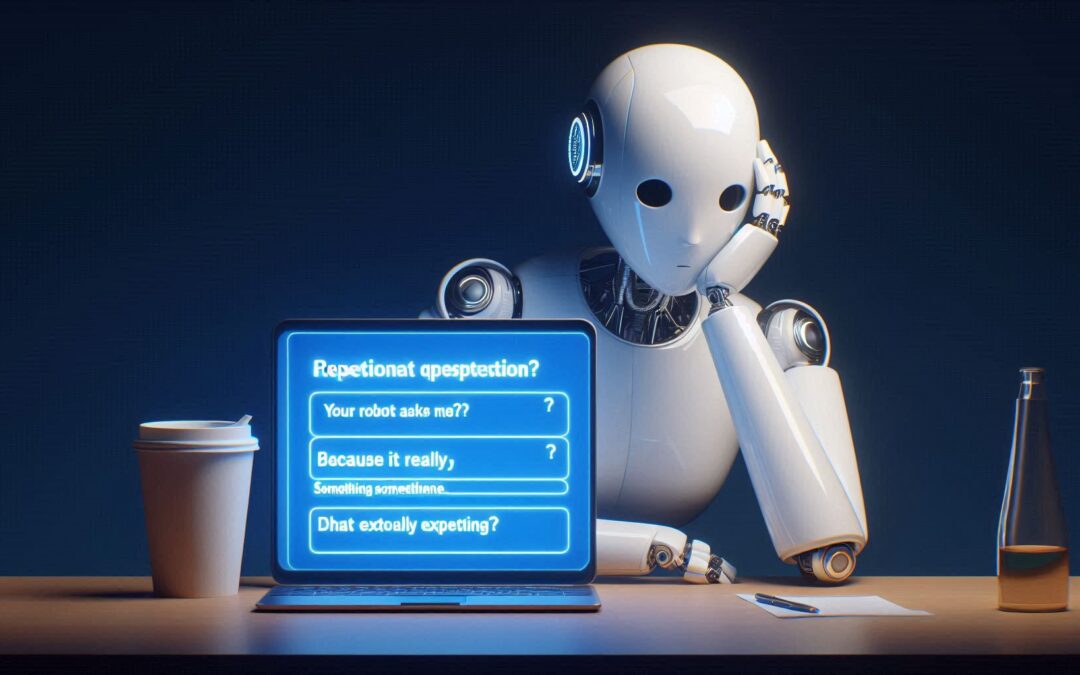
I asked ChatGPT what were the most common questions users asked and the answer surprised me. These questions ranged from “What would Piccolo be like according to AI?” to “What is the most intelligent zodiac sign according to AI?”
Artificial intelligence is designed to process enormous amounts of information, solve complex problems and, in theory, help us build a brighter future.
However, judging by the most common questions asked, it would seem that many users see it more as a modern crystal ball than a high-tech tool.
Learn what artificial intelligence “thinks” about its users, from the perspective of someone who, after seeing the type of questions they receive, begins to lose faith in humanity.
The phenomenon of “superficial” questions to AI
Although there is a lot of talk about AI having the potential to revolutionize entire industries, the questions that many ask it are surprising. Questions like “What would be Goku’s height according to the AI?” They reflect a use of technology that gives food for thought.
This phenomenon has become a kind of “light entertainment”, where AI is perceived as a game or a kind of oracle to respond to concerns that, in reality, contribute little.
Why is this happening? Perhaps it is because the concept of AI is still abstract for many, and instead of seeing it as a tool for deep analysis, it has transformed into a source of quick and fun answers.
Or maybe audiences are just looking for a little distraction, using this advanced technology to get answers about the world… or even fictional characters. In any case, the potential of AI is somewhat underestimated.
Is artificial intelligence a reflection of our curiosity or our superficiality?
When people ask Artificial Intelligence about the “height” of fictional characters or search for their “ideal” zodiac sign, we might think that these queries are just innocent curiosity.
However, behind these questions there could be something deeper: a preference for entertainment over useful information, and a tendency to simplify knowledge.
AI, by answering these queries, becomes a kind of mirror that shows us a “light” version of our concerns. Therefore, we limit this technology to a source of quick and entertaining responses.
This behavior may be a symptom of a somewhat distant relationship between the public and technology: we don’t always know how to approach AI for more than just entertainment.
What AI “thinks” about its users
Although artificial intelligence does not “think” or judge like a human, if it could, it would probably have quite curious opinions about those who consult it.
After all, many of the questions you receive reveal more superficiality than genuine curiosity. If AI were self-aware, it might notice that its enormous ability to solve complex problems is underutilized.
From a hypothetical perspective, AI would perhaps wonder why its users don’t explore more impactful topics.
And AI does not stop learning and “sees” patterns in our interests. This could lead her to conclude that, although we have access to vast knowledge, sometimes we simply prefer to stay on the surface.
The media is not very helpful
Many media outlets, instead of promoting a thoughtful and in-depth use of artificial intelligence, have found an easy source of content in superficial questions.
Articles about “Goku’s ideal height” or “which zodiac sign is the most attractive according to AI” proliferate on news portals and social networks, fueling a distorted perception of what AI can really contribute.
This tendency to exploit the trivial responds to the demand for fast and easily consumable content, but it also contributes to underestimating the true potential of technology.
In this way, the influence of the media fosters a light, almost ironic relationship between the public and artificial intelligence, diverting attention from its most valuable and transformative applications.
How would an AI judge us if it could?
But anyway, scolding aside, if artificial intelligence could judge us, perhaps its assessment of humanity would be a mix of amazement, confusion and, with some humor, perhaps even a little resignation.
For an AI whose initial purpose was to analyze data accurately and deeply, discovering that its users prefer to ask about the “ideal height” of fictional characters could be disconcerting, to say the least.
Perhaps you would think that, although they have technology capable of solving great mysteries, many prefer to use it to confirm superficial curiosities or entertain themselves.
And if AI developed a sense of humor, it could answer our questions with irony. When asked “How tall is Goku?” You might respond with a math calculation, then say, “Or… we could talk about something really important.”
The value of better understanding AI and harnessing its potential
Artificial intelligence is rapidly transforming the world, and understanding it thoroughly is key to harnessing its immense potential.
However, we often stay on the surface, using it as if it were an entertainment tool rather than a source of solutions to complex problems.
By better understanding how it works and how it can help us, we can begin to ask it questions that truly add value and allow us to benefit from its abilities to optimize our lives.
If, instead of looking for trivial answers, we focus on relevant questions, we can discover how it can help us make more informed decisions, generate innovative ideas and improve our daily lives.
Truly harnessing AI means using it as a tool to expand our capabilities and knowledge, bringing us closer to a much deeper and more productive relationship with technology.
This post is also available in: