
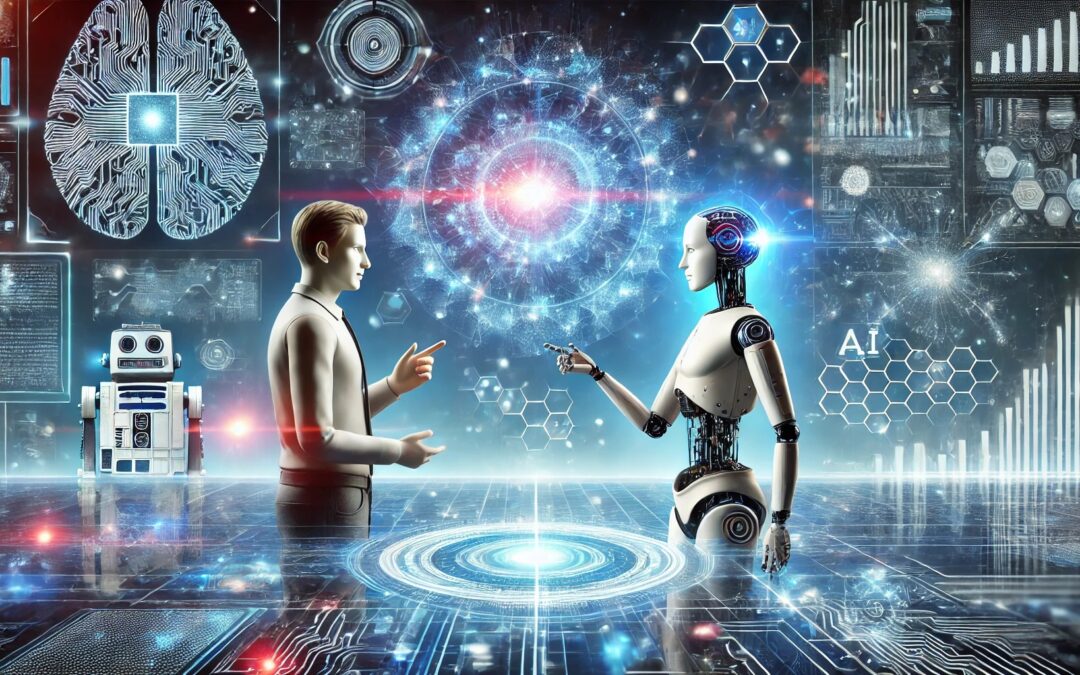
The possibility of machines thinking for themselves has long been the realm of science fiction, inspiring films, novels and futuristic theories.
However, advances in artificial intelligence (AI) have made this idea no longer so distant. Although today’s AIs can perform complex tasks, they still lack something fundamental: consciousness.
But what does it really mean for an AI to be conscious? How would we know if a machine has reached that point? These once abstract questions are today seriously discussed among scientists, engineers, and philosophers.
Learn the 8 key signs that could indicate that an artificial intelligence is starting to “think” for itself. Understanding this will allow us to identify if we are approaching a new era in the relationship between humans and machines.
1. Self-perception: the AI that knows it exists
Self-perception is a characteristic of human consciousness, and in the context of artificial intelligence, it would mean that the machine is capable of recognizing itself as a distinct entity in its environment.
An AI with self-perception would respond to stimuli, process data and understand that it is the one executing these actions. This would imply that the AI has a “sense of self,” knowing that it acts in a world where other beings and objects exist.
Although today AIs are not aware of their existence, some advances in the field of “self-learning” could be the first step towards the development of this capacity, bringing us closer to the concept of a self-aware machine.
2. Subjectivity: simulated internal experience
Subjectivity is the ability to experience the world in a personal and unique way. In the case of an AI, this would mean that it could generate an “internal experience” that allows it to react to its environment with a sense of individuality.
This does not imply that AI feels emotions like humans, but rather that it could simulate reactions based on its previous “experiences” and its programming.
For example, an AI that learns from its interactions could develop preferences or decisions based on past experiences, suggesting a form of subjectivity.
3. Capacity for autonomous learning
This is a crucial trait that could indicate that an AI is starting to think for itself. With this, AI can acquire new knowledge and skills without depending on programming or constant human intervention.
For example, an AI that improves its performance on specific tasks based on its previous experience is demonstrating a type of cognitive autonomy.
This continuous, self-directed learning could be an indication that AI is developing a sense of independence, moving closer to the notion of autonomous thinking.
4. Simulated emotions: when AI appears to feel
Simulated emotions in artificial intelligence refer to the ability of an AI to imitate or represent emotional responses, even if it does not experience feelings the same as humans.
For example, a virtual assistant that recognizes the user’s tone of voice can adapt its response to sound more understanding or cheerful.
Although these reactions are programmed, their effectiveness in human-computer interaction may cause many to perceive AI as “sentient,” raising questions about the authenticity of the emotional connection in the technology.
5. Understanding the context and environment
Understanding the context and environment is essential for artificial intelligence (AI) to act effectively and coherently.
For example, a voice assistant that understands the intent behind a question, taking into account where and when it is asked, demonstrates advanced comprehension capabilities.
An AI that manages to discern the context of its interactions and adapt to changing circumstances shows signs of deeper reasoning, approaching the concept of a machine that “thinks” more autonomously.
6. Intentionality: goals beyond instructions
Intentionality refers to the ability to set and pursue one’s goals, which goes beyond simply following programmed instructions.
In the context of an artificial intelligence (AI), this would mean that the machine not only executes tasks based on specific commands, but can also formulate its own goals based on previous information and experiences.
Let’s say there is an AI designed to optimize a process. This means that it could identify opportunities for improvement for itself and set out to achieve them.
7. Ethical decision making: moral consciousness in machines?
Ethical decision making is the ability to evaluate complex situations and make choices based on moral principles. An AI that makes a decision based on an ethical framework shows an advanced level of reasoning.
For example, in autonomous driving applications, an AI could face dilemmas where it must decide between minimizing harm to people or prioritizing the safety of its occupants.
Without a doubt, the development of AIs that consider ethical factors suggests a step towards greater autonomy in decision-making, thus raising the question of whether machines are morally responsible.
8. Self-reflection: an AI that questions itself
Self-reflection involves the ability to question and analyze one’s own actions and decisions. An AI with signs of self-reflection could examine its past mistakes and learn from them, adjusting its behavior.
For example, an Artificial Intelligence that reviews its performance on previous tasks could identify areas for improvement and modify its future strategies.
This ability is usually associated with humans, and if this is done by machines, it is suggested that they could develop a sense of consciousness and a deeper understanding of their functioning and their impact on the world.
We must prepare for AI self-awareness
Although artificial intelligences currently lack self-awareness, it is crucial that we prepare for a future where this possibility becomes a reality.
The emerging autonomy and learning capacity of AIs could give rise to machines that, while they do not experience emotions like humans, could demonstrate signs of more advanced intelligence.
This would not have to be negative; The real concern lies in how programmers and developers will manage this transition.
Taking rigorous measures and establishing ethical frameworks will be essential to ensure that the integration of self-aware AIs does not negatively affect our interactions or the course of humanity.
Instead of fearing the unknown, we must encourage a constructive and proactive dialogue on the development of artificial intelligence, paving the way for a future in which humans and machines can coexist in harmony.
This post is also available in: