
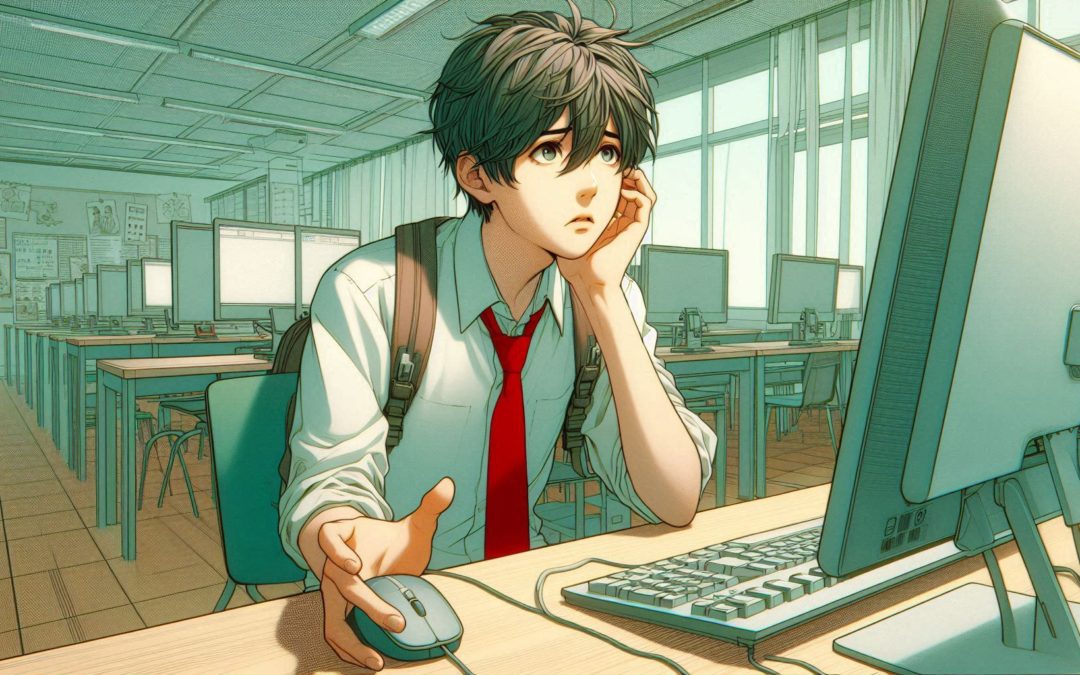
Some time ago a meme appeared on the Internet, where a student appears preferring Artificial Intelligence over Wikipedia. And although the meme might make you laugh, this is not exactly what happens in reality.
Although the concept of education and AI seems promising, many students encounter practical barriers and technical difficulties when trying to use these tools in their daily lives.
From cultural resistance to technological and educational barriers, students and educators face obstacles when integrating AI into the classroom. Does this mean that AI should stop being used in education?
Find out why students (and even teachers) find it difficult to use artificial intelligence to do schoolwork and how this can be addressed, without students becoming completely dependent on this technology.
Lack of judgment and training
Many education systems don’t know how to teach students how to use AI tools critically. This results in poor judgment, where students accept information from AI without questioning its accuracy.
And although AI is increasingly present in education, students do not receive the necessary training to understand how these tools work and how they can be applied effectively in their studies.
The absence of educational programs that teach about AI creates a gap in students’ knowledge. This affects students’ ability to integrate AI into solving academic and everyday problems.
Without a clear understanding of how to analyze and interpret the data delivered by AI, students may find themselves overwhelmed or confused, reducing the effectiveness of AI-assisted learning.
The “Tik-Tok” effect
One of the main effects of social networks is distraction. The addictive nature of these platforms diverts students’ attention, making it difficult to concentrate and decreasing the time spent learning technologies such as AI.
Additionally, social media influences the way students perceive and use information. The appearance of misinformation and the tendency to consume superficial content lead to a frivolous understanding of complex topics.
This negatively affects students’ ability to use AI tools effectively, as they may not have the ability to discern the veracity of the information given by these tools.
Social comparison also plays an important role. Seeing the achievements and capabilities of their peers on social networks like Tik-Tok and Instagram, students may feel demotivated to explore AI.
Technological barriers and access
Technological barriers and limited access to artificial intelligence (AI) in education affect students’ ability to benefit from these tools. One of the main barriers is inequality to access technology.
Few students have access to devices or a high-speed Internet connection, essential to use AIs. This digital divide perpetuates educational disparities, leaving students from disadvantaged socioeconomic backgrounds behind.
Many educational institutions lack the technological infrastructure necessary to implement AI solutions effectively. Lack of investment in education results in poorly equipped classrooms and inadequate computer networks.
Another barrier is the lack of training for students and teachers. Even when there is technology, without the necessary knowledge to use it, its impact is minimal. Teachers must be trained to integrate AI into their teaching and guide students.
Teachers are also to blame
Teachers also have a responsibility to integrate artificial intelligence (AI) into education. Many educators resist change or feel intimidated by AI, reducing their interest in learning and adopting new educational tools.
This resistance limits the ability to give students a modern educational experience. It is common for some teachers to be wary of students using AI to do written work, lacking tools to verify the authenticity of the work.
This dilemma is not limited to teachers; They expect students to learn on their own merits, without depending on technology to facilitate the process. However, this point of view perpetuates ignorance and incorrect use of AI in education.
Furthermore, some teachers lack the minimum technical and pedagogical training to effectively integrate AI into the classroom. Lack of knowledge about how to incorporate AI into the curriculum results in limited or inefficient use of this technology.
Resistance to change and lack of training can widen the gap between teachers trained to use AI and those who are not, creating disparities in the educational quality of students.
There is still work to do with AI in education
Successful integration of artificial intelligence (AI) in education requires a continuous and coordinated effort. Training both students and teachers in the critical and effective use of AI is essential to fully reap its benefits.
This challenge implies a change of mentality in educators, who must be prepared to adapt their teaching methods and guide students in the ethical and productive use of technology.
It is crucial to involve diverse disciplines to develop accessible educational programs, especially in regions where opportunities are limited. This includes collaborations between the education, technology and government sectors to improve digital infrastructure.
With a proactive and collaborative approach, it is possible to close the educational gap and ensure that all students, regardless of their location or socioeconomic circumstances, can benefit from the opportunities that AI offers.
This effort will not only transform education, but will also contribute to building more equitable societies prepared for the digital future.
This post is also available in: