
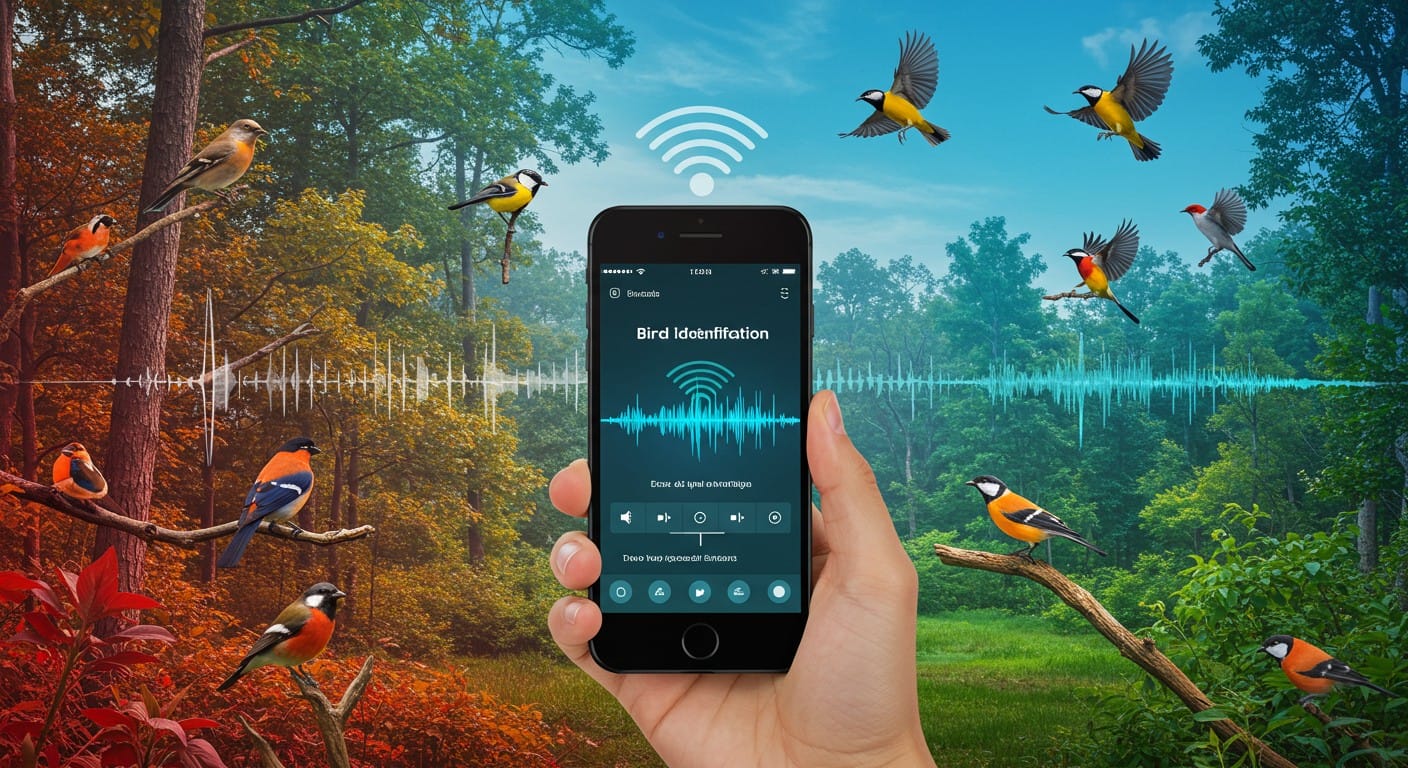
Over the last few years, bird song recognition using artificial intelligence (AI) has become a fascinating and accessible tool for ornithologists, hobbyists and conservationists alike.
This technological advance allows to identify bird species from their calls, which is especially useful in natural environments where viewing the bird may be difficult or even impossible.
Similar to how virtual assistants recognize our voices, this technology analyzes sound patterns to discover which species is singing, opening up a world of possibilities for exploring nature.
How does bird song recognition with AI work?
In simple terms, this technology processes audio recordings to extract key features of birdsong. For example, techniques such as Mel Frequency Cepstral Coefficients (MFCC) are used, which convert sounds into numerical data.
This data is then analyzed with machine learning models, such as neural networks, trained to recognize unique patterns in songs. Although it sounds complicated, imagine that AI “listens” and learns to distinguish between the chirp of a sparrow and the song of a blackbird, all thanks to intelligent algorithms.
The basic concepts are easy to understand:
- Feature Extraction: Each song has unique features, which may include frequency, rhythm, duration, and sound intensity. Algorithms detect them and create a “sound profile.”
- Neural networks: Trained with thousands of recordings, they learn to identify species. Once trained, the network can compare a new song with already learned profiles and suggest which species it belongs to.
- Interpretable models: Some apps explain which parts of the song they used to identify, helping to understand the process and adjust the models if necessary.
And the identification process occurs without the need for specialized chips, with AI algorithms optimized for mobile devices. This allows audio data processing and species identification in real time, even in areas without internet connection.
Applications available to Identify Birds
Currently, there are several applications and web platforms that use this technology, and that you can use to identify birds in real time or through recordings. Some of the most notable are:
BirdNet
Developed by the Cornell Laboratory of Ornithology and other institutions, this application can identify more than 6,000 species of birds worldwide.
BirdNet not only helps you recognize birds in real time, but also allows users to contribute their own recordings. It is a very complete tool for those who dedicate themselves to studying or simply enjoy bird watching.
BirdNet is available for Android devices with version 6.0 or higher and for iOS 13.0 or higher. You can download it from Google Play Store and from the App Store.
Merlin Bird ID
Also powered by Cornell, this application offers functionality for both identifying birds from photographs and their songs.
With an extensive database and a simple interface, it is ideal for amateurs who are just beginning to become interested in ornithology. In addition, it allows you to work even without an Internet connection, which is very practical when you are in the middle of nature.
Merlin Bird ID is compatible with Android devices running version 6.0 or higher and is available at Google Play Store. For iOS devices, requires version 16.0 or later and can be downloaded from the App Store.
WhoBird
An open-source alternative that stands out for being free and easy to use, WhoBird allows you to identify birds based on their vocalizations. Like the other applications, its objective is to facilitate citizen science and biodiversity monitoring.
WhoBird is available only for Android, but is not in the Google Play Store. It can be downloaded from the F-Droid store or directly from your GitHub.
Both WhoBird and the other apps can work without an internet connection, allowing the identification of birds in remote areas. In addition, they can save the place and time in which each identification was made.
How can you try these apps?
If you are interested in testing the accuracy of these apps, or you simply don’t have birds singing around you, a good way to do this is by using song recordings available on websites like xeno-canto.org.
Xeno-canto.org is a citizen science project collects thousands of recordings of bird songs and calls from around the world, which will allow you to compare the recordings with those produced by applications.
To test an app, simply listen to an interesting recording from xeno-canto and use the recognition function of the app of your choice.
This will not only allow you to see how the technology works, but it will also help you learn to distinguish between different species and appreciate the sound diversity of the animal kingdom.
Practical tips when identifying bird calls with AI
If you are new to using these technologies for bird identification, here are some practical tips:
- Start with clear recordings: Look for recordings on xeno-canto.org that have little background noise. This will help you better understand what each species’ song sounds like.
- Use multiple apps: Don’t stick with just one app. Try several (BirdNet, Merlin, WhoBird) and compare the results. Each can have its strengths and limitations depending on the geographic area and the type of birds you are trying to identify.
- Participate in observation communities: There are forums and groups on social networks dedicated to ornithology and bird identification using technology. Sharing your findings and doubts can be very enriching.
- Stay curious: Although apps are very useful, nothing replaces the experience of going out into the countryside and observing birds in their natural environment. Use technology as a complementary tool to improve your knowledge.
Not everything is perfect. Noise, like traffic in a city, can confuse AI. Also, similar songs between species or seasonal changes in vocalizations are challenges.
Benefits for conservation and science
This technology is not only fun, but also powerful for conservation. By automating identification, it allows to monitor large areas and detect changes in bird populations, such as in nature reserves.
In addition, these applications encourage community participation in scientific projects. By simply using an app on your mobile, you can contribute to collective knowledge, sharing your observations and helping to build databases that, together, are very useful for experts.
Science benefits enormously from these tools, since they allow any interested person to provide valuable information for the conservation of species and the management of ecosystems.
This post is also available in: