
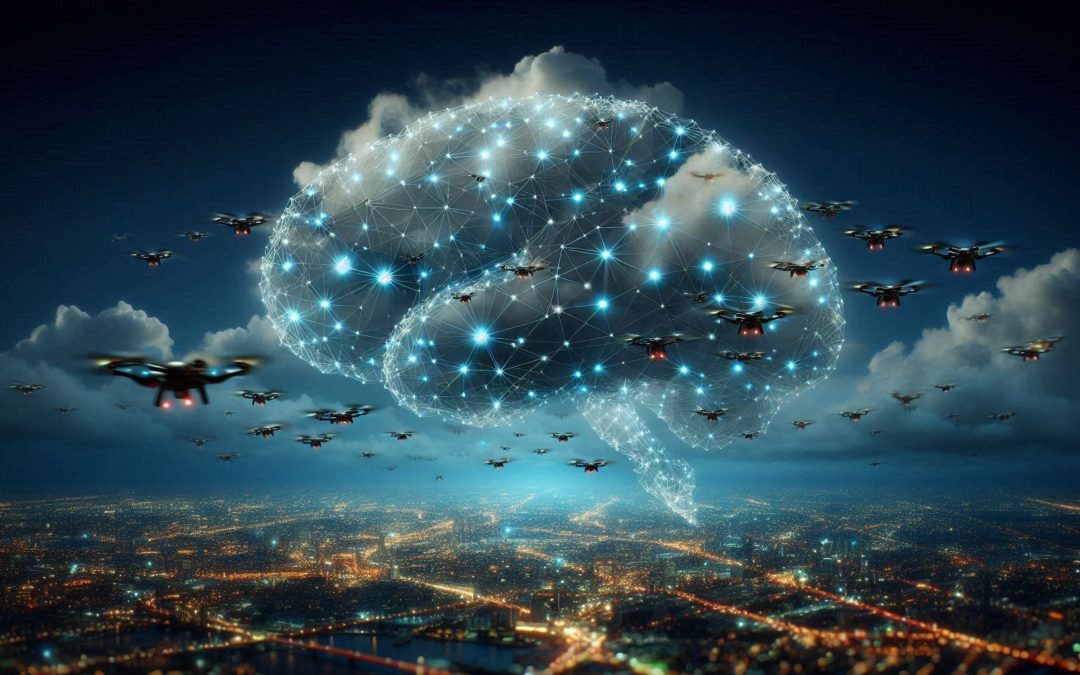
Drones have evolved from simple recreational devices to become indispensable tools in a wide variety of industries, from agriculture to filmmaking and security.
However, as the number of drones increases, so do the challenges related to safety and managing their traffic. This is where artificial intelligence (AI) comes into play.
Thanks to its ability to process large amounts of data in real time and make autonomous decisions, AI is changing the way drones navigate, avoiding collisions, optimizing their routes and improving their performance.
Discover how AI is transforming the world of drones, from autonomous flight to improving aviation safety, and how this alliance promises to change the future of aviation.
Rise of smart drones
It is estimated that there are more than 10 million drones operating globally, which has driven a drastic change in the way airspace is managed and used.
Artificial Intelligence, by incorporating advanced technologies such as computer vision or machine learning algorithms, has made drones become devices capable of making decisions in complex environments.
This rise is not only due to their increased accessibility, but also to advances in AI, which have allowed drones to push the limits of what was previously possible.
The combination of these technologies is leading to a new era of smarter, safer and more efficient drones.
Fields where smart drones are common
The growing integration of artificial intelligence in drones is opening new opportunities in various industries:
Precision agriculture
Equipped with advanced sensors and cameras, drones can analyze crop health, detect pests, and optimize water and fertilizer use. This helps improve performance, reduce costs and minimize environmental impact.
Delivery and logistics
Amazon, Google and other tech giants are already testing drones capable of delivering packages in a matter of minutes. With AI, drones can optimize routes, avoid obstacles, and manage deliveries more efficiently.
Construction and mining
Drones equipped with AI help inspect construction sites, evaluate terrain and generate detailed 3D maps, allowing more precise and real-time control of projects. This speeds up planning and reduces risks in dangerous locations.
Security and surveillance
In the security field, smart drones are increasingly common for aerial surveillance, border monitoring and rescue operations. Their ability to operate in hard-to-reach areas and in real time makes them a valuable tool for security forces.
Drone shows
At events like drone shows, the combination of drones and artificial intelligence has taken aerial displays to a new level of spectacularity and precision.
With advanced algorithms, drones synchronize their movements autonomously, creating impressive aerial choreographies.
Components that allow the safe flight of drones
The safe flight of smart drones depends on a number of factors that ensure the drone navigates without incident:
Visual sensors and LIDAR
Today’s drones have high-resolution cameras that capture images in real time. Together with LIDAR sensors, which emit laser pulses to measure distances with great precision, these systems allow the drone to identify obstacles, determine its position and plan safe flight routes.
LIDARs are especially useful in low visibility conditions, such as in darkness or fog, where cameras alone can fail.
Acoustic sensors
These sensors allow drones to “listen” to sounds, such as the engines of other aircraft. Using sound analysis and the Doppler effect, the drone determines whether an aircraft is approaching or moving away, adjusting its path to avoid collisions.
Although this technology is still in development, it promises to add an additional layer of air traffic safety.
Information redundancy
The integration of multiple sensors allows the drone to maintain reliable situational awareness. If one sensor fails or encounters interference, others can take control and ensure the drone continues to operate safely.
Real-time data processing systems
The AI is responsible for processing the information collected by the sensors and making instant decisions about navigation. Learning algorithms improve the drone’s ability to avoid hazards and adapt to new flight conditions.
Ethical considerations in the use of Drones and AI
The use of drones and AI raises ethical considerations that must be addressed as these technologies become more integrated into society. One of the main problems is privacy.
Drones equipped with advanced cameras and sensors can capture visual and acoustic data from people without their consent. This can raise concerns about intrusion into privacy.
Furthermore, liability in case of accidents or malfunctions is a critical issue. If a drone causes damage to people or property, the question arises of who is responsible: the manufacturer, the operator, or the developer of the AI software.
Another aspect is the use of drones in militarization and surveillance applications. The deployment of drones in war conflicts raises concerns about the dehumanization of combat and the impact on civilian life.
Likewise, the use of drones for government or corporate surveillance can lead to abuses of power and discrimination.
The responsible use of smart drones is possible
The advancement of smart drones, powered by artificial intelligence, is redefining multiple industries and opening new opportunities. However, along with these benefits come ethical concerns that must be addressed, such as privacy and liability in case of accidents.
It is essential to recognize that, although these challenges are significant, there is also a path forward towards creating a legal framework that guarantees the responsible use of this technology.
Developing appropriate regulations and safety protocols will allow innovation and ethics to coexist, building public trust and promoting a future where drones can operate safely and effectively.
With a proactive approach to research and legislation, it is possible to balance technological advances with social well-being, ensuring that smart drones benefit society as a whole.
This post is also available in: