
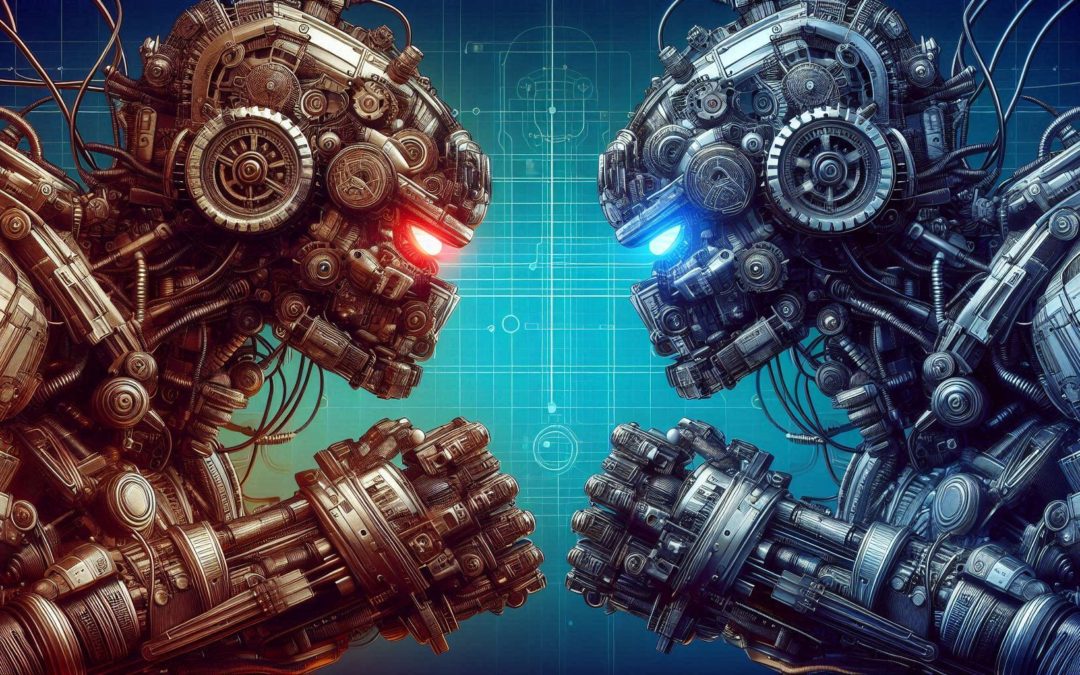
Thanks to the rapid advance of Artificial Intelligence, narratives have emerged that speak of a “war” for supremacy in the development and control of this revolutionary technology.
The term “war” evokes fierce competition, where innovation, market dominance and global influence are the most coveted trophies. Companies like OpenAI or Microsoft develop technologies that promise to transform entire industries and redefine the interaction between humans and machines.
In this context, a crucial question arises: is it really a war we are witnessing, or is it a necessary competition to move towards a more inclusive and equitable technological future?
Understanding the “war” over Artificial Intelligence
The “war” over artificial intelligence (AI) refers to the intense competition that has emerged between technology companies and nations to lead the development and control of this cutting-edge technology.
Top contenders include OpenAI, known for its popular ChatGPT model, or Microsoft, which has integrated Copilot into its business productivity tools.
In China, companies like Baidu and SenseTime are leading the way, driven by government support that sees AI as a priority. The current AI landscape is highly competitive, with a focus on innovation and market expansion.
Companies compete to attract users, improve the user experience, and develop applications that can transform key sectors of the global economy.
Main competitors in the race for AI
In the race for artificial intelligence, several competitors have emerged as leaders in the industry, each with different approaches and objectives:
OpenAI
OpenAI has established itself as a pioneer with its ChatGPT model, which has captured the attention of over 150 million users.
Its success is due not only to the quality of its generative AI, but also its accessibility and strong advertising support. ChatGPT has redefined human-computer interaction, becoming a benchmark in the field of AI.
Anthropic
Anthropic, with its Claude model, has taken a different approach, prioritizing safety and ethics in AI development.
Although its user base, with approximately 25,000 paid subscribers, is smaller compared to OpenAI, its commitment to responsible development has earned it a specific niche in the market.
Microsoft
Microsoft, another key player, has integrated its AI model, Copilot, into productivity tools like Microsoft Office.
With around 50,000 paid users, mainly in the corporate sphere, Copilot focuses on improving business efficiency, standing out for its practical application in the work environment.
Perplexity
Perplexity seeks to revolutionize traditional search engines using AI. Although its user base is modest relative to the industry giants, its focus on search indicates its potential for growth in the future.
Baidu and SenseTime
In China, companies like Baidu and SenseTime are leading the race, backed by strong government support.
These companies are focused on AI applications ranging from facial recognition to industrial automation, reflecting China’s national priority in becoming a global leader in AI.
Global and Regional Impact of the “War” for AI
The “war” over artificial intelligence has a significant impact at a global and regional level, driving both technological development and government policies around the world.
China: An emerging leader in AI
China stands out as a leader in the global race for AI, with companies like Baidu and SenseTime at the forefront.
The Chinese government has declared AI a national priority, which has fueled the industry’s growth and positioned China as a formidable competitor in the global arena.
Europe: Regulated and ethical innovation
Europe, for its part, has taken a more cautious approach, focusing on the creation of an AI Regulatory Framework that seeks to balance innovation with ethical and safety standards.
Although this region is home to influential companies like DeepMind, stricter regulation may slow the adoption of new technologies relative to other countries, but it can also serve as a model for the responsible development of AI globally.
United States: competing technology giants
In the US, competition is fierce between tech giants like OpenAI, Microsoft, and Anthropic. These companies are leading innovation in AI, leveraging both access to large volumes of data and massive private investment.
Its influence on the global market is indisputable, with technologies that are transforming industries and redefining the interaction between humans and machines.
How could this competition evolve?
The competition for artificial intelligence is constantly evolving and its future will depend on several key factors. One of the main drivers of this evolution will be continuous technological innovation.
Leading and emerging companies will seek to develop more advanced and efficient AI models, which could include the creation of general AI (AGI), capable of performing any human cognitive task.
Another crucial factor will be government regulation. As AI becomes integrated into everyday life, governments will likely implement stricter regulations to ensure security, privacy, and ethics in its use.
Likewise, the democratization of access to AI would allow more companies and people to take advantage of its benefits. This could dilute the dominance of current tech giants and encourage more diverse competition.
Finally, international collaboration could play an important role in this evolution. While some countries focus on competition, others could seek alliances to share resources, accelerating the global development of AI.
War or tough competition?
More than a “war”, what we see in the field of artificial intelligence is an intense competition for innovation and technological development.
While the term “war” suggests a destructive conflict, what is really at stake is a race to lead in a field that has the potential to transform every aspect of society.
AI companies do not seek to destroy their competitors, but rather to surpass them with technological advances and innovative solutions. This competition, although challenging, drives progress and fosters an environment where creativity and ethics can coexist.
Instead of viewing this dynamic as a power struggle, we need to focus on how these competitive forces can collaborate to build a future where artificial intelligence benefits all of humanity.
This post is also available in: