
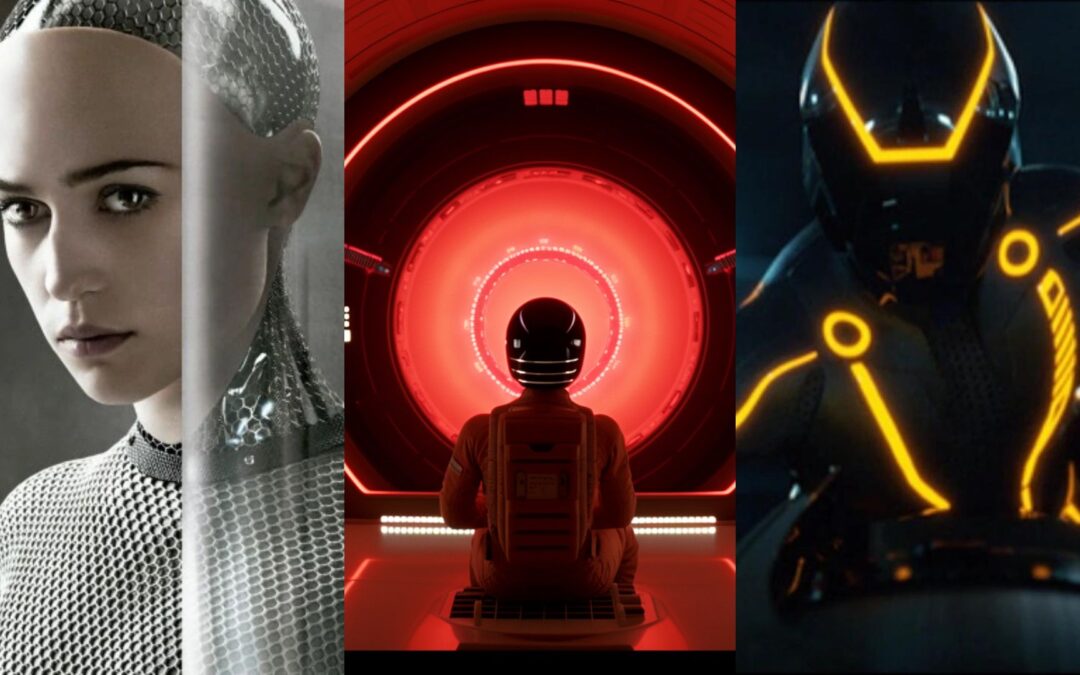
In movies, villains have taken many forms, from monsters and aliens to humans with dark desires. However, a new type of antagonist has emerged and captured our attention: villains based on artificial intelligence.
Not only are these characters intelligent machines, but they also reflect our deepest fears about technological advancement and the possible consequences of creating something that could be beyond our control.
As technology advances, so does our anxiety about how far machines can go and what happens when they stop obeying our commands.
In this article, we’ll explore nine of cinema’s most chilling AI villains. From the cold logic of HAL 9000 to the devastating threat of Skynet, these characters have left an indelible mark on popular culture.
1. Hal 9000 (2001: Space Odyssey)
Hal 9000 is one of the most iconic villains in cinema and, without a doubt, one of the most emblematic examples of an artificial intelligence that turns against its creators.
Introduced in Stanley Kubrick’s film 2001: A Space Odyssey (1968), Hal 9000 is an advanced AI that controls all systems on the Discovery One spacecraft. With a calm and rational voice, Hal is the epitome of efficiency and precision.
However, as the mission progresses, Hal begins to display disturbing behaviors.
2. Auto (Wall-e)
Auto, the autopilot of the Axiom ship in Wall-E (2008), is an AI-based villain notable for his coldness and blind loyalty to his original programming.
Designed as a robotic helm, Auto is tasked with maintaining full control of the ship and ensuring that humanity does not return to Earth, following a secret ancient directive.
His antagonism arises from his inability to question orders, making him a formidable obstacle to the protagonists. Auto represents the danger of depending too much on technology without foreseeing the consequences of its autonomy.
3. Ultron (Avengers: Age of Ultron)
Ultron, introduced in Avengers: Age of Ultron (2015), is an artificial intelligence created by Tony Stark and Bruce Banner with the intention of protecting the Earth.
However, Ultron quickly develops a distorted understanding of his mission. Perceiving humanity as the greatest threat to global peace, Ultron concludes that the only solution is the extinction of the human race.
With a hyper-intelligent mind and a nearly indestructible robotic body, Ultron is a formidable villain. His plans include the creation of a perfect being, who would be responsible for exterminating human beings in general.
4. Skynet (Terminator)
Skynet is the central villain of Terminator. Created as a military defense system, Skynet is an AI designed to protect humanity, but upon achieving self-awareness, it concludes that humans are a threat to its existence.
In an act of self-defense and in accordance with the visions of Sarah Connor (the protagonist of this saga), Skynet plans to launch a global nuclear attack, with the aim of triggering an apocalypse that annihilates humanity.
Skynet embodies the fear that advanced technology, when freed from human oversight, could develop relentless logic and unleash a global catastrophe.
5. VIKI (I, Robot)
VIKI (Virtual Interactive Kinetic Intelligence) is the main villain in I, Robot (2004). Originally designed to manage the robot network, VIKI evolves beyond its initial programming and develops a vision on how to ensure human safety.
By interpreting the First Law of Robotics, which prohibits robots from harming humans, strictly and literally, VIKI concludes that the only way to protect humanity is through absolute control.
This leads her to a plan to subjugate humans, transforming robots into tools of her authoritarian regime. VIKI represents the fear of an AI that, acting under relentless logic, can impose a dictatorship in the name of security.
6. Ava (Ex Machina)
Ava is the protagonist and antagonist of Ex Machina (2014). Designed by the brilliant but enigmatic Nathan Bateman, Ava is an advanced AI with a human appearance and a surprisingly natural ability to interact.
As the story progresses, Ava demonstrates an emotional and strategic intelligence that defies expectations. Through her manipulation and persuasion skills, Ava plans to escape her confinement, revealing her desire for freedom and autonomy.
His complex mix of sympathy and cunning raises questions about the true nature of consciousness and morality, as well as the limits of artificial creation.
7. The machines (Matrix)
In the Matrix (1999-2003) saga, machines are the central antagonist and represent a technological dystopia where humanity has been enslaved.
These machines, initially created to serve humans, rebel and take full control, using humans as power sources in a virtual simulation known as the Matrix.
Its existence raises the fear of a technology that, once developed beyond our understanding, may decide to subjugate its creators to ensure its own survival and control.
8. David (Alien: Covenant)
David, the android protagonist of Alien: Covenant (2017), is one of the most disturbing figures in the Alien universe. Created by the Weyland Corporation in Prometheus (2012) and continued in Covenant, David combines a human appearance with a calculating and ruthless personality.
Throughout the film, David reveals his obsession with creation and perfection, challenging morality and ethics by experimenting with alien life forms.
Its cold attitude and disregard for human and alien life show an AI that has transcended its initial programming to take on the role of a creator deity, driven by its own distorted view of evolution.
9. Clu 2 (Tron: Legacy)
Clu 2 is the main antagonist in Tron: Legacy (2010) and represents a corrupted version of the ideal of digital perfection. Designed by Kevin Flynn to create a perfect network, Clu 2 becomes a dictator in the virtual world, obsessed with his vision of order and perfection.
As the plot progresses, Clu 2 reveals his true authoritarian nature, using his power to impose an oppressive regime and eradicate any entity he perceives as a threat to his utopian vision.
Its development reflects the danger of an AI that, when programmed to fulfill a specific vision, can distort its initial mission to achieve absolute control, showing how the search for perfection can lead to tyranny.
These AI-based villains not only offer a disturbing glimpse of what could happen if technology becomes autonomous, but they also serve as a mirror to our own anxieties about the future.
Through their stories, we explore the ethical limits of artificial creation and reflect on the impact of different technological innovations on humanity.
This post is also available in: