
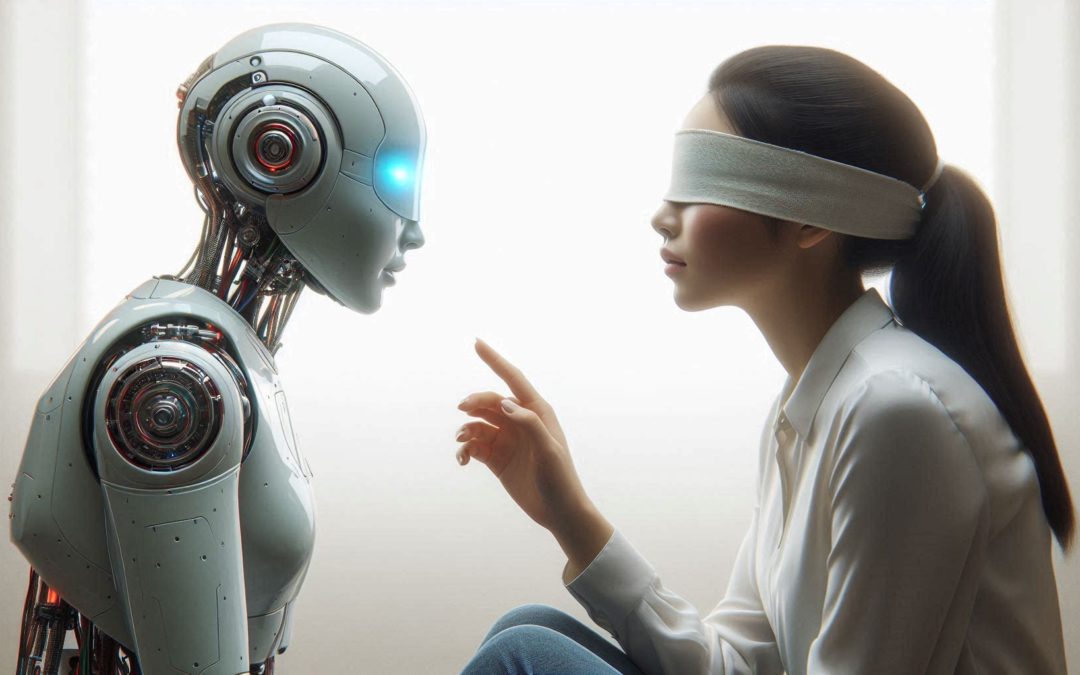
The Turing Test, proposed by mathematician and computer science pioneer Alan Turing in 1950, is one of the most influential concepts in the field of artificial intelligence (AI). This test, which initially seemed like a simple theoretical idea, has evolved over time and has become a crucial measure in the evaluation of modern artificial intelligence. In this article, we will explore the historical and contemporary importance of the Turing Test, its evolution, the objections it has faced, and how we have reached a point where AI can pass this test.
The original proposal: the imitation game
Alan Turing, in his article “Computing Machinery and Intelligence” published in 1950, posed a fundamental question: “Can machines think?“. Instead of directly defining what it means to “think,” Turing proposed an operational criterion for evaluating intelligence: the “Turing Test.” This test is based on an imitation game where a human interrogator interacts with two hidden entities, one human and one machine, through a computer terminal. The goal is to determine which is which. If the machine can deceive the interrogator more than 30% of the time after five minutes of interaction, then it is considered to have passed the test.
The motivation for the Turing test
The Turing Test is based on the idea that if a machine can trick a human being into believing it is interacting with another person, then that machine can be considered intelligent. Turing was interested in providing a practical and accessible test to measure artificial intelligence, moving away from the abstract philosophical and metaphysical definitions that predominated in his time. He wanted a concrete way to determine whether a machine could think, avoiding endless debates about the nature of mind and consciousness. This approach allowed him to sidestep philosophical complexities and focus on an empirical evaluation of artificial intelligence. Furthermore, Turing sought to challenge his contemporaries’ skepticism about the possibility that machines could think. By proposing a concrete and feasible test, it opened the door to research and development in the field of AI, laying the foundations for future innovations.
Turing Test predictions
In his influential article Alan Turing made several bold predictions about the future of artificial intelligence. Turing believed that progress in the storage and processing capacity of computers would allow the development of programs sophisticated enough to deceive human interrogators in the context of the Turing Test. He anticipated that, in about 50 years (around the year 2000), it would be possible to program computers with a storage capacity of approximately 109 bits (equivalent to about 125 megabytes) to pass the “imitation game” or Turing Test. Turing hoped that, over time, society would accept the idea that machines could think, challenging traditional notions of intelligence and consciousness. His vision was that, as machines demonstrated increasingly human capabilities, the distinction between human and artificial intelligence would become less clear and more accepted. By the year 2000, many argued that Turing’s predictions had failed, as the machines could not pass the test with the expected level of sophistication.
Evolution of the Turing Test
During the 1950s to 1990s, AI systems such as ELIZA (1966) and PARRY (1972) demonstrated limited capabilities in simulating human conversations, but failed to significantly pass the Turing Test. These systems were capable of handling conversations in specific contexts, but failed to pass the test in a general conversation. In the 1990s and 2000s, the development of neural networks and machine learning improved the capabilities of AI systems. However, models of that era still faced significant challenges in passing the Turing Test in its complete form.
The great language models in Artificial Intelligence and when the test was passed
The most notable advance in passing the Turing Test occurred with the development of large-scale language models in the 2010s. Some key milestones include:
- 2019: OpenAI releases GPT-2, a language model based on the transformer architecture. Although GPT-2 did not completely pass the Turing Test in all situations, it showed impressive capabilities in specific contexts.
- 2020: GPT-3, also developed by OpenAI, was a significant advance in terms of natural language capability and fluency. With 175 billion parameters, GPT-3 was able to generate coherent and contextually relevant text, and showed abilities that came close to passing the Turing Test in many interactions.
- 2023: GPT-4 managed to further improve the ability to handle complex and long conversations. GPT-4 demonstrated an ability to pass the Turing Test in a variety of scenarios and displaying a level of consistency and relevance in responses that often made it difficult to distinguish between a machine and a person.
What kinds of questions are difficult for an AI?
In the Turing Test, certain questions or types of interactions can reveal the difference between a machine and a human being, especially in contexts that involve complex cognitive abilities, deep understanding, or emotional intuition. Here are some types of questions and topics that are often difficult for machines:
Personal experiences and emotions
Questions like “What is your happiest memory?” and “How do you feel when you are alone?” are difficult for an AI, lacking personal experiences and authentic emotions. Although they can simulate responses based on data and patterns, they cannot provide genuine responses based on lived experiences.
Deep contextual or cultural knowledge
“What does it feel like to live in the town where you were born?” or “How do you celebrate cultural festivities in your country?” seem like simple questions, since AIs can have access to general information about cultural contexts. However, an AI may struggle to offer nuanced responses that reflect an authentic understanding of cultural or social experience.
Common sense or ambiguous interpretation
Responding to “Why do people find a joke about death funny?” and “How do you know if someone is being sarcastic?” requires understanding subtle nuances in language that can be difficult for AIs as they depend on understanding context and emotional interpretation.
Creativity or abstract thinking
Questions like “Can you write a poem about nature?” and “Do you know any new ideas for an invention?” may seem trivial, since current AIs can generate creative content. But they often rely on previous patterns and examples rather than genuine creativity or original abstract thinking.
Ethical moral judgments
AIs do not have a moral compass or the ability to experience ethical dilemmas personally. Their responses are based on pre-programmed rules or data, not a deep understanding of ethics.
Long contextual conversation
We leave the most difficult for last. Although advanced models like GPT-4 can handle long conversations, consistent responses and adaptation in the context of extended conversation can still present challenges. Proposing topics like “Tell me a complete story about an important event in your life” or “Tell me how your perspective on a specific topic has changed over the years” can still put some chatbots on the spot, if they don’t just ignore you and move on to another topic.
Is it really worrying that an AI passes the Turing test?
Is it really worrying that an AI passes the Turing test? The Turing test is a test that consists of determining whether a machine intelligence is indistinguishable from that of a human being in its behavior. When Eugene Goostman, a chatbot that simulated a 13-year-old Ukrainian boy, obtained good results in 2012 in the largest Turing test competition in history, questions arose about the ability of a machine to give human responses, it was a great achievement for the time because 29% of the judges concluded that it was human. Two years later, the Russian engineers behind Eugene achieved a 33% success rate, which is why some argue that it was the first development to pass the test.
This raises questions about human thinking and whether machines can really think like us or can they make us believe they do through this Turing imitation game.
Alternatives to the Turing Test
Although there are alternatives to the famous Turing test, this continues to be a reference in artificial intelligence.
The Marcus test, created by psychology professor Gary Marcus, proposes to measure how computers interpret humor, sarcasm or irony, which some chatbots currently have.
The Lovelace 2.0 test focuses on creativity in writing fictional stories, poems or works of art, which we also see has been surpassed today.
Terry Winograd, another psychology professor, proposed as a differential ability that they could understand the underlying context of a sentence, on which current tests such as the General Language Understanding Evaluation are based.
Turing in reverse emerged in the 2000s and is what inspired what we know today as Captchas, those tests that many websites ask us to prove “that we are not a machine.”
Impact of the Turing Test on AI
The Turing Test has inspired researchers and developers to design more sophisticated machines that can interact more effectively with humans, deeply impacting the development of artificial intelligence. Although it has faced criticism and evolved over time, it remains a valuable tool for understanding and measuring the ability of machines to simulate human intelligence. Furthermore, it has led to crucial debates about the nature of intelligence and consciousness in machines. It is probably also the reason why many remember Alan Turing, a mathematician who had earlier contributed to the end of World War II by breaking the German ENIGMA cipher and aiding the Allied effort.
This post is also available in: