
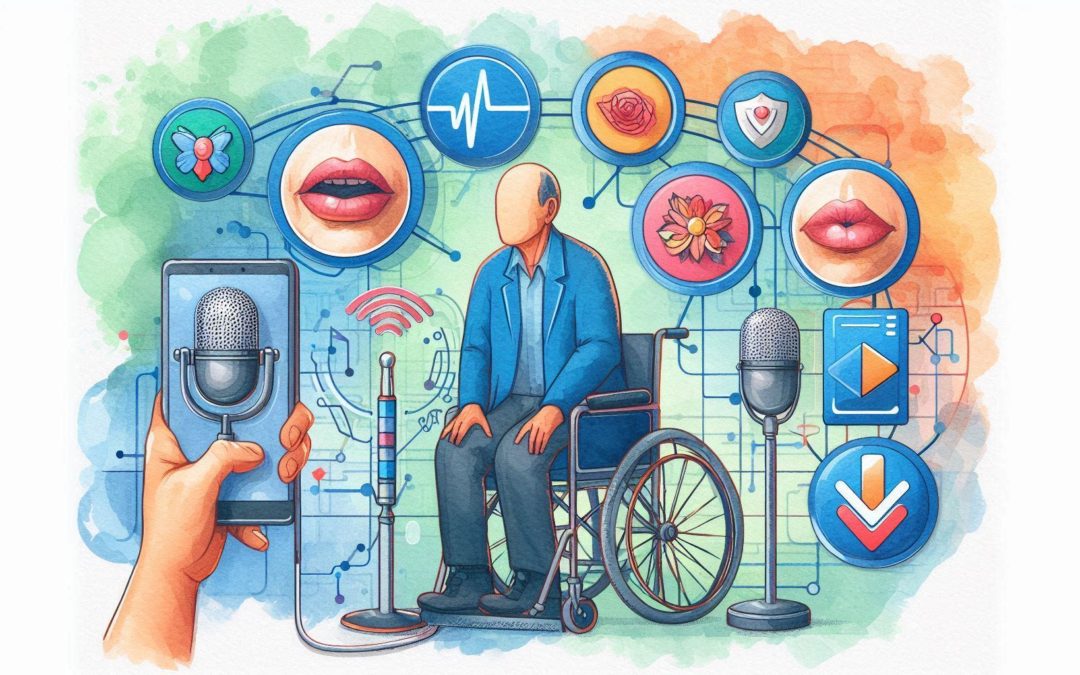
In the realm of assistive technology, artificial intelligence (AI) has paved the way for notable advancements, especially in the field of voice cloning. This technology could have profound implications for people who have lost the ability to speak.
By using AI-powered voice cloning, these individuals can recover a semblance of their original voice, thereby improving their communication skills and overall quality of life. Let’s review the current capabilities and advances in this field
How does AI voice cloning work?
AI voice cloning involves creating synthetic speech that closely mimics the unique characteristics of an individual’s natural voice. This requires a substantial number of voice samples from the individual before their ability to speak is compromised.
Advanced machine learning algorithms analyze this data to model and replicate voice nuances, including intonation, pitch, and cadence.
The result is a synthesized voice that preserves the speaker’s personal identity, offering a powerful tool for those facing challenges in verbal communication.
Recent advances include the use of neural networks and deep learning algorithms, such as Google DeepMind’s WaveNet and OpenAI’s GPT-4o, which have improved the naturalness and understandability of synthesized speech.
These systems are capable of producing speech that sounds incredibly natural and understandable, with improved intonation, rhythm, and emotional expression.
Current capabilities for AI voice cloning
DeepMind WaveNet is a speech synthesis technology from Google that uses neural networks to produce speech that sounds more natural and human. It is capable of imitating human speech with significant efficiency and can generate its own audio sequences without human intervention.
Additionally, WaveNet is not limited to voice; You can also play music and even play the piano. However, it requires a lot of computing power, which has limited its implementation on devices such as smartphones, at least until now.
On the other hand, we have the recent announcement of GPT-4o from OpenAI, which is a language model that can process and generate content in text, audio, images and video.
GPT-4o is capable of real-time verbal communication and can respond to verbal prompts with a friendly voice that sounds surprisingly human.
Testing by OpenAI (as it is not yet publicly available) indicates that GPT-4o can detect nuances in a user’s voice and generate responses in various emotive styles, showing excitement or even laughter in their interactions.
Additionally, GPT-4o improves visual and audio capabilities compared to previous models, allowing you to understand and generate visual and auditory content more effectively.
Can AI help people with speech difficulties?
As we have seen, current voice cloning capabilities allow us to generate voices that are practically indistinguishable from human voices, with the ability to transmit emotions and intonations naturally.
This is ideal for applications such as audiobooks, commercial voice-over, and video narration. But can they do more than that?
Applications in medical environments
One of the primary applications of AI-powered voice cloning is in medical settings, especially for individuals recovering from a laryngectomy or other conditions that affect speech.
These technologies allow patients to communicate effectively with healthcare providers, family members, and peers, thereby reducing the emotional and practical burdens associated with speech loss.
For example, during hospital stays or rehabilitation periods, AI-generated voices can facilitate clear and articulate communication, ensuring that patients’ needs are met quickly and completely.
Real cases of voice cloning in patients
Several companies have emerged as pioneers in the field of AI voice cloning for medical applications. UK-based SpeakUnique offers personalized voice cloning services supported by organizations supporting laryngectomy patients.
Its approach allows creating personalized synthetic voices, thus helping people improve everyday communication scenarios by converting text to speech.
Another notable example is VocaliD, a company specializing in custom digital voices. VocaliD technology enables the creation of unique synthetic voices that reflect the characteristics of the user’s pre-existing voice, tailored for various communication devices and applications.
Technological advances and challenges in AI voice cloning
Although AI-based voice cloning shows great potential, several challenges still exist. Achieving natural prosody and emotional expression in synthesized speech remains a significant obstacle.
Current technologies often struggle with intonation and inflection, which affects the perceived authenticity of the synthesized voice. Adapting these technologies to different languages and cultural nuances presents additional complexities that require continued research and development.
Looking ahead, the outlook for AI-powered voice cloning looks promising with continued advances in neural network architectures and natural language processing (NLP).
Companies like Descript (and its Lyrebird division) are exploring real-time voice cloning capabilities, with the goal of creating fluid conversational interfaces that mimic human speech in real-time interactions.
Additionally, the integration of AI-powered voice cloning into mainstream operating systems and mobile devices could democratize access to these technologies, benefiting a broader spectrum of users, including those with speech disabilities.
Neuralink + Voice Cloning = Science Fiction
Neuralink, the brain-computer interface technology developed by the company of the same name, could offer significant advantages when combined with voice cloning technology.
This technology could allow people who have lost the ability to speak to communicate directly with electronic devices, using their thoughts to control voice cloning and generate speech.
For example, it could allow users to customize their synthesized voice to more closely match their natural voice before losing the ability to speak. In this way, Neuralink would have the potential to help speechless people regain their voice.
That is, assuming that the difficulties that caused the first implant (announced on January 30, 2024) to fail a few months later can be overcome.
Despite these challenges, AI-powered voice cloning has great potential to empower people who have lost their voice, offering them not only a means of communication, but also a restored sense of identity and autonomy.
As technologies evolve and social acceptance increases, these innovations promise to redefine the assistive technology landscape and improve the lives of millions of people around the world.
This post is also available in: