
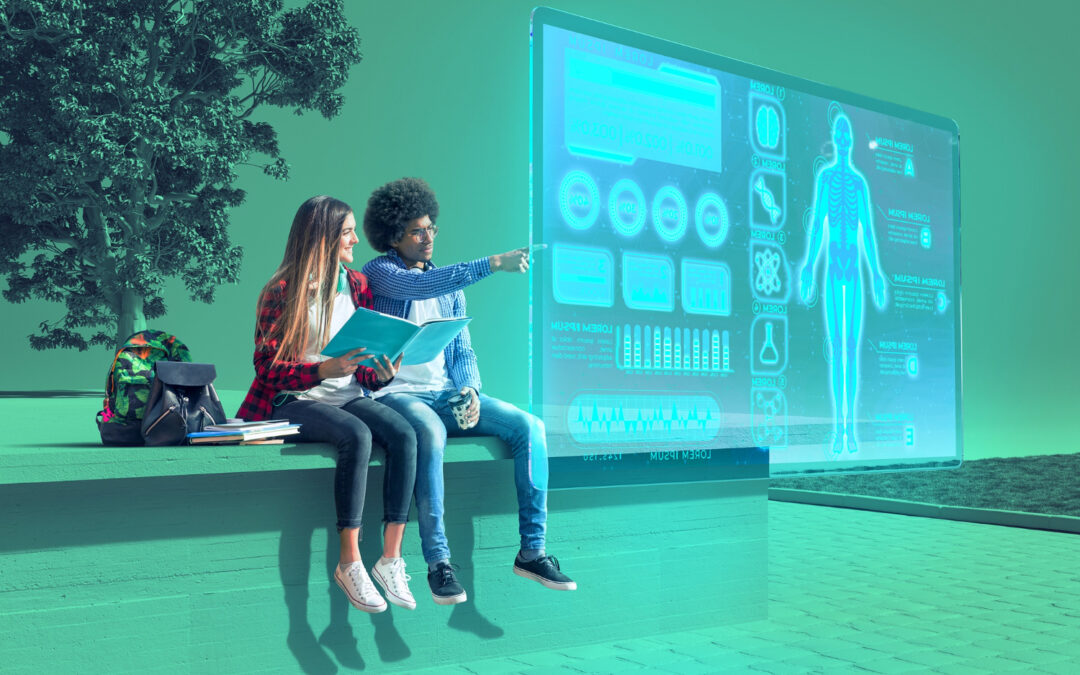
In today’s era, the integration of artificial intelligence (AI) into daily life is inevitable. One of the areas where AI is leaving a significant mark is in education.
As technologies advance, the educational landscape is undergoing changes like never before, with AI emerging as a tool that helps improve teaching and learning.
Integrating AI into education opens up many possibilities, from personalizing learning to optimizing school administration. But what are the ethical and practical challenges posed by the use of this technology?
Learn more about the integration of artificial intelligence in education, analyzing its benefits, challenges and approaches for successful implementation.
Beginnings and evolution of AIs in education
In this context, education was perceived as a fertile field to apply AI and improve the teaching process. One of the first educational AI systems was “The Logic Theorist” program, developed by Allen Newell and Herbert Simon in the 1950s.
This program demonstrated the ability of computers to solve symbolic logic problems, laying the foundation for future applications in education.
In the following decades, educational AIs were developed, from tutoring programs to adaptive learning environments. These systems were designed to adapt content to the needs of students and facilitate access to advanced educational resources.
Today, AI is transforming the educational landscape considerably, from classroom teaching to school administration.
Benefits of Artificial Intelligence in education
The integration of Artificial Intelligence (AI) in education offers a wide range of benefits that are transforming the way students learn and educators teach:
- Personalization of learning: AIs can collect data on student performance and provide personalized recommendations to help them improve their understanding and achieve better academic results.
- Instant feedback: This helps students correct errors in real time, which improves their understanding and retention of the material.
- Access to advanced educational resources: AI can facilitate access to a wide range of online educational resources, such as interactive tutorials, simulations and virtual laboratories.
- Administrative efficiency: AI can automate many administrative tasks in educational institutions, such as timetable management, exam grading, and performance reporting.
- Promoting inclusion and educational equality: This technology can be adapted to the needs of all students, regardless of their skill level, background, or physical or intellectual abilities.
Repercussions of the integration of AIs in education
Despite the benefits, integrating Artificial Intelligence (AI) into education also presents significant challenges.
One of the main challenges is concerns about the privacy and security of student data, as data collection and analysis are vital for the effective functioning of AI.
Additionally, there is the risk of algorithmic bias, where algorithms can reproduce and amplify inherent biases in the data used to train them. Another challenge has to do with ensuring educators are trained to use AI effectively in the classroom.
There are also concerns that an overreliance on technology could undermine essential human skills, such as critical thinking and problem solving.
Even the quality of the content used in conjunction with AI is crucial, as the effectiveness of AI depends largely on the quality of the data input.
Examples of success of Artificial Intelligence in education
Here are some case studies and concrete examples that illustrate the successful application of Artificial Intelligence (AI) in education:
- Adaptive tutoring systems: Companies like Knewton and DreamBox Learning use AI to personalize learning to each student’s needs, offering content recommendations and adapted activities.
- Online learning platforms: Coursera and Udacity use AI to recommend courses and automatically evaluate assignments, providing instant feedback.
- Virtual assistants in the classroom: Educational chatbots help students find information and access educational resources, integrated into online platforms or messaging applications.
- Educational data analysis: AI analyzes large data sets to identify patterns in student performance and predict potential challenges, such as school dropouts.
- Adaptive learning apps: Duolingo and Khan Academy use AI to personalize content and automatically adjust the difficulty level based on student progress.
Future of education with Artificial Intelligence
The integration of Artificial Intelligence (AI) in education not only represents a technological advance, but also promises to radically transform the future of teaching and learning.
As we move towards an increasingly digitalized world, AI will play a crucial role in the evolution of education systems, offering a number of benefits that will improve the educational experience of students and educators alike.
However, to fully realize the potential of AI in education, it is essential to address the ethical, practical and implementation challenges that may arise.
From concerns about data privacy and security to the need to ensure educator training and buy-in, a careful and balanced approach needs to be taken in integrating AI into the classroom.
By addressing challenges responsibly and ethically, we can build an educational future in which AI is an integral ally in the teaching-learning process, promoting digital competencies and guaranteeing quality education.
Do you want to know more about AI? Visit our Artificial Intelligence page and get the most out of it.
This post is also available in: