
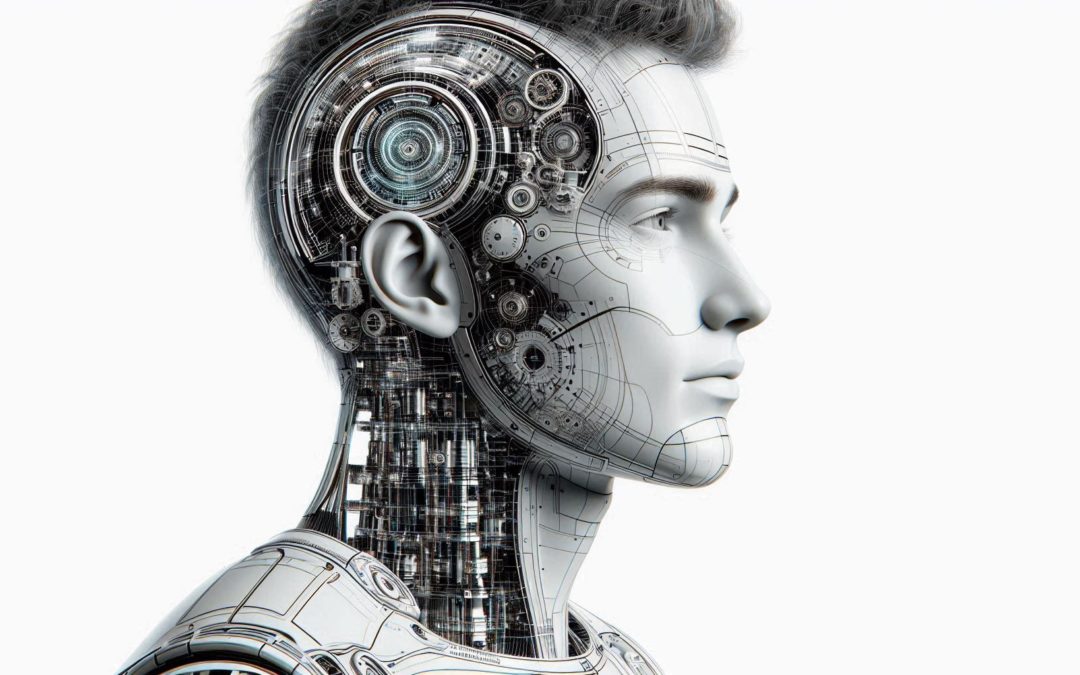
In a world where artificial intelligence (AI) and robotics advance, the line between human and artificial is increasingly blurred. This transformation generates both fascination and fear, especially when the artificial creations become more like us.
One of the most intriguing phenomena associated with this evolution is the “uncanny valley,” a concept that describes the discomfort we feel when confronted with human replicas that are almost, but not quite, perfect.
From robots that care for the elderly to chatbots that simulate human conversations, the ability of machines to imitate human appearance and behavior has generated diverse emotional responses.
Learn the roots of the uncanny valley, its implications for our interactions with AI, and how scientists and roboticists are working to overcome these emotional barriers.
Origin and definition of the uncanny valley
The concept of the “uncanny valley” was coined in 1970 by Japanese roboticist Masahiro Mori. In his essay, Mori observed that as robots become more human-like in appearance, our empathy toward them increases.
However, when they reach a level of similarity close to, but not identical to, that of humans, there is rejection. This, on a graph, is seen as a valley that represents the relationship between the human-likeness of a robot and our emotional response to it. Hence the term “uncanny valley.”
Mori postulated that this reaction arises due to the detection of imperfections and mismatches in human replicas, which leads us to perceive them as almost human beings, but with something strange and incorrect.
This uneasy feeling is not just limited to humanoid robots; It can also be triggered by virtual representations and synthetic voices that attempt to imitate human reality.
What is the reason for the rejection of images generated by AI and some robots?
The rejection of images generated by AI and some robots is primarily due to configural processing. This theory suggests that we are extremely sensitive to the position and size of human facial features.
And when we detect perceptual imbalances, such as realistic eyes on unrealistic skin, we feel discomfort due to this incongruity.
From an evolutionary perspective, these reactions could be linked to survival instincts. The perceptual imbalance can be interpreted as a sign of illness or threat, which activates a disgust response to avoid possible sources of contagion.
Furthermore, mate selection theory suggests that we perceive these artificial beings as poor partners because of their imperfections, which reinforces our aversion toward them.
Another explanation is the cognitive dissonance we experience when assigning human qualities to non-human entities.
When we interact with human-like artificial agents, our brain faces confusion about how to treat them and what to expect from them, causing a feeling of unease.
Is this rejection innate or learned?
The rejection of images generated by AI and some robots is a phenomenon that can be both innate and learned. On the one hand, there is evidence that suggests that certain reactions are innate, a product of our evolution.
Theories such as configural processing indicate that our ability to detect mismatches in human facial features is an innate response designed to protect us from possible threats or diseases.
On the other hand, rejection can also be learned culturally. Throughout our lives, we are exposed to social and cultural norms that influence our perception of what is “normal” and “acceptable.”
The media and movies portray robots as dangerous entities, reinforcing the idea that we should fear them. These influences amplify innate responses when faced with artificial beings that seem almost human, but are not quite human.
Additionally, repeated exposure to emerging technologies may modify responses. For example, younger generations, who grow up interacting with advanced technologies, could develop greater acceptance towards these beings.
Case Studies and Real Examples
Learn about some real examples where the uncanny valley is present:
Geminoid HI-1: The haunting android
One of the most emblematic cases of the uncanny valley is the development of the Geminoid humanoid robots. Robotist Hiroshi Ishiguro created an android that is almost an exact replica of himself, called Geminoid HI-1.
Although visually impressive, the robot provoked uncomfortable reactions from many viewers due to its almost human but slightly imperfect appearance.
Sophia: The social robot
Another notable example is the Sophia robot, developed by Hanson Robotics. Sophia has been designed to interact socially with humans, as she has a realistic appearance and facial expressions.
Despite his advanced abilities, many people find his appearance and behavior disturbing, especially when his facial expressions do not perfectly match his speech or when his movements appear mechanical.
“The Polar Express”: The uncanny valley in cinema
In the realm of entertainment, Robert Zemeckis’s film “The Polar Express” (2004) is a case study in the use of CGI (computer generated imagery).
Although the film attempted to create realistic human characters, many viewers found the characters disturbing due to their glassy eyes and unnatural facial expressions, exemplifying the uncanny valley effect in animation.
Impact of the uncanny valley on AI development
The uncanny valley presents challenges in the development of artificial intelligences (AIs), especially those that are designed to interact with humans on a daily basis.
AI developers and designers must balance realism with the need to prevent machines from becoming unsettling to users. This phenomenon can slow the adoption of advanced technologies and limit their acceptance in environments where there is human interaction.
The effort to overcome the uncanny valley has led to the creation of more stylized and less realistic designs, prioritizing functionality and efficiency over perfect human appearance.
In addition, it has promoted research in areas such as psychology and neuroscience to better understand human reactions and adjust AI design accordingly.
Therefore, the goal is to develop AIs that are not only useful, but also acceptable to the majority of users, facilitating their integration into daily life.
This post is also available in: