
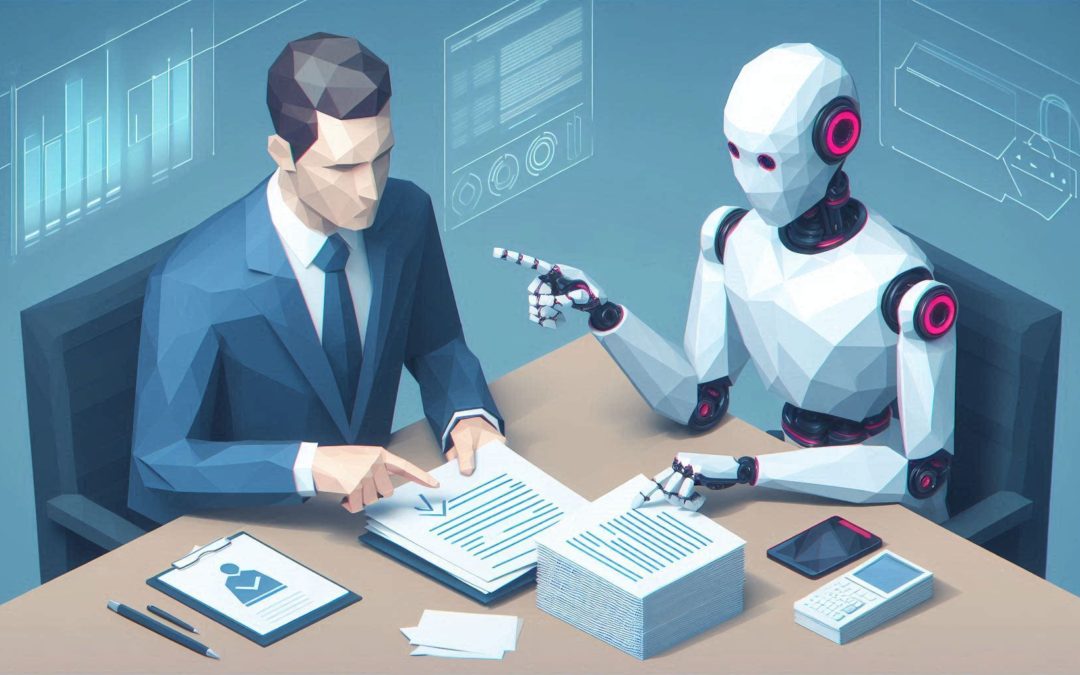
Artificial intelligence (AI) has sparked debates and fears about its impact on the workforce, the economy, and people’s daily lives. Many have the impression that machines are replacing humans.
However, in this technological panorama an alternative concept emerges that seeks a collaborative relationship between humans and machines: Augmented Intelligence (AI).
This approach highlights the support that machines can offer to humans in decision making, rather than replacing them, becoming a key tool to enhance human capacity, rather than replace it.
What is Augmented Intelligence?
Augmented Intelligence, often abbreviated to AI, is a field within artificial intelligence that focuses on enhancing human capabilities.
While traditional AI seeks to emulate and automate human processes, AIu focuses on assisting humans in carrying out complex tasks, improving their efficiency and allowing them to focus on higher-value functions.
A simple example of augmented intelligence is the use of tools such as virtual assistants or recommendation systems that help professionals analyze large amounts of data to make informed decisions.
These tools do not make decisions themselves, but rather provide the foundation and context necessary for humans to do so more accurately.
What is the difference between Artificial Intelligence and Augmented Intelligence?
Traditional AI tends to develop in the direction of complete task automation, with the idea that machines can perform human actions with equal or greater precision, which in many cases could lead to the replacement of people in certain roles.
Augmented intelligence, on the other hand, is not intended to replace the human being, but rather to be a tool that allows us to improve our capabilities.
Instead of focusing on automating jobs, AI is dedicated to amplifying human intelligence, allowing people to perform their tasks faster, more accurately, and with more information at their fingertips.
A key aspect in the difference between the two is the type of decisions in which they are involved.
Advanced AIs can perform routine or repetitive tasks, while AI aims to improve decision-making in more complex contexts, where intuition and human judgment are essential.
How does Augmented Intelligence work?
The operation of AI is based on a symbiosis between advanced algorithms and direct human interaction. The system provides analysis and suggestions on large amounts of data, and the human being decides how to implement that information.
To better understand how it works, we can apply psychologist Daniel Kahneman’s model of fast and slow thinking. Kahneman divides human thinking into two systems: System 1, which is fast, intuitive, and automatic, and System 2, which is slow, deliberate, and analytical.
While current AIs tend to excel at System 1 tasks (fast and automatic processes), AI works as a support for System 2, helping humans make more informed and thoughtful decisions in complex situations.
For example, in the field of customer service, AI can help by providing fast and accurate data to the agent, allowing them to focus on solving the most complicated problems in a personalized and effective way.
In this way, the human being can dedicate their time and effort to the most valuable interactions, while the AI manages the more mechanical aspects of the work.
Is AI related to Augmented Reality?
Although at first glance they may seem like different concepts, Augmented Intelligence and Augmented Reality (AR) are closely related in certain contexts.
AR allows digital information to be overlaid on the physical world, while AI can be a key source of that information.
Let’s imagine a surgeon using augmented reality glasses in an operation. Augmented intelligence could provide real-time data on the patient’s condition, possible risks and best practices to follow.
In this way, AI improves the surgeon’s capabilities and allows him to focus on the most critical task: surgical decision-making.
How is AI applied in business?
The adoption of Augmented Intelligence has been particularly rapid in sectors such as customer service, risk management and business strategy. Companies take advantage of their capabilities to improve efficiency and offer more personalized services.
For example, contact centers using AI allow human agents to handle complex queries while automated systems handle more repetitive tasks.
Gartner, one of the most recognized research and consulting firms in information technology, has pointed out that these types of solutions not only improve the customer experience, but also optimize the productivity of workers by allowing them to concentrate on what is essential.
Another area in which AIu is standing out is in data management. With the rise of large language models like GPT-4o, companies can now process and summarize enormous amounts of information in a short time.
This allows human workers to make decisions based on much deeper and more complete analysis. These AI-assisted systems help manage data efficiently, reducing the risk of error and increasing the capacity for innovation.
The future of Augmented Intelligence
As the world moves towards an increasingly information-based economy, augmented intelligence is being positioned as an essential tool to increase the competitiveness of companies.
Organizations that embrace AI are better prepared to innovate, improve the employee experience, and deliver high-quality customer service.
However, this progress is not without challenges. There is a risk that the obsession with full automation will shift the focus on collaboration between humans and machines.
Therefore, it is crucial that future research in AI and AIu focuses on how to enhance human capabilities, rather than seeking to replicate or replace them.
This post is also available in: