
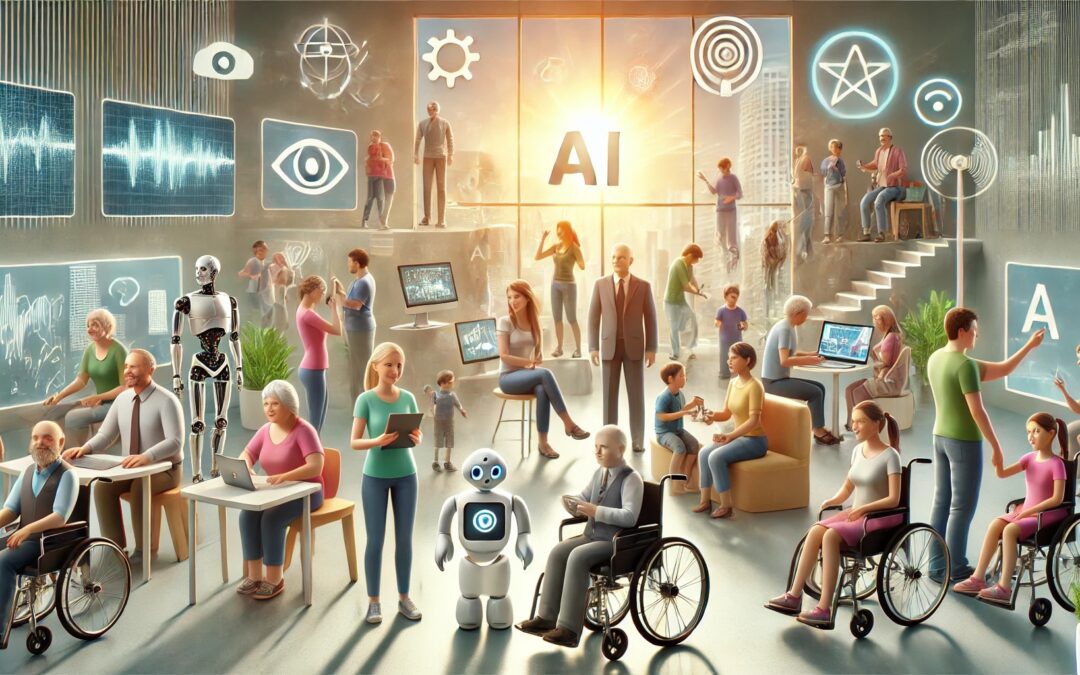
Imagine a world where a hearing-impaired person can “listen” to conversations with subtitles generated in real time, where someone with reduced mobility controls their home with just their voice.
These advances can be real thanks to Artificial Intelligence (AI). AI has the potential to transform the lives of millions of people with disabilities, providing solutions that expand accessibility and autonomy.
However, this power is not without challenges: if it is not developed with an inclusive perspective, it could perpetuate barriers and discrimination.
Discover how AI can help build a more inclusive world, the risks we should avoid and the keys to making the most of this technological revolution.
A look at the current panorama
From the invention of the Braille language to smart prosthetics, each advance has transformed what was previously unthinkable into something everyday. In recent years, AI has taken a step forward, offering even more powerful tools.
Today, voice recognition applications, virtual assistants, and smart home devices have begun to significantly improve the quality of life for those who face physical, sensory, or cognitive barriers.
For example, algorithms that transcribe conversations in real time allow people with hearing disabilities to interact without problems.
However, these advances have not yet reached everyone. The lack of access to technology and social inequalities continue to leave many people on the sidelines, evidencing the need for an inclusive approach.
The benefits of inclusive AI
Below, we explore how this technology transforms key areas such as communication, mobility and independence:
Communication without limits
Thanks to AI, people with hearing or visual disabilities can communicate more easily. Applications that transcribe automatic subtitles allow you to participate in meetings or live events.
On the other hand, text and voice recognition algorithms transform physical documents into audio or digital readings, facilitating access to information.
Mobility and accessibility in the environment
AI is revolutionizing mobility with technologies such as self-driving cars, which promise greaterindependence for those who face driving difficulties.
In addition, smart homes controlled by voice commands or mobile devices allow you to manage lights, thermostats and appliances, improving comfort and security at home.
Personalized assistance and autonomy
Assistive robots equipped with AI can help with daily tasks such as lifting objects or remembering medication, alleviating dependency on caregivers.
In the healthcare field, AI-based tools personalize treatments and therapies, optimizing rehabilitation and care.
Job opportunities
Technological inclusion at work is another key benefit. Tools such as screen readers, specialized software and collaborative platforms allow people with disabilities to access jobs that were previously inaccessible.
This not only encourages inclusion, but also demonstrates their enormous potential as a workforce.
Possible risks and challenges
One of the main challenges lies in biases in data and algorithms. If the data used to train AIs does not include diversity, the resulting tools can perpetuate stereotypes and exclude those with specific needs.
Another problem is the design of technologies that do not consider functional diversity. Complex interfaces or models that assume “standard” capabilities can make systems inaccessible to many, perpetuating their exclusion.
In addition, there is concern about the use of AI in job or genetic selection processes, which could implicitly or explicitly discriminate against those with disabilities.
The lack of participation of people with disabilities in the development of these technologies is another challenge. If designers and programmers do not understand the realities of this population, their solutions may not be effective.
Focus towards inclusive design
For Artificial Intelligence to fulfill its potential as an inclusive tool, it is essential that it is developed with a focus on people with disabilities.
This involves including these people in the design process, ensuring that their needs and experiences are considered from the start. Co-creation and constant accessibility testing are vital to ensuring solutions are effective.
Additionally, designers and developers should receive training on various disabilities and how they affect interaction with technology. This will help avoid bias and build more equitable systems.
Inclusive design also involves creating regulations and ethical standards that ensure that all technologies are accessible to everyone, regardless of their abilities.
The path to a more accessible future with AI
Artificial Intelligence is presented as a powerful tool to transform the lives of people with disabilities, breaking barriers and expanding horizons.
From improving communication to fostering autonomy and opening up new job opportunities, its benefits are undeniable.
However, these advances will only be truly inclusive if we address associated challenges, such as data biases, exclusionary design, and the lack of participation of people with disabilities in their development.
An ethical, participatory approach focused on diversity is key for AI to be a driver of inclusion and not exclusion.
In the end, the true impact of technology lies not only in what it can do, but in how it is used to build a more just, equitable and accessible society for all.
This post is also available in: