
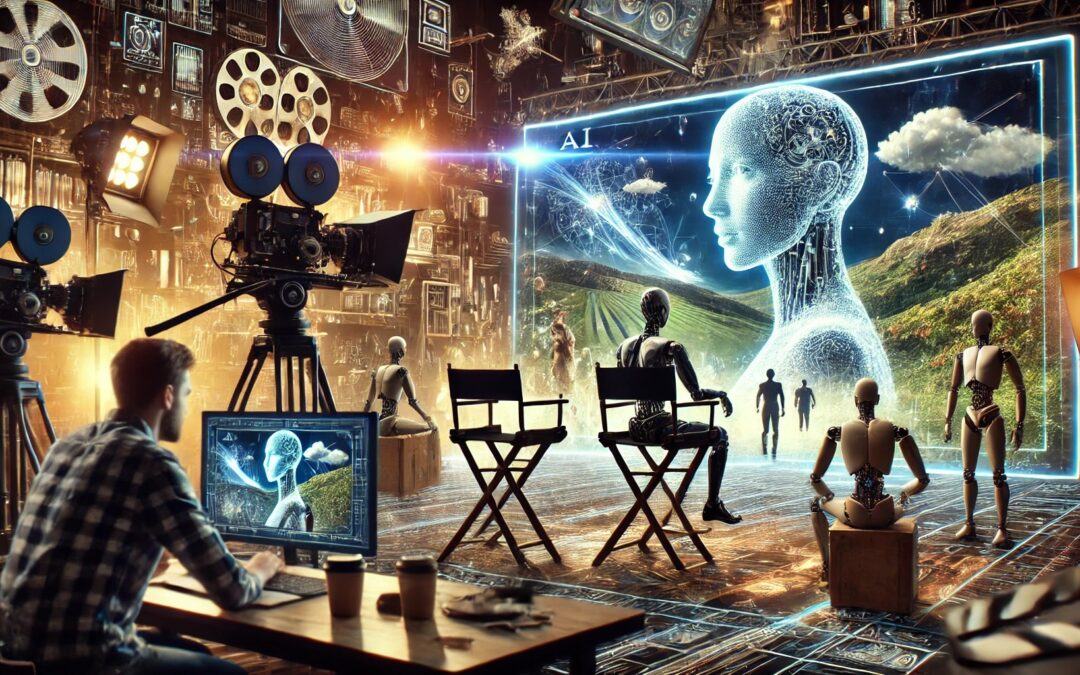
Think about a future where movies aren’t made on huge film sets or require hundreds of hours of human labor. In its place, an AI that creates characters, dialogues, landscapes and even music, all thanks to an algorithm.
This future is already beginning to take shape and although it may seem like something out of a science fiction movie, there are already real examples of feature films created almost entirely using AI.
Cinema, as we know it, is about to enter a new era, where economic and creative barriers are blurred thanks to technology. But is it possible that AI will ever completely replace filmmakers?
In this article we help you answer this question and analyze the impact that artificial intelligence could have on the future of cinema.
What does it mean to make a movie with AI?
Making a film with artificial intelligence involves using tools based on advanced algorithms to generate most of the elements that make up a film production.
This includes everything from character and setting design to dialogue and music creation. Instead of depending on human teams, AI is responsible for generating everything from a set of data and pre-established guidelines.
A recent example is the Bollywood film adapted from the novel Maharaja in Denims, where most of the visual and sound elements were created using AI.
Generative models allow you to design characters, visual effects or complete video sequences. Additionally, AI can be used to create scripts, generate voices for characters, and synchronize dialogue with facial expressions.
Advantages of AI in cinema
From reducing costs to democratizing production, AI is opening up new possibilities for established and new filmmakers alike:
Cost reduction
Traditional film production requires large budgets,especially when it comes to special effects and technical work.
With AI, many tasks that previously required a team of experts can now be automated, dramatically reducing costs. This allows filmmakers to create ambitious projects with a much lower budget.
Greater creative accessibility
AI tools make the creation of visual and audio content accessible to a greater number of people.
Filmmakers without technical experience in visual effects or animation can now use AI to produce quality films, democratizing the industry and opening space for new voices and perspectives.
Streamlining the production process
Speed is another great benefit of AI. Tasks that could previously take weeks or months, such as creating visual effects or editing images, can now be completed in much less time.
This not only improves efficiency, but also allows for more creative flexibility, as filmmakers can quickly experiment with their ideas without spending additional time or resources.
What would be the creative and technical challenges?
If AI is used to make films, one cannot fail to talk about the technical and creative challenges that make its complete implementation difficult:
Visual and narrative inconsistencies
Generative models, although advanced, often produce unpredictable results, which can lead to variations in the appearance of characters and settings, making consistency across a film difficult.
This variability affects the visual continuity of the narrative, forcing filmmakers to use additional tools to correct and adjust the results.
Limited artistic control
Human creativity plays a crucial role in directing a film, but AI follows pre-existing patterns and data. This limits filmmakers’ ability to control the tone, atmosphere, and emotions they wish to convey.
Although AI can generate impressive visual content, it still cannot fully replicate the human touch in the delivery of dialogue or the emotional construction of scenes.
Cultural authenticity and sensitivity
Although the technology can generate images, AI may not capture cultural nuances, which could lead to inaccurate or superficial representations, especially in scenes that require high cultural authenticity.
Opinions divided in the industry
On the one hand, many experts highlight the transformative potential of AI, seeing it as a tool that can open new doors for creativity.
Jamie Upherson, creative head of Runway, emphasizes that the possibility of using AI to create cinema requires great creativity and technical skill, which would take cinema to new heights, especially in the field of visual effects and animation.
AI’s ability to reduce costs and speed up production is also seen as a positive development that democratizes film creation, allowing filmmakers without deep pockets to pursue ambitious projects.
On the other hand, Professor Abe Davis of Cornell University points out that AI automation could limit the artistic control of filmmakers, affecting the emotional interpretation of characters and the cohesion of the narrative.
For these critics, although AI is a powerful tool, it cannot replace the human touch in creating an authentic and emotionally impactful work of cinema.
Future of AI in the film industry
The future of AI in film looks promising, but it is also full of challenges. AI has the potential to democratize the industry, offering new tools to filmmakers around the world and reducing economic barriers.
However, its full integration will depend on how creatives manage to balance efficiency and costs with authenticity and artistic control.
In the future, we will see greater collaboration between human and artificial intelligence, where AI becomes another tool within the creative process, but it does not replace the emotional and cultural essence that defines cinema.
While AI changes the way movies are made, humanity will remain at the heart of the stories told. The real challenge will be finding how to harness its power without losing what makes the seventh art unique.
Do you know everything you can do with Runway?
This post is also available in: