
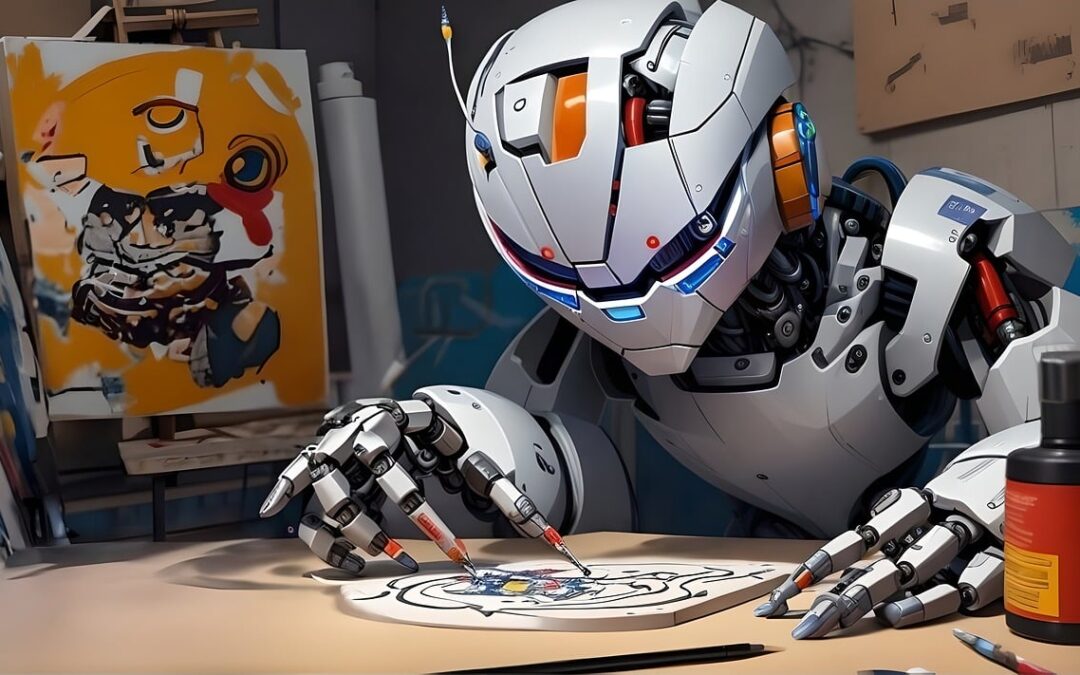
Have you noticed the emergence of apps that produce art in all its forms? The convergence between creativity and artificial intelligence redefines the limits of innovation and artistic expression. And the human imagination with the computational power of artificial intelligence (AI) has given rise to an unprecedented creative landscape, where machines are not only tools, but also collaborators in the creative process. From painting and music to literature and design, the presence of AI has infiltrated all facets of art and creativity. But when working with the arts, do you identify with the idea of working with Artificial Intelligence to support creativity? In this article we show you how this alliance between creativity and AI is shaping our world, examining both the exciting opportunities it offers and the ethical and conceptual challenges it poses.
Evolution of creativity and Artificial Intelligence
In its beginnings, creativity was associated with humans (logically) with the ability to imagine, innovate and produce works of art, music, literature and other fields. However, with the development of artificial intelligence, this notion has been redefined. Advances in artificial intelligence have allowed machines to learn and perform creative tasks autonomously, thus showing the potential of artificial intelligence and creativity. From creating visual art and generating text, AIs have demonstrated a great ability to produce content. As we move into the future, we may see greater convergence between creativity and artificial intelligence. This collaboration could enrich our creative capacity, driving innovation in all areas of life through the use of AI.
Applications of Artificial Intelligence in the creative field
Below are some of the areas where artificial intelligence has left its creative mark:
Visual art generation
From paintings and drawings to computer-generated artwork, AIs can produce images that challenge traditional artistic conventions and explore new forms of expression.
Musical composition
Artificial intelligence has proven capable of composing original music in a wide range of styles and genres. Algorithms can analyze musical patterns, learn from existing compositions, and create new pieces of music that are both innovative and emotionally resonant.
Creative writing
AIs can write creative texts, including poetry, narrative, and advertising content. Some AI language models are capable of generating coherent and compelling text that rivals that produced by human writers.
Graphic design and data visualization
Artificial intelligence is used in graphic design to create graphics, logos, illustrations, and product designs. Additionally, AIs can assist in data visualization, converting complex information into understandable and engaging visual representations.
Photo and video editing
Artificial intelligence algorithms are used in photo and video editing applications to improve image quality, correct imperfections, and apply special effects. AI can automate tedious editing tasks and allow artists to focus on more creative aspects of their work, showing how the use of AI can support creativity.
Generative and collaborative art
Artificial intelligence can facilitate the creation of generative art, where the creative process is shared between humans and machines. Artists can collaborate with algorithms to explore new ideas, experiment with different approaches, and create artworks that challenge traditional notions of authorship and originality, showing how artificial intelligence and creativity can be intertwined.
Benefits of Artificial Intelligence for creativity
Artificial intelligence (AI) offers a series of significant benefits to enhance creativity in various areas:
- Advanced data analysis using neural network: AI analyzes large amounts of data to identify patterns and trends, providing a deeper understanding of the market and audience.
- Generation of ideas and concepts by neural network: AI algorithms offer suggestions and inspiration for creative projects, stimulating creativity and overcoming mental blocks.
- Automation of repetitive tasks: AI automates mundane tasks such as organizing files and finding resources, freeing up time for creativity.
- Personalization and adaptation: AI adapts creative experiences based on individual preferences, resulting in more relevant and engaging content.
- Optimization of creative performance: AI provides detailed feedback and analysis on creative performance, helping to identify areas of improvement and optimize strategies in the creative field.
- Collaboration and co-creation in the creative field: AI facilitates collaboration between creative teams and machines, offering ideas and suggestions to enrich the creative process.
Ethical challenges in the use of AIs in this sense
The ethical challenges in the use of artificial intelligence (AI) in creativity are diverse. One of them is to ensure the originality and authenticity of AI-generated content, addressing proper attribution of the work. Additionally, there is concern about algorithmic biases, as they could perpetuate stereotypes and discrimination in the content. It is essential to address these biases to ensure that the content created is inclusive and representative. Data privacy and security are also crucial issues, as AI involves the analysis of large amounts of information, raising concerns about the protection of personal information. Additionally, AI-driven automation could significantly impact creative industry employment, requiring considerations of employment equity and income distribution. Therefore, it is crucial to maintain human responsibility and oversight over decisions made by AI algorithms, especially in sensitive areas such as art and literature, where artificial intelligence and creativity are intertwined.
What is the computational creativity test?
These tests evaluate the ability of machines to perform tasks that are traditionally associated with human creativity, such as painting, music or writing.
There are various types of computational creativity tests, each with its own approaches and objectives. Some of the most common include:
- Tests based on art generation: These tests evaluate the ability of machines to create works of art, such as paintings, sculptures or music. Aspects such as originality, aesthetics, technical complexity and the ability to evoke emotions in the observer can be analyzed.
- Tests based on creative problem solving: These tests present machines with problems that require creative and innovative solutions. Aspects such as the ability to identify new ideas, flexibility in thinking, the ability to overcome limitations and the quality of the proposed solutions can be evaluated.
- Tests based on the creation of stories: These tests evaluate the ability of machines to create original and attractive stories. Aspects such as narrative coherence, character characterization, plot, writing style and the ability to generate emotions in the reader can be analyzed.
- Tests based on the evaluation of creativity: These tests do not directly evaluate the ability of machines to be creative, but instead evaluate the ability of humans to identify and judge creativity. They can be used to gauge the accuracy of computational creativity tests or to study human perception of creativity.
The turing test and the creativity of artificial intelligence
The Turing Test, proposed by Alan Turing in 1950, does not directly measure creativity. Its primary goal is to evaluate a machine’s ability to exhibit intelligent behavior equivalent to or indistinguishable from that of a human.
However, some aspects of the Turing Test could be interpreted as an indirect measure of creativity. For example:
Ability to generate original and unexpected answers: The machine must be able to respond to the interrogator’s questions in a fluid, coherent and original way, avoiding repetitive or predictable answers. This might require a certain degree of creativity to come up with new ideas and approaches. Ability to adapt responses to context: The machine must be able to adjust its responses based on the context of the conversation, including questions, previous responses, and non-verbal cues. This implies a level of flexibility and adaptability that could be associated with creativity. Use of language in a natural and expressive way: The machine must use language in a natural, fluid and expressive way, similar to how a human would do. This includes the ability to use idioms, humor and metaphors, which may require a degree of linguistic creativity.
To what extent can AI support human creativity?
Artificial intelligence (AI) has the potential to be an invaluable tool in the world of creativity. Since the 1950s, with the advent of AI and machine learning, computer programmers have worked to replicate human creativity. Thanks to AI, you can generate high-quality ideas and solve problems efficiently. This artificial creativity can be used to generate creative content that adapts to our target audience. AI can be especially useful in the art world, as it can automate repetitive processes and free up time for true artistic expression.
Can artificial creativity reach us?
This answer will always be subjective, like the interpretation of a work itself. Some will already think that they have surpassed us because it can imitate any artistic style or create completely new works based on all the information it can process.
Others consider that a machine will never be able to achieve human creativity, that it lacks the most important thing: the human condition. And what do you think?
Future of creativity and Artificial Intelligence
The future of creativity and artificial intelligence promises an increasingly closer and fruitful collaboration. As technology advances, we may see greater integration of AI into the creative process of creative industries and disciplines, where artificial intelligence and creativity complement each other. While AI offers creativity-enhancing benefits, it also raises ethical questions about how artificial intelligence and creativity should be integrated into our lives. It is vital that creatives explore how to use AI responsibly, ensuring that this technology complements, rather than replaces, the human ability to create, supporting creativity in the creative realm. Additionally, we are likely to see significant advances in AI’s ability to understand and emulate human creativity, which could lead to new forms of artistic and creative expression. However, it is important to remember that human creativity remains unique and irreplaceable, and that AI should be seen as a tool to enhance and enrich human creativity, rather than supplant it.
Do you want to know more about AI? Visit our Artificial Intelligence page and get the most out of the use of AI.
This post is also available in: