
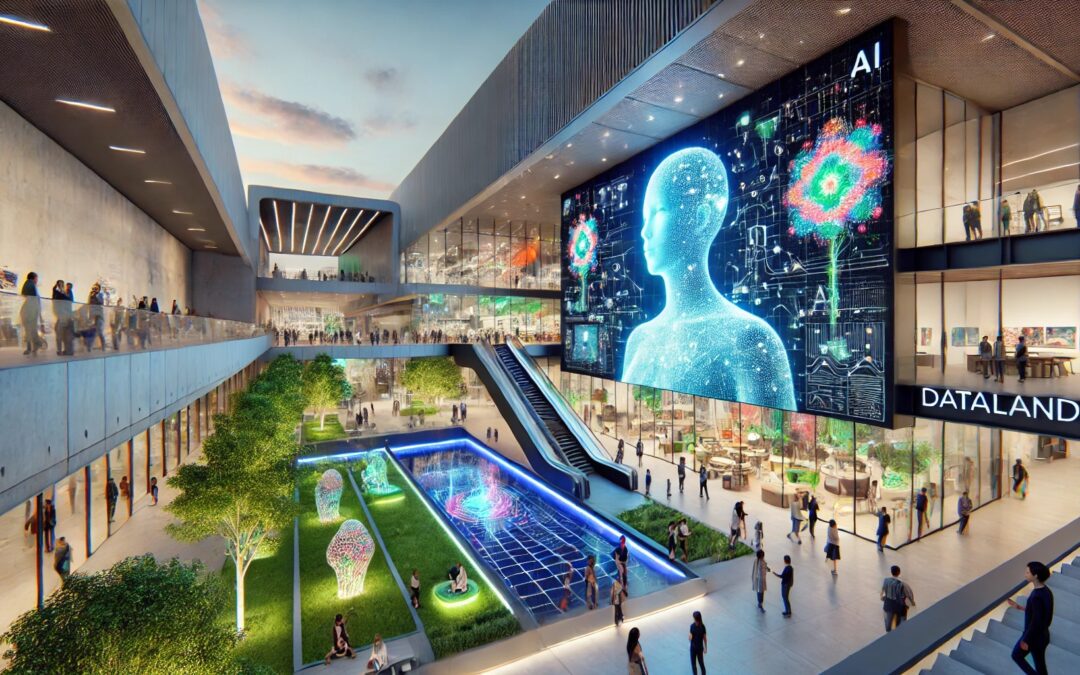
More and more artists are experimenting with AI models to create amazing works. But what happens when an entire museum is dedicated to exploring this type of art?
This is precisely what Dataland proposes, the world’s first Artificial Intelligence art museum, which will open its doors in Los Angeles at the end of 2025.
More than a traditional gallery, Dataland wants to break the mold and rethink the relationship between art, technology and ethics. Under the direction of media artist Refik Anadol, Dataland seeks to become a global benchmark.
Through this museum, Anadol not only wants to exhibit digital art, but also demystify artificial intelligence and create a space where innovation and culture can coexist.
What is Dataland?
Dataland will be the world’s first museum dedicated exclusively to art created with Artificial Intelligence (AI).
It is scheduled to open its doors at the end of 2025 in Los Angeles, near renowned cultural spaces such as the Museum of Contemporary Art (The Broad) and the headquarters of the Los Angeles Philharmonic.
Its objective is to become a meeting point between human creativity and the artistic potential of machines, offering an experience that goes beyond traditional art.
The project is led by Refik Anadol, a prominent media artist, known for his digital installations and his innovative use of algorithms to create interactive works.
With Dataland, Anadol seeks to redefine the way a museum is conceived, combining art, technology and science in a space that also promotes ethical AI and sustainability.
An innovative and ethical museum
Refik Anadol, its founder, has stated that one of the museum’s pillars will be to promote “ethical AI”,highlighting the importance of using technology responsibly and transparently.
At a time when AI is generating controversy due to its economic and cultural impact, Dataland wants to demystify it and show its creative potential without losing sight of the challenges it poses.
One of the museum’s most relevant commitments is the exclusive use of renewable energy to power its technological systems.
Anadol has worked with Google to find sustainable energy solutions, thus avoiding dependence on fossil fuels. Although this involves slower processes, the museum’s focus is clear: prioritize long-term positive impact over speed.
The art of Refik Anadol: A controversial vision
Refik Anadol is a leading figure in the digital art world, known for creating immersive installations and interactive digital canvases using AI algorithms.
His work has been exhibited at renowned institutions such as the Museum of Modern Art in New York (MoMA), the Serpentine Gallery in London and the United Nations Headquarters.
However, his style has not been without controversy. While some consider his works as an innovative fusion between art and technology, others describe them as overloaded and lacking depth.
Among his most talked-about creations is Unsupervised, a digital canvas that uses AI to reinterpret 200 years of MoMA works, generating ever-changing patterns.
Anadol’s vision remains clear: AI should not replace humans, but rather act as a tool to enhance creativity and open up new artistic possibilities.
Dataland as a research and technology space
Dataland will not only be a museum to display digital art, but also a research center where new creative applications of Artificial Intelligence (AI) will be developed.
The museum will be equipped with advanced sensors, interactive systems and high-performance computers to enable the creation of immersive and personalized experiences.
Visitors will not only contemplate works, but will also be able to interact with the installations, transforming their experience in real time thanks to AI algorithms.
Dataland also aims to become a meeting point for artists, scientists and developers, encouraging interdisciplinary research and collaborative creation.
Anadol sees it as vital for artists to develop their own AI tools rather than relying on external solutions, which will promote innovation and reduce the skepticism that still exists towards digital art in traditional institutions.
Refik Anadol and his commitment to responsible AI
Aware of the environmental impact that this technology generates, especially due to the high energy consumption of data centers, Anadol has expressed concern about the ecological footprint of digital development.
Despite the enthusiasm surrounding AI, its application does not always contribute to mitigating climate change; In fact, the infrastructures necessary to train and maintain AI systems often have a negative impact on the environment.
In collaboration with Google, Anadol has found solutions in Oregon to power the museum exclusively with renewable energy, avoiding the use of fossil fuels.
Although this decision slows down some creative processes, the objective is to prioritize long-term positive impact. “The idea here is not to be fast or to be first, but to be right,” says Anadol.
Dataland: A mix between art and sustainability
Dataland is a proposal that unites creativity and innovation with environmental awareness. Its approach goes beyond showing what AI can do; seeks to demonstrate how technology and art can collaborate in an ethical and sustainable way.
The intention is not to advance quickly or at any cost, but to build a future where machines enhance human expression without compromising the planet.
This space represents a new way of understanding the relationship between culture and technology: a place where artistic exploration with AI is aligned with principles of ecological responsibility.
Dataland invites us to rethink the impact of digital art and technology on our lives, offering an experience that inspires, transforms and raises new possibilities for a more balanced future.
This post is also available in: