
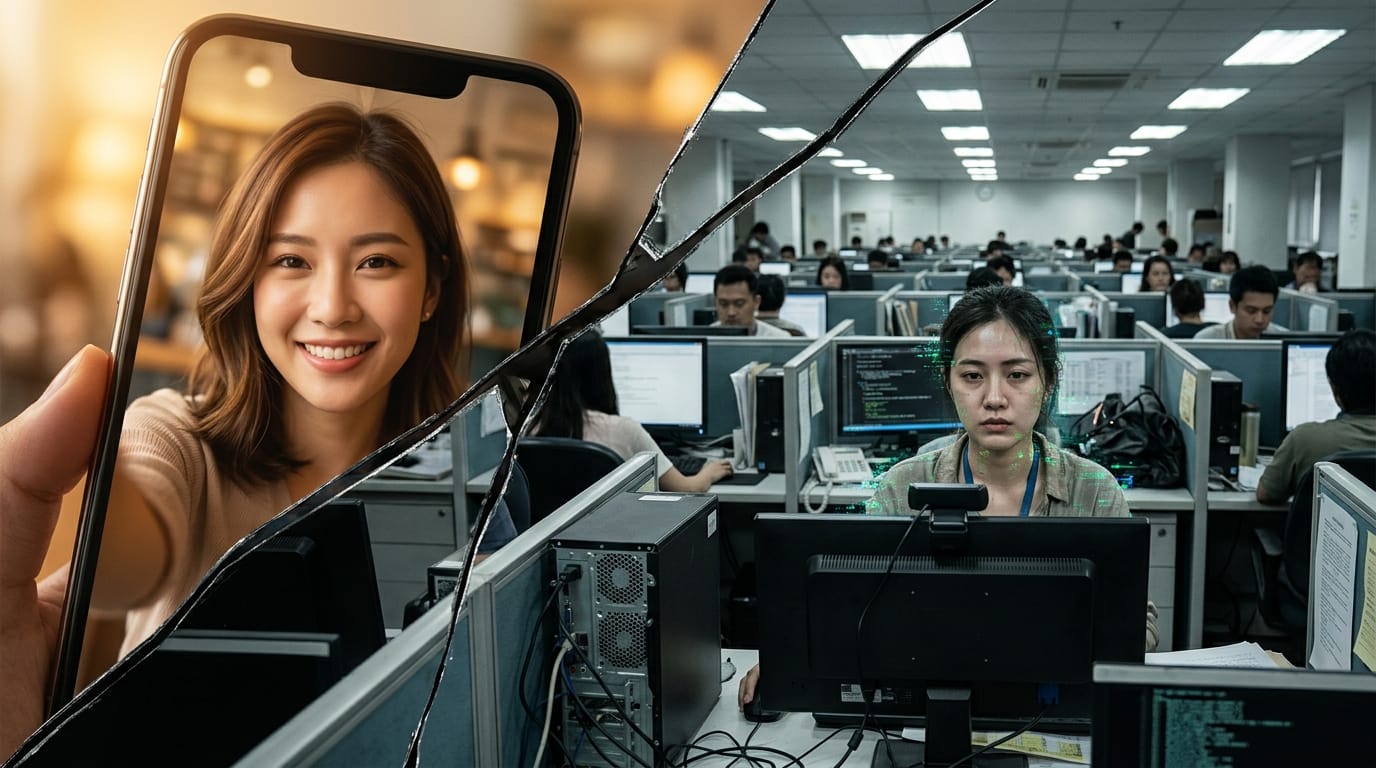
Imagine that, after days of exciting messages with someone who seems to understand you perfectly, you finally agree to a video call. A young, charismatic and real woman appears on the screen, who smiles at you while talking to you about a prosperous future.
You feel lucky, but what you don’t know is that that smile is the cog in a high-tech criminal machine.
On the other side of the world, in a cold office in Cambodia, that “model” is making her hundredth call of the day, using an artificial intelligence filter to impersonate you and steal your life savings.
This is the reality of pig butchering: an industry that recruits human faces to fabricate digital lies, exploiting your need for affection and desire for advancement.
Why we are vulnerable to beauty and deception
Surely you’ve heard that “the face is the mirror of the soul.” Scammers know this and count on the fact that, as a human being, your brain is programmed to trust someone you find attractive more quickly.
This is what is known in psychology as the “halo effect”: if someone is beautiful, we unconsciously assume that they are also honest and brilliant. This vulnerability is what mafias exploit when recruiting young people like Angel.
They don’t just sell you a cryptocurrency investment opportunity or a love story; They sell you the validation of a real person who, by looking at you through a camera, disarms all your alarms.
When a professional model smiles at you on a video call, your guard goes down. It’s hard to believe that behind that fluid and natural look hides a deepfake algorithm designed to empty your pockets.
The “Pig Butchering” factory
How do you make a video call seem so real? It’s not magic, it’s an industrialized operation that combines human talent with advanced algorithms. This is how they set up the deception:
- Recruitment in the shadows: Through Telegram channels, mafias look for “AI facial models.” They attract young people with promises of salaries of up to $7,000, asking them to master languages and have an impeccable appearance.
- The “AI Rooms”: Once hired, the models work in closed complexes in Southeast Asia. There, they sit in front of cameras that, using face-swapping software, replace their real face with one designed to be the perfect bait.
- The deception script: The model’s job is to “humanize” the scam. While other operators send text messages, she makes short video calls, smiles and generates confidence so that you buy gold or non-existent cryptocurrencies.
It’s an assembly line where your trust is the final product.
Consequences of falling into the network
For you, as a victim, the impact is an emotional earthquake: discovering that the person you connected with, whom you saw smiling on video, was just an avatar of a criminal network, leaves you with a sense of vulnerability and betrayal that is difficult to heal.
Many people lose their life savings or go into debt, facing financial ruin that comes with great shame. But there is another side of the coin just as dark: the cost for those on the other side of the screen.
These models, although some arrive looking for high income, end up trapped in guarded facilities, with their passports withheld and under exhausting days of up to 150 calls a day.
It is a chain of exploitation where everyone, the one who pays and the one who cheats, ends up being disposable pieces of a criminal machine.
How to identify and prevent these scams
In order not to become another figure in these mafias, it is vital that you learn to look beyond a pretty face on your screen. Here is a list of signs to protect yourself:
Detect errors in the deepfake
Notice if the lip movement does not match the audio, if there are strange blinks, or if the face “deforms” slightly when the person passes their hand over their face or moves suddenly.
The echo of the “office”
Listen to the background. Many of these models work in shared rooms; If you hear an echo of other voices or ambient office noise while they talk to you about an intimate or luxurious environment, be immediately suspicious.
The money barrier
Establish that you never, under any circumstances, make investments in unknown platforms (gold, crypto or betting) suggested by someone you just met online, no matter how many video calls they have made to “prove” that they are real.
Reverse verification
Use image search tools with the photos they send you. If the face appears in model catalogs or other profiles with different names, cut off communication.
The broken mirror: Recovering trust in the synthetic era
In the end, technology has not invented deception, but it has given it an almost perfect human mask. Don’t let the brightness of a screen cloud your instincts; In this new digital board, doubt is your best armor. **
The beauty you see on a video call may be real, but the intention behind it is an algorithm designed to exploit your humanity.
Stay alert, question “flawless,” and remember that true connection comes not from an AI filter, but from transparency that no scam network can ever replicate.
This post is also available in: