
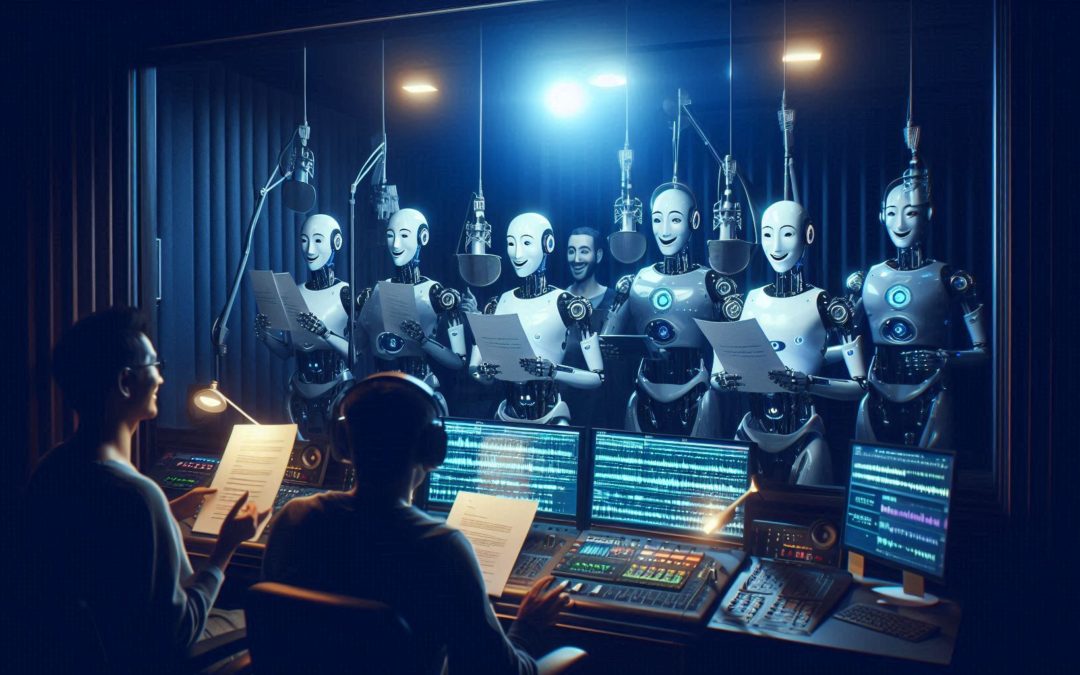
Dubbing has been an essential tool to bring films, series and audiovisual content to people from different parts of the world.
Traditionally, this process involved long hours of work in studios, involving teams of translators, voice actors and timing experts.
However, artificial intelligence (AI) is transforming this sector. Today, AI dubbing allows you to generate high-quality voiceovers quickly and efficiently, eliminating the language barrier.
In this article, we’ll explore what AI voice-over is, how it works, and how it can help maximize the reach of our content. You’ll also find some easy platforms to start dubbing your videos for free with AI.
What is AI dubbing?
AI dubbing consists of the use of machine learning algorithms to generate synthetic voices that replace the original dialogues of audiovisual content in multiple languages.
Unlike traditional dubbing, which requires voice actors in studios, AI dubbing uses advanced AI tools to recreate the emotion and flow of human speech.
This allows videos, movies, podcasts and other formats to be available in multiple languages without the need for such costly and time-consuming processes.
How AI dubbing works
AI dubbing combines several advanced technologies to create natural and synchronized voiceovers. The main steps and components of the process are described below:
Audio analysis and transcription
The first step is transcribing the original dialogue and translating it into the target language. This phase goes beyond literal translation, adjusting the texts to match the duration and lip movements of the character.
Voice cloning and voiceover generation
AI can clone human voices by analyzing hours of recordings to capture emotional nuances and specific characteristics. These synthetic voices can be customized to maintain the essence of the original actor or adapt to the cultural context of the new language.
Automatic lip sync
One of the biggest challenges of dubbing is lip-sync: the synchronization between voices and lip movements on screen. AI tools analyze the length and patterns of the original dialogues, automatically adjusting the generated audio to align with the image.
Post-production and sound adjustment
Finally, the generated audio is adjusted to integrate with the music and sound effects of the original content. Although this process is increasingly automated, in some cases human supervision is required to ensure a perfect finish.
Advantages of AI dubbing for content creators
Traditional dubbing is an expensive process, especially when you need to dub into multiple languages. AI allows you to generate multiple versions of content at a much lower cost.
While manual dubbing can take weeks or months, AI tools allow you to generate dubs in minutes. This is especially useful for content creators on platforms like YouTube, who frequently post videos.
AI dubbing makes it easier to localize content for international audiences. Not only does it increase viewership, but it also improves the experience by offering versions in the audience’s native language.
Technologies have advanced to the point where AI-generated voices sound natural and expressive. In addition, it is possible to customize the voices for different tones, genres or styles, adapting them to the type of content.
AI dubbing also contributes to inclusion, allowing more people to access educational, cultural and entertainment content in their language. Additionally, complementary tools such as automatic subtitle generation make videos accessible to people with hearing disabilities.
Where is AI voice acting used?
Currently, videos are dubbed with AI for a wide variety of sectors and formats:
- Streaming platforms and social networks: Services such as Netflix or YouTube are exploring the use of AI to offer dubbed versions of their content in several languages.
- Education and e-learning: Online courses and tutorials can be located quickly, facilitating learning in different languages.
- Podcasts and audiobooks: AI allows podcasts or narrated books to be translated and dubbed to reach more listeners around the world.
- Corporations and internal training: Companies can translate their training materials efficiently for employees in different countries.
How to get started with AI dubbing?
Nowadays, there are several platforms that offer AI voice-over services. The processes are simple: you just need to upload your video file, select the target language and let the AI generate the new synchronized audio.
More advanced tools even allow you to adjust the intonation and style of the voices to suit your needs.
Tools to dub videos with AI
Here is a list of free AI video dubbing tools, along with their main features and limitations:
EzDubs
EzDubs stands out for its simplicity and ease of use. It allows you to generate dubbing and subtitles in another language from a video. However, the quality of the generated voice may not be as high as that of paid tools.
You can try it at ezdubs.ai, where without registration you can dub videos from YouTube and X (formerly Twitter). Additionally, you can mention the X bot (@ezdubs_bot) to translate videos directly on the platform.
ElevenLabs
ElevenLabs allows you to dub videos into 29 different languages, maintaining the emotion, rhythm, tone and unique characteristics of each speaker. You can upload or link videos from platforms like YouTube, TikTok or Vimeo and start translating them immediately.
The free version has certain limitations regarding the length and number of videos that can be dubbed, it is still an excellent option to try the tool.
For business users ElevenLabs also offers a professional dubbing service managed through ElevenStudios, where AI experts and bilinguals will assist the AI in the dubbing work.
Capcut (desktop version)
Capcut, known for its powerful video editor, has incorporated AI dubbing functionality into its desktop version. This tool allows users to translate and dub their videos in just a few steps.
The free version of Capcut offers access to this AI dubbing feature, although with certain limitations. Users can translate and dub videos of limited length and there are restrictions on the number of videos that can be processed per month.
However, these restrictions do not diminish the usefulness of the tool, especially for those looking to experiment with AI voice acting without incurring additional costs.
The future of dubbing with AI
As technology advances, synthetic voices are expected to become indistinguishable from human voices, and automatic synchronization will become even more precise.
This will not only benefit content creators, but will also allow streaming platforms and production companies to save time and money in localizing their products.
In the future, AI tools may allow dubbing of content in real time, opening the door to multilingual live events.
Furthermore, combining AI with emerging technologies such as virtual reality could offer fully immersive audiovisual experiences.
This post is also available in: