
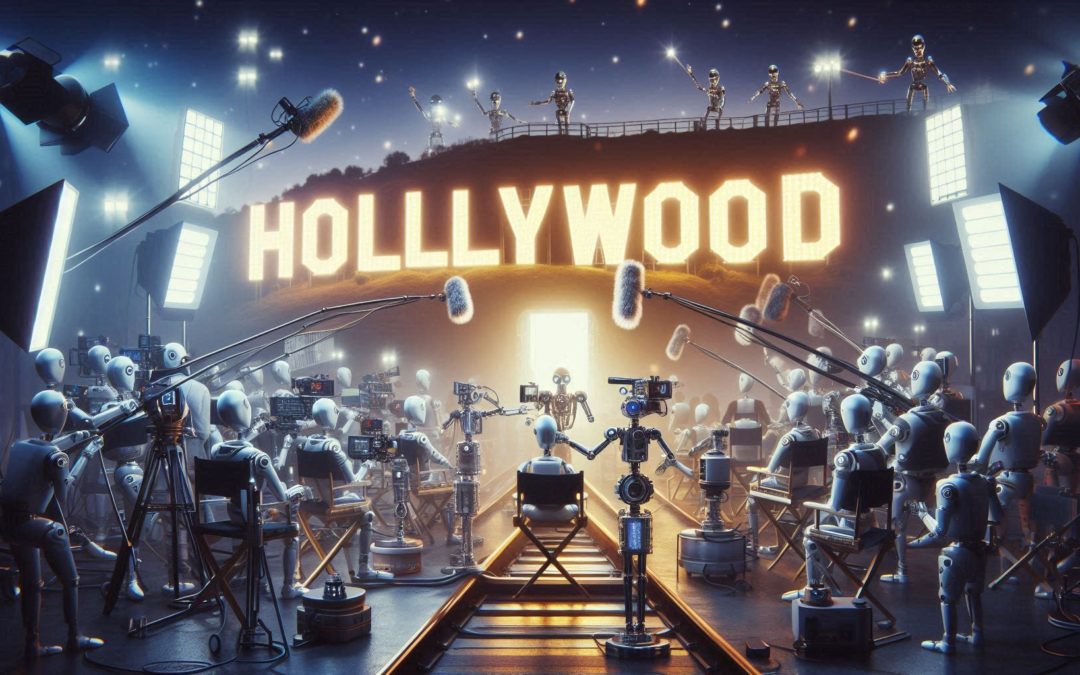
From script creation to visual effects production, AI is revolutionizing the way movies and TV shows are made.
However, this technological evolution also brings with it controversies and concerns that are at the center of the debate in the entertainment industry.
Let’s take a look at some recent movements in Hollywood and how they are shaping a landscape where AI will be present at all levels of audiovisual creation and marketing.
Innovations powered by AI
One of the most impactful developments in Hollywood is the ability of AI to generate audiovisual content.
Tools like OpenAI Sora allow you to transform text into realistic videos, meaning that, in theory, a screenwriter could generate an entire movie just from a written script.
This automation capability promises to make film and television production more accessible and affordable, with budgets that could be reduced by up to 90% compared to traditional methods.
On the other hand, platforms like Wonder Studio allow creators to make drastic visual changes with a simple drag and drop.
This not only saves time and money, but also democratizes access to tools that were previously reserved for large studios with multi-million dollar budgets.
The reaction of the industry
Despite these innovations, many Hollywood professionals view the advancement of AI with concern.
Tyler Perry, a prominent director and producer, recently paused a capital expansion (valued at $800 million) at his studio, citing the imminent arrival of these technologies as a cause for concern.
“Jobs are going to be lost,” Perry said, reflecting the fear felt by many in the industry about the potential relocation of creative jobs.
This fear is understandable given that AI not only has the potential to create content, but can also replace people in creative roles.
The possibility that a single person can produce a feature film from home raises serious questions about the future of collaboration and community that has defined the film industry.
The inevitable legal and ethical controversies
One of the hottest issues arising with the adoption of AI in Hollywood is copyright and intellectual property issues.
Lawsuits against AI companies for copyright infringement have been on the rise, both for the use of protected content and for the output of AI that is considered to be derived from original works.
The courts are still grappling with these issues, and many experts believe the outcome of these disputes could shape the way AI is regulated in the industry.
Another worrying aspect is the use of AI for defamation. Since AI can “hallucinate” misinformation about real people, this has led to defamation claims against companies using this technology.
In this sense, legal liability for AI remains a gray area, which could have significant repercussions for content creators and distributors.
The resistance of the unions
Labor organizations, such as the Writers Association of America (WGA) and the Screen Actors Guild (SAG), have expressed discontent with the use of AI in content production.
In recent contract negotiations, an agreement was reached for studios not to replace writers and actors with AI.
However, given the rapid advancement of technology, many are wondering how long this agreement can last. In three years, when the next negotiations begin, it is certain that AI will be much more advanced, which will further complicate the situation.
Can AI really level the playing field?
Despite the concerns, there are those who see AI as a tool that can democratize the creative process.
Mika Johnson, a filmmaker and documentary filmmaker, maintains that by offering access to AI tools, doors will open so that people who previously did not have the possibility to tell their stories can do so.
This could lead to an explosion of diverse and unique narratives that would enrich the cultural landscape.
However, the reality can be more complicated. Allan Loeb, a Hollywood screenwriter, warns that this “explosion of access” could collapse under its own weight, creating a sea of content that, while diverse, could lack quality and depth.
“Every artist on the planet is having a Wile E. Coyote moment,” says Loeb, suggesting that too much choice could lead to creative stagnation.
An uncertain future for cinema and TV
The intersection of AI and Hollywood raises fundamental questions about the future of film and television. As technology advances, the possibilities are almost endless.
However, AI also poses challenges that the industry must proactively address. Will writers and actors become a thing of the past? Can human creativity survive in a world where machines can generate content instantly?
The answer to these questions is not simple. While some believe AI can enrich the creative process, others argue it could strip the industry of its essence: human connection.
Hollywood, with its rich history of innovation and adaptation, faces another critical moment in its evolution.
The challenge will be to find a balance between taking advantage of the opportunities that AI offers and protecting what makes film and television unique and valuable.
Meanwhile in Bollywood…
Bollywood, India’s film industry, is one of the largest and most prolific in the world. The situation there is not very different from that in Hollywood in terms of the adoption of AI and the concerns it generates.
Several personalities from Indian cinema have expressed concern about the possible damage that AI could cause to industry workers and its intellectual properties.
Megastar Amitabh Bachchan has been one of the most prominent voices, expressing his fear of losing control over his own image and his likeness.
Violations and infringements of intellectual rights have already been reported. A notable case is that of Vijay Vikram Singh, recognized for his voice in shows like Bigg Boss and Indian Idol.
In 2018, Singh signed a deal to lend his voice to machines training text-to-speech technology. However, six years later, he is preparing a lawsuit against the company, alleging that his voice has been used in ways he had no intention of allowing.
“I have lost the right to my voice. They can use my voice and completely replace me,” Singh stated, acknowledging that AI has expanded the scope of his voice use in ways he never anticipated.
Many in Bollywood are trying to find ways to protect their rights to their public identity, appearance and intellectual property.
Actor Anil Kapoor, for example, secured exclusive rights to his name, image and other attributes of his personality through a ruling by the Delhi High Court.
More uncertainties than certainties
The arrival of AI may change the way stories are told, but the essence of those stories will depend, as always, on the human voice behind them.
The struggle to balance technological innovation with the preservation of creative work is a path that Hollywood will have to travel in the coming years, a journey full of uncertainty, but also unprecedented potential.
Ultimately, AI represents both an opportunity and a challenge in this context.
This post is also available in: