
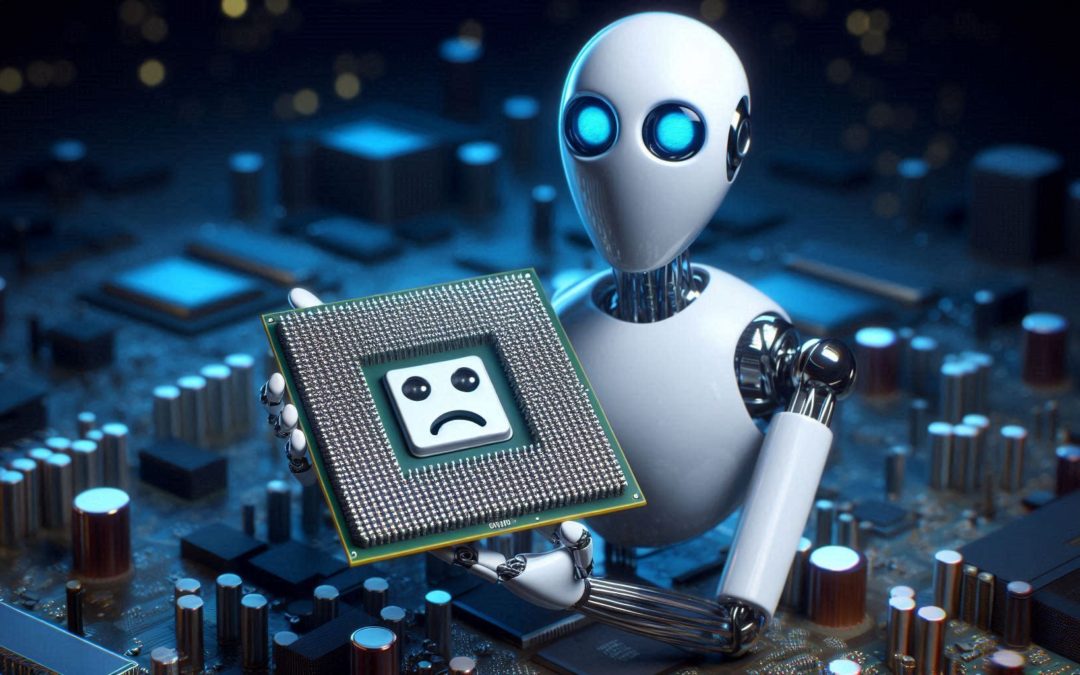
Intel, the semiconductor giant that for decades was synonymous with innovation and leadership in the technology industry, today faces a crisis that has shaken its position in the market.
While competitors like AMD and Nvidia rub their hands over profits, Intel is fighting to survive. With its share value falling more than 38% in 2024, the company finds itself at a crossroads.
Despite its efforts to stay relevant in the (AI) era, Intel seems to be in an almost insurmountable situation. The reason? Late decisions and the inability to compete effectively in the growing generative AI market.
When Intel refused to invest in OpenAI
In 2017 and 2018, Intel had the opportunity to buy a stake in OpenAI, which at the time was a nonprofit research organization focused on generative artificial intelligence.
For several months, executives from both companies discussed various options, including Intel buying a 15% stake for $1 billion. The possibility of Intel taking an additional 15% stake if it provided hardware to OpenAI at cost was also considered.
However, Intel decided not to move forward with the deal. Part of the reason was that then-CEO Bob Swan did not believe that generative AI models would come to market anytime soon and therefore did not think that investment would be recovered quickly.
Additionally, Intel’s data center unit was unwilling to manufacture products at cost for OpenAI. OpenAI was interested in Intel’s investment because it would have reduced its dependence on Nvidia chips and allowed it to build its own infrastructure.
However, the lack of agreement meant that OpenAI continued to use Nvidia chips, eventually leading to the launch of ChatGPT in 2022 and a valuation of approximately $80 billion for OpenAI. And that brings us to the next point.
Nvidia: He who gives first gives twice
A few years ago, Nvidia dominated the nascent AI hardware market thanks to its powerful GPUs (graphics processing units). These were (and still are) especially well-suited for AI tasks due to their ability to handle multiple operations in parallel.
Nvidia recognized the potential of AI early and positioned itself as a leader by offering not only hardware, but also software and access to specialized computers. It soon began manufacturing hardware specifically dedicated to AI, known as AI accelerators.
For years, Nvidia has poured talent and money into developing its CUDA platform, which makes it easier for developers to create AI applications optimized for its GPUs. This integration has been a key factor in its success.
Intel, on the other hand, has had a hard time keeping up. Not only did it fail to offer GPUs that competed with Nvidia in performance and power efficiency, but it also recognized too late the potential of specialized hardware for AI.
It was not until 2019 that it acquired Habana Labs, which allowed it to launch products such as Gaudi chips. However, these came to market later than Nvidia products, failing to match the performance and efficiency of Nvidia GPUs in many AI applications.
The results? The first half of 2024 has been difficult for Intel. Although they can boast 5% annual growth in their Data Center and AI unit, this is a paltry figure compared to Nvidia’s triple-digit sales growth in the same segment.
The problem of wanting to do everything “at home”
Historically, Intel has been known for keeping all stages of design and manufacturing of its chips “in-house.” However, this approach appears to be delaying its intentions to remain competitive in the specialized AI hardware market.
One of Intel’s main problems has been the complexity and delays in transitioning to new manufacturing nodes. In 2020, Intel had to postpone the launch of its 7nm chips due to manufacturing issues, while TSMC was already mass producing 7nm chips for customers like AMD.
These delays not only affected Intel’s ability to compete in terms of performance, but also impacted the power efficiency of its products.
Intel’s less advanced manufacturing processes have resulted in chips that consume more power and perform less than those of the competition. For example, Nvidia chips, manufactured by TSMC, have proven to be more efficient in terms of performance per watt, which is crucial for processing-intensive AI applications.
Intel’s decision to continue manufacturing its chips in-house, rather than adopt a “fabless” model like Nvidia and AMD, has resulted in costly delays and production problems.
What has Intel been doing then?
If not AI, what has Intel invested its money and the talents of its employees in? Why does the market seem to fear for its future?
Intel’s strategy has been to transform from a CPU-focused company to a multi-architecture company, in addition to opening its factories to other companies’ designs. Both are necessary decisions, but risky and perhaps late.
On the one hand, Intel has focused its efforts on the Internet of Things (IoT), an area that connects devices and systems over the network to improve efficiency and automation.
The company has developed hardware and software solutions for IoT applications in sectors such as healthcare, automotive and smart cities. This approach has allowed Intel to capture a share of the IoT market, but it does not appear to be enough for investors.
On the other hand, Intel has continued to innovate in its traditional lines of processors for data centers and PCs. The company has launched new generations of CPUs and has improved its architecture to offer better performance and energy efficiency.
And on a more experimental front, Intel continues to lead the race for quantum computing, an emerging field with the potential to revolutionize technology. However, commercialization is still years away, meaning these efforts have not had an immediate impact on the company’s bottom line.
Is Intel lost?
It’s still early to tell, but Intel’s current situation is a reminder of how a company that once dominated the industry can fall behind if it doesn’t quickly adapt to new technological trends.
The delay in adopting and competing in the generative AI space, coupled with questionable decisions in its manufacturing strategy, has led the company to a significant loss in market value.
The road ahead is challenging, but not impossible. Intel has the ability to innovate and lead once again, but it needs clear focus, bold decisions and, most importantly, time. Time you may no longer have.
This post is also available in: