
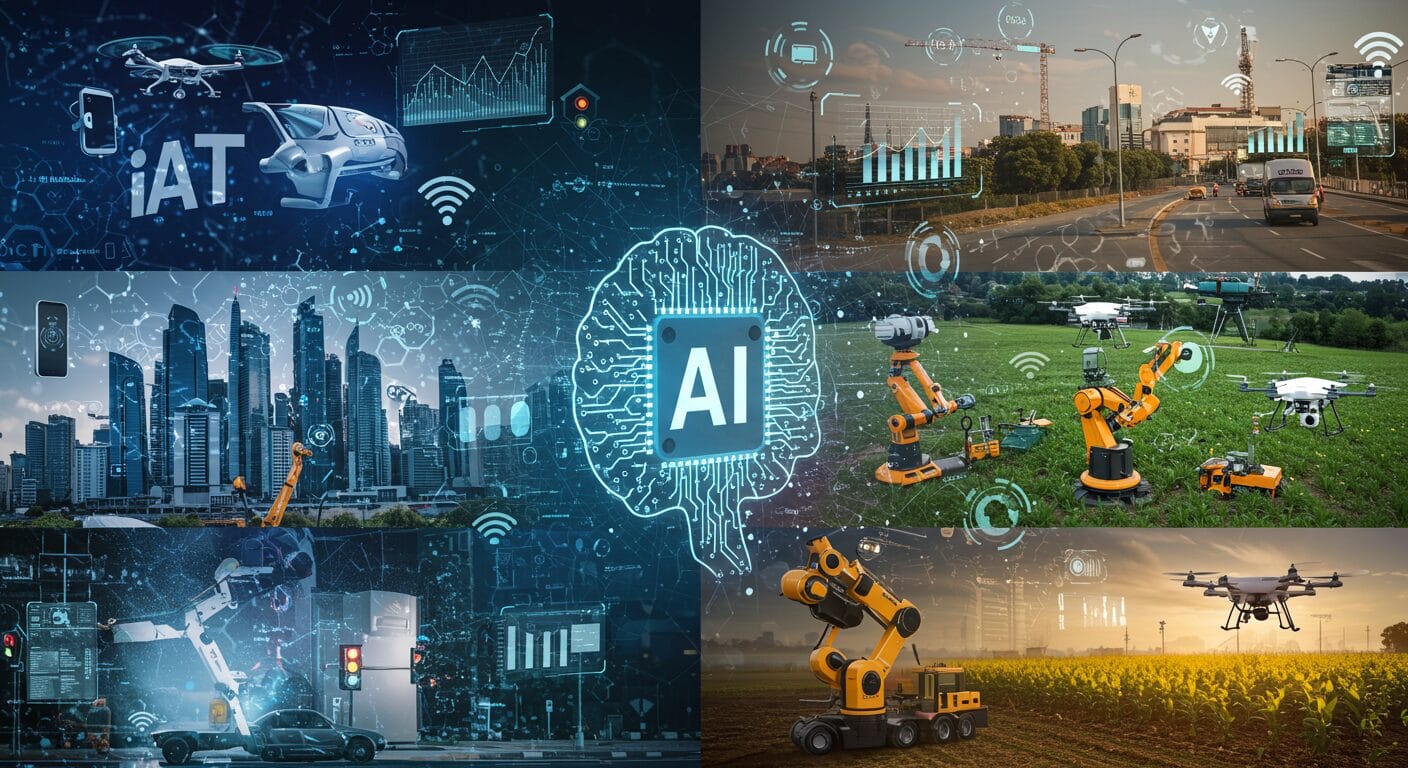
¿Te has preguntado cómo sería vivir en un mundo donde las máquinas no sólo están conectadas, sino que también piensan por sí mismas? Donde los semáforos ajustan su ritmo para evitar atascos o los hogares aprenden de ti para hacerte la vida más fácil.
Esto ya no es un sueño lejano, sino una realidad impulsada por la unión de dos tecnologías que están redefiniendo nuestro futuro: el Internet de las Cosas (IoT) y la Inteligencia Artificial (IA).
Esta combinación, conocida como Artificial Intelligence of Things (AIoT), está dando vida a dispositivos y sistemas que no solo recopilan datos, sino que los analizan, aprenden de ellos y toman decisiones inteligentes en tiempo real.
Descubre cómo esta poderosa alianza está revolucionando industrias, mejorando nuestra calidad de vida y abriendo un mundo de posibilidades que antes parecían imposibles. ¿Listo para descubrir cómo estas tecnologías están cambiando todo?
¿Qué es el Artificial Intelligence of Things (AIoT)?
El Artificial Intelligence of Things (AIoT) es la fusión de dos tecnologías transformadoras: el Internet de las Cosas (IoT) y la Inteligencia Artificial (IA).
Mientras el IoT conecta dispositivos para recopilar y compartir datos, la IA les da la capacidad de analizar esa información, aprender de ella y tomar decisiones inteligentes en tiempo real.
En otras palabras, el AIoT convierte a los dispositivos conectados en sistemas autónomos y proactivos. Por ejemplo, un sistema de seguridad con AIoT detecta movimiento y puede distinguir entre un intruso y una mascota, enviando alertas cuando es necesario.
En el ámbito industrial, las máquinas equipadas con AIoT predicen fallos antes de que ocurran, optimizando el mantenimiento y reduciendo costos.
Contexto de la fusión de estas tecnologías
La fusión del Internet de las Cosas (IoT) y la Inteligencia Artificial (IA) surge como respuesta a la necesidad de darle un mayor valor a los datos. El IoT, con su capacidad para conectar dispositivos y recopilar información, generó un flujo masivo de datos.
Sin embargo, sin un análisis profundo, estos datos carecían de utilidad práctica. Aquí es donde entra la IA, que con sus algoritmos de aprendizaje automático y procesamiento avanzado, permite interpretar y transformar esos datos en información útil.
Esta unión, conocida como Artificial Intelligence of Things (AIoT), no solo optimiza procesos, sino que también habilita la toma de decisiones en tiempo real y la automatización inteligente.
For example, in a factory, IoT sensors collect data about machine performance, and AI analyzes that data to predict failures or adjust production. Thus, AIoT becomes a tool that drives innovation and efficiency.
Practical applications of AIoT
Artificial Intelligence of Things (AIoT) is transforming multiple sectors, taking efficiency and intelligence to a level never seen before. These are some of its most notable applications:
Smart cities
In smart cities, AIoT optimizes traffic through traffic lights that adjust in real time according to the flow of vehicles.
It also improves waste management, with containers that alert when they are full, and public lighting, with streetlights that turn on only when they detect movement.
Industry and manufacturing
Machines equipped with IoT sensors and AI algorithms can predict failures before they occur, reducing costs and avoiding unplanned downtime. In addition, it optimizes the supply chain, adjusting production according to demand in real time.
Health
In the healthcare field, wearable devices with AIoT constantly monitor vital signs such as heart rate or glucose levels, alerting doctors and patients to abnormalities.
It is also used in AI-assisted diagnostic systems, which analyze medical images to detect diseases such as cancer in early stages.
Transport and logistics
Autonomous vehicles are a clear example of AIoT in action. They use sensors, cameras and AI algorithms to make decisions in real time, such as braking when faced with an obstacle or choosing the most efficient route.
In logistics, AIoT optimizes delivery routes and manages fleets intelligently.
Agriculture
In the field, IoT sensors monitor soil conditions, humidity and climate, while AI analyzes this data to recommend the ideal time to plant, water or harvest. This increases productivity and reduces resource waste.
Smart Home
Home appliances such as refrigerators, washing machines or air conditioning systems learn from users’ habits and automatically adjust to offer greater comfort and energy savings.
Retail and commerce
In physical and online stores, AIoT personalizes the customer experience through AI-based recommendation systems, that suggest products based on preferences and purchasing behaviors.
Benefits of the union between IoT and AI
These are some of its main benefits:
- Operational efficiency: AIoT allows data to be analyzed in real time, optimizing processes and reducing errors. In factories, machines can adjust their operation to maximize production and minimize waste.
- Intelligent automation: AIoT-based systems are capable of making autonomous decisions, reducing the need for human intervention. This saves time and allows businesses and homes to run more efficiently.
- Personalization: Thanks to AI, IoT devices can learn from user behaviors. This is seen in virtual assistants, recommendation systems on streaming platforms or thermostats.
- Security and privacy :AIoT improves the detection of fraud in banking transactions to intrusions in security systems. Additionally, AI algorithms help protect personal data with encryption and analysis techniques.
- Sustainability: By optimizing the use of resources such as energy, water or materials, AIoT contributes to reducing environmental impact. For example, in agriculture, smart systems minimize water and fertilizer waste.
Next advances in AIoT
The future of Artificial Intelligence of Things (AIoT) promises even more revolutionary advances. With the arrival of the 6G network and quantum computing, data processing speed and capacity will reach unprecedented levels.
In addition, Edge Computing (data processing on the device) will gain prominence, reducing dependence on the cloud and improving privacy and efficiency.
Within the field of health, wearable devices capable of predicting diseases with greater precision are expected. In terms of smart cities, autonomous transportation systems and energy management will become more efficient.
In the case of industries, collaborative robots (cobots) will be gradually integrated with AIoT, which will undoubtedly optimize production.
The AIoT will give a lot to talk about soon
Artificial Intelligence of Things (AIoT) is not just a technological trend; It is a revolution that is redefining how we interact with the world.
By combining IoT connectivity with AI intelligence, this fusion is creating more efficient, autonomous and adaptive systems, capable of transforming entire industries and improving our quality of life.
From smart cities that optimize resources to medical devices that prevent disease, AIoT is proving that the future will not only be connected, but also smart.
Without a doubt, this technology will continue to be talked about, not only for its technological impact, but for its ability to solve global challenges and build a more sustainable and inclusive future.
This post is also available in: