
If you have been reading us for a long time, you will know that a couple of years ago we published an article asking whether it was worth investing in the famous “AI PCs”.
At that time, we were talking about processors with NPUs (Neural Processing Units) from brands such as Intel, AMD and Qualcomm, aimed at light tasks such as blurring the background in video calls or making translations in real time.
But, to be completely honest with you: in 2026 the landscape has changed drastically for the end user.
Today, the real revolution is not in the cloud, but on your own desktop. The explosion of free and open source tools, such as Ollama, LM Studio and MLX, has made running gigantic Artificial Intelligence models (from 70B LLMs to generating extremely high quality images with Flux) completely viable on consumer hardware.
We already warned you when we talked about how the “thirst for memory” was going to suffocate global hardware: the rules of the game have changed. And the big question is: why should you complicate your life by running AI on your own computer instead of paying for ChatGPT or Claude?
The superpower of agencies and creators
For those of us who work in marketing, content creation or manage our clients’ data, making the leap to local mode is no longer a geeky whim, it is a brutal competitive advantage. The reasons are self-evident:
- Absolute and shielded privacy: Your clients’ sensitive data, confidential campaigns or your most valuable prompts never leave your machine. Nobody uses them to train other models.
- Goodbye to surprise invoices: Zero API costs. No more monthly subscriptions that accumulate at the end of the month.
- Total offline freedom: You have unlimited speed to work without depending on whether the OpenAI servers are down or your internet connection.
- Your brand, your rules: Fine-tuning is now much easier, allowing you to customize models to match the exact tone and style of your copy.
- Generation without limits: You can create texts, images and campaign variations in bulk without getting the “you have reached your message limit” notice.
The King is dead, long live the VRAM
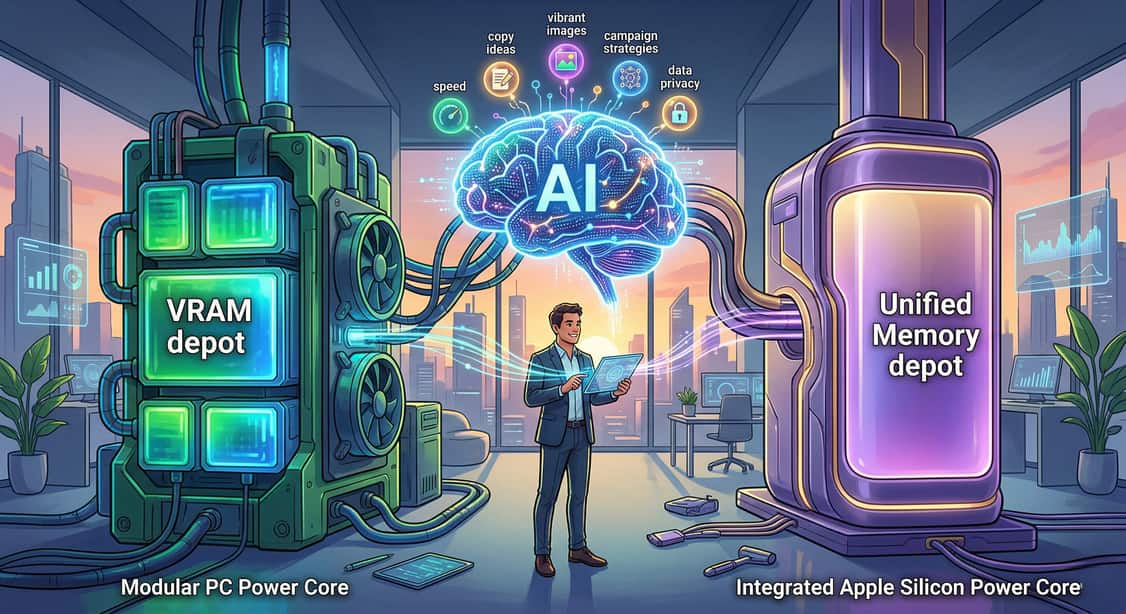
If you are going to buy a computer today, forget a little about the marketing of NPUs. Yes, NPUs are great and super efficient for background OS tasks. But for “real inference”, that is, to make a truly powerful model think, the absolute deciding factor is VRAM (the graphics card memory) or unified memory in the case of Apple.
Think of VRAM as the size of your car’s trunk: if the model you want to use weighs 20 GB and your graphics card only has 8 GB, it simply won’t fit. Fortunately, thanks to “quantization” (techniques for compressing these giant models with minimal loss of quality), today we can do magic with fewer resources.
The essential hardware checklist
If you’re setting up your shopping cart, this is the exact order in which you should spend your budget:
VRAM / Memory (No skimping here)
- Minimum viable: 16 GB (to run fluid models with 7B to 13B parameters).
- Sweet spot: 24 to 32 GB (perfect for quantized 70B models and conveniently generating high-resolution images).
- God/Pro level: 48 GB or more.
The Graphics Card (GPU)
- NVIDIA (RTX 40/50 Series): It remains the undisputed king due to its mature ecosystem and perfect support in all AI tools. The beastly RTX 5090 (32 GB) is the new reference, but buying a second-hand RTX 4090 (24 GB) is still a masterstroke.
- Apple Silicon (M4/M5): Its unified memory architecture (where all RAM serves as VRAM) is a huge advantage. They are efficient, silent and spectacular devices if you use the MLX Mac environment.
System RAM and Storage
You need a minimum of 64 GB of fast RAM (DDR5). And be careful with the hard drive: the models occupy tens of gigabytes, so an ultra-fast 2 TB NVMe SSD is the minimum you should consider.
Find your ‘Sweet Spot’: What equipment do you need according to your budget?
To make it very easy for you, we have crossed real data and benchmarks from 2026 (calculating speeds similar to those of using ChatGPT, about 30-45 tokens per second). This is how the market looks:
The entry level (500 – €1,200)
If your goal is daily chat, do tests and generate basic copywriting.
The machine: A PC with a 16 GB NVIDIA RTX 4060 Ti, or go to the second-hand market for a 24 GB RTX 3090 (a quality-price gem), accompanied by 64 GB of RAM.
- What runs: Models from 7B to 30B great
The “Sweet Spot” or recommended (1,500 – 3,000 €)
The ideal team for professional marketing and generation of complete campaigns in agencies.
The machine: There is a technical tie here. Either a tower PC with a beastly RTX 5090 (or 4090) with 64-128 GB of RAM, or a Mac Mini M4 Pro with 48 GB of unified memory.
- What runs: Top quantized 70B models, heavy image generation (Flux/SDXL) and multiple models at the same time.
The Advanced / Agency level (3,000 – 6,000 €+)
For agencies that want to do fine-tuning, video generation with AI and set up a local server for the entire team.
The machine: Multi-GPU systems with Dual RTX 5090 or the almighty Mac Studio M4 Ultra (128-512 GB).
- What runs: Monsters with more than 100B parameters at full speed.
Is it worth investing in local AI?
The short and direct answer is: Yes, absolutely. If you use Artificial Intelligence daily in your marketing or content creation strategies, the investment pays off by eliminating subscriptions and gaining privacy and speed.
Frequently, the most balanced and sensible equipment for an agency office is the 48 GB Mac Mini M4 Pro (due to its simplicity, size and silence) or a PC with an RTX 5090/4090 graphics card if you prefer the Windows/Linux ecosystem.
Both will allow you to run free models that today far surpass many of the payment APIs on the market, and best of all: no surprise bills at the end of the month.
The AI ecosystem is advancing very quickly, but it is now fully accessible to any professional. It is no longer a thing for engineers in laboratories; It is the tool that will boost your business today.
This post is also available in: