
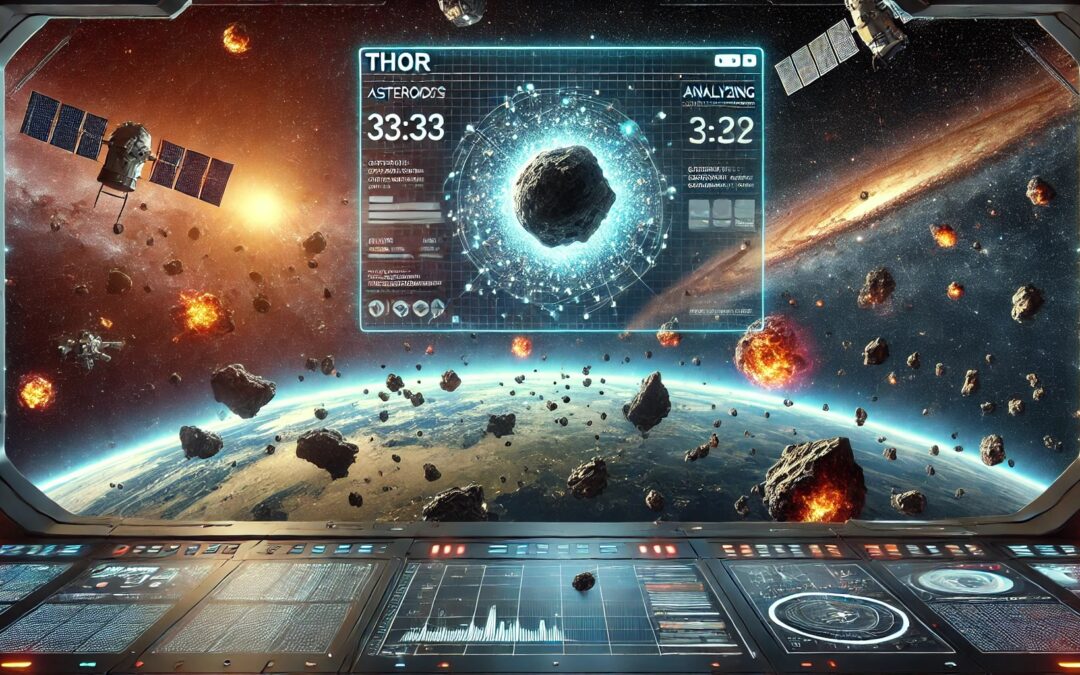
A gigantic asteroid is likely traveling at thousands of kilometers per hour, straight towards Earth. Although it seems like something out of a science fiction movie, the possibility of a catastrophic impact has always worried humanity.
Fortunately, we are not helpless. Thanks to the combination of scientific and technological advances, we have developed tools capable of anticipating these events with astonishing precision.
Among them stands out THOR, a revolutionary artificial intelligence designed to track asteroids that could represent a risk to our planet.
THOR not only identifies and classifies asteroids, but is able to predict their trajectories with data obtained from multiple sources. Get to know him and discover how he is helping to protect us from deep space.
What is THOR?
THOR, whose full name is Tracklet-less Heliocentric Orbit Recovery, is an artificial intelligence designed to detect and track asteroids that could pose a threat to Earth.
This innovative project was developed by the B612 Foundation, an organization dedicated to protecting the planet from asteroid impacts, with the support of former NASA astronaut Ed Lu.
THOR’s mission is to identify asteroids close to our planet and calculate their trajectories with great precision. This AI analyzes historical and current data, connecting points of light captured by telescopes that identify previously unknown asteroids.
The system is based on the ADAM platform, a cloud infrastructure that combines the processing and storage power of tools such as Google Compute Engine and Google Cloud.
How does THOR work?
THOR’s operation is based on an advanced machine learning model combined with a unique ability to process massive data from multiple sources.
The core of the system is on the ADAM platform (Asteroid Discovery Analysis and Mapping), an open source tool hosted on the Google Cloud and Google Compute Engine infrastructure.
Thanks to this computational power, THOR can analyze large quantities of images captured by telescopes around the world, even those archived for years.
Its magic is in linking seemingly unconnected observations. For example, it identifies points of light in different images—taken on different nights or by different telescopes—and connects them to recognize them as the same moving object: an asteroid.
Once identified, THOR uses complex calculations to plot the trajectories of these celestial bodies. Its machine learning capability means that each new data analyzed improves its accuracy, making it more effective over time.
Impact on astronomy and planetary defense
THOR’s ability to detect asteroids has made it possible to identify more than 27,500 space objects in just a few years, including more than 100 asteroids that previously went unnoticed by traditional agencies.
In astronomy,THOR has transformed the way asteroids are studied. Its approach allows maximizing the use of historical and current data, processing millions of light points into images of the sky.
Furthermore, its ability to link scattered observations has shown that telescopes do not need to track the same object continuously, a radical change in monitoring processes.
In terms of planetary defense, THOR’s impact is crucial. By predicting the trajectories of near-Earth asteroids with great precision, it becomes a key tool for anticipating possible threats.
How does THOR present itself for the future?
Currently THOR has established itself as a key tool for identifying near-Earth asteroids, but its capacity for growth and learning positions it as an essential pillar in space monitoring in the coming years.
As more next-generation telescopes, such as the Vera C. Rubin Observatory, begin operating, THOR will be able to analyze even greater volumes of information in greater detail.
For example, THOR could work together with space probes to study asteroids in real time, supporting both planetary defense and scientific research.
In a more ambitious scenario, this technology could be integrated into global early warning systems, allowing faster responses to possible threats.
Who can access THOR?
One of the most notable features of THOR is its accessibility. Designed as an open source system, any institution, researcher or astronomy enthusiast can use it to study asteroids and their trajectories.
This makes it a democratic tool that transcends the limits of large space agencies, allowing universities, small observatories and independent scientists to contribute to planetary knowledge and defense.
The ADAM platform, which underpins THOR, is hosted on Google Cloud infrastructure, making it easy to use anywhere in the world with internet access.
In addition, the B612 Foundation, responsible for its development, encourages international collaboration, inviting scientific and technological communities to participate in improving the system.
Importance of this type of AIs
Artificial intelligence, represented by systems like THOR, is redefining our ability to confront global challenges.
In the case of planetary defense, these technologies give us advanced tools to detect and track potential threats, such as near-Earth asteroids, with a precision that previously seemed unattainable.
Beyond protecting us from catastrophic events, these AIs also expand the scope of human knowledge, allowing scientists and hobbyists to access data and collaborate on astronomical research.
Its ability to analyze large volumes of information in real time not only accelerates the discovery of asteroids, but also lays the foundation for future innovations in space exploration.
In a world where threats can be unpredictable, the application of technologies like THOR not only ensures our safety, but also reminds us of the power of human ingenuity to protect and explore our universe.
This post is also available in: