
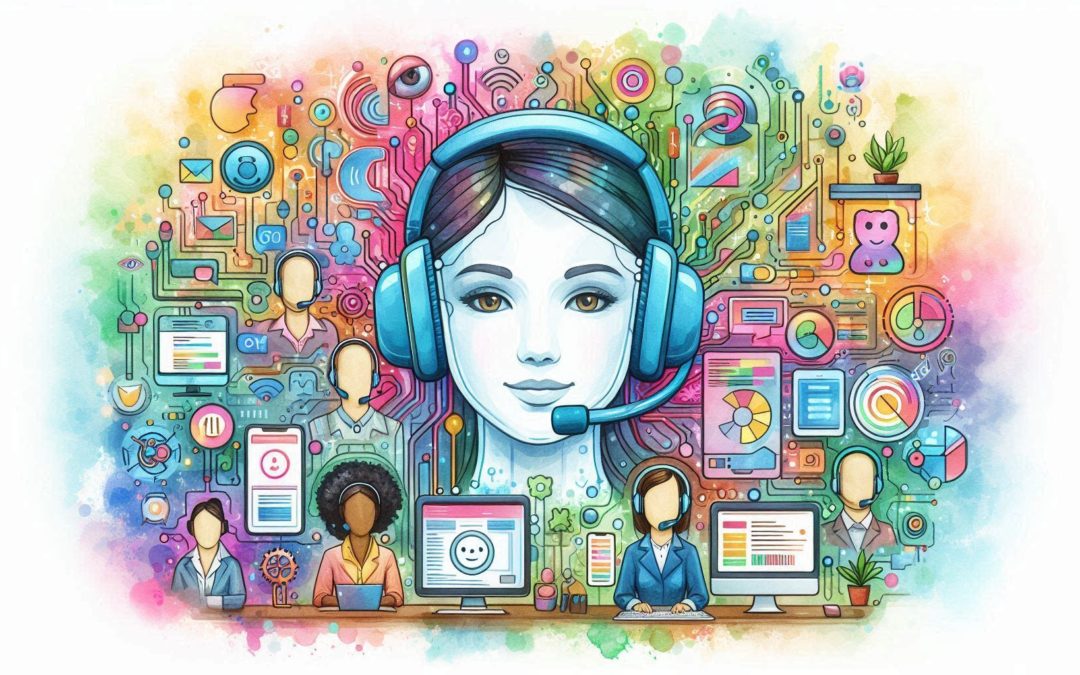
Artificial intelligence (AI) has emerged as a transformative force in the field of customer service. From humble beginnings as simple automated response programs to today’s sophisticated chatbots, AI has come a long way.
Traditional customer service, characterized by long waits and endless phone menus, is giving way to modern methods powered by AI.
At this crucial time, it is appropriate to review the current state of these technologies, focusing on chatbots and how they can change the way call centers of the future will operate (and whether they will still exist).
Chatbots, from text to voice in real time
Modern chatbots are powered by advanced technologies such as natural language processing (NLP) and machine learning. NLP allows chatbots to understand and generate human language, facilitating more natural interactions.
On the other hand, machine learning continually improves chatbot responses by incorporating data and previous experiences. This ability to learn and adapt is what distinguishes today’s chatbots from previous generations.
Chatbots without having to write code
Chatbots integrated into messaging platforms such as Facebook, Whatsapp, Slack and Telegram have seen a significant increase in popularity due to their versatility and ease of integration into organizations.
Currently there are numerous options to customize a chatbot according to the specific needs of each business, without requiring programming knowledge. Notable examples include platforms like Simplified, collect.chat, and Flow XO (among others) that offer ready-made solutions to quickly deploy and adapt.
Instant resolution of simple problems
In the retail sector, chatbots assist in sales advice, recommending products based on customer preferences. In the financial realm, these help users manage accounts, check balances, and make simple transactions.
In the telecommunications sector, chatbots resolve frequently asked questions and provide basic technical support, reducing the workload of human agents.
Chatbots and social networks, a virtuous synergy
A growing trend is the use of chatbots as virtual assistants that actively monitor social media, identifying mentions and instantly responding to comments and messages.
These responses are designed to adapt to the context, encouraging interaction with potential customers and improving the quality of customer service.
Thanks to detailed analysis of data and user preferences, chatbots can also offer personalized marketing content within social platforms.
This segmentation ability increases the relevance of messages, which translates into higher interaction and conversion rates.
All of this automation frees up valuable resources for marketing teams, allowing them to focus on broader, deeper strategies.
Voice Chatbots: The natural evolution of call centers
The launch of the ChatGPT-4o model by OpenAI has been a notable event, especially for the introduction of an AI voice reminiscent of Scarlett Johansson’s character in the movie “Her”.
In its demo, the chatbot not only engaged in more natural conversations, but also showcased its singing ability.
What is truly revolutionary about this model lies not only in its ability to manage complex queries, but in its ability to interact naturally and with “authentic” emotional expressiveness.
The potential benefits, if it were to be used on a large scale, seem clear and compelling: greater customer satisfaction, a notable cost reduction and a decisive competitive advantage.
Unfortunately, OpenAI continues to refine its innovative voice functionality, which is anticipated to be available by mid-fall. Meanwhile, we can review a couple of platforms specialized in the development of voice chatbots that are already established in the market.
Alexa for business: Amazon Lex
Amazon Lex is an AWS service designed to build conversational interfaces using voice and text, similar to the engine that powers Amazon Alexa.
It is a powerful tool that allows companies to develop advanced voice assistants to manage various functions that a call center would traditionally handle. These are some ways Amazon Lex can be used to replace a call center.
- Interaction Automation: Users can interact with the voice assistant naturally, asking questions and receiving relevant answers without the need to speak with a human agent.
- Query Management and Support: Voice assistants built with Amazon Lex can manage common customer queries, providing information about products, services, company policies, etc.
- Scalability and availability: Amazon Lex-based voice assistants can be available 24/7. Plus, they automatically scale to handle demand spikes without the need for manual intervention.
- Personalization and context: Amazon Lex allows you to create personalized experiences based on the context of the conversation. You can remember the history of past interactions and adapt your responses accordingly, improving the customer experience.
Amazon Lex easily integrates with other AWS services such as Lambda, Cognito, DynamoDB, and more. This makes it easy to connect the voice assistant to databases and business systems, allowing responses based on up-to-date and accurate data.
Dialogflow, Google’s AI applied to conversations with customers
Dialogflow is a platform developed by Google and designed to build chatbots, voice assistants, and other interactive agents using NLP and machine learning.
This platform understands text or voice conversations and can automatically translate into more than 30 languages. Dialogflow key features include:
- Multiple languages: Dialogflow uses NLP to understand and process conversations in multiple languages, allowing virtual agents to handle complex interactions with precision.
- Conversational flow design tools: The platform allows you to create sophisticated conversation flows without the need for deep technical knowledge.
- Analytics and optimization: Dialogflow provides analytical tools to monitor and optimize interactions, helping companies continually improve efficiency and customer satisfaction.
- Omnichannel compatibility: Dialogflow is flexible and compatible with multiple platforms, including mobile devices, web and smart displays, allowing seamless interaction across various channels and devices.
Comparison between Amazon Lex and Google Dialogflow
Amazon Lex is optimized to integrate with the Alexa environment and AWS services, making it ideal for organizations that already use these technologies.
On the other hand, Dialogflow excels in omnichannel flexibility and the ability to support more platforms natively, including Google tools.
The choice between Amazon Lex and Dialogflow depends on your existing infrastructure. Companies that already use Google tools can find Dialogflow a more comprehensive and easy-to-implement solution.
On the other hand, those who are deeply integrated with the AWS ecosystem may prefer Amazon Lex for its compatibility and ease of use.
Impatient customers require automated solutions
In a world where instant gratification has become the norm, customer patience is an increasingly scarce resource. The digital age has accelerated our expectations for service, and with it, tolerance for waiting has decreased dramatically.
Modern customers, with a multitude of options and the ability to switch providers in just a few taps, demand quick responses and efficient solutions.
Companies that don’t adopt the automated solutions we’ve talked about risk being left behind. Impatient customers will not hesitate to look for alternatives that value their time and provide them with the answers they seek immediately.
Therefore, implementing automated responses (using chatbots and AI) is not just a matter of technology, but an essential strategy to retain customers and ensure long-term viability in today’s market.
This post is also available in: