
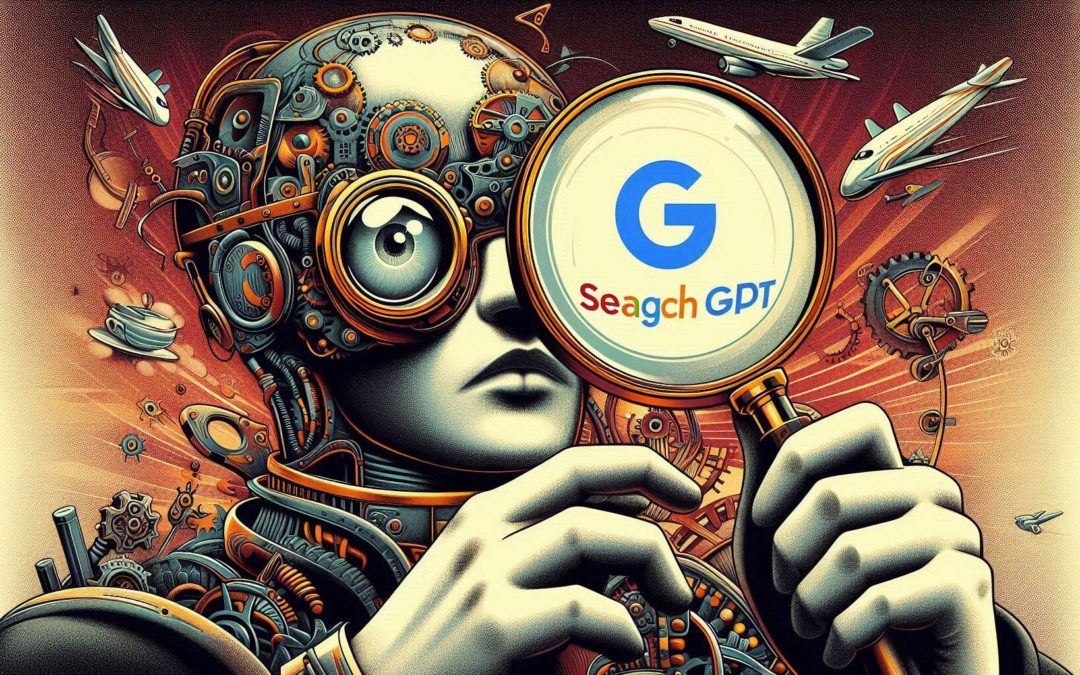
Almost by surprise, OpenAI has launched SearchGPT, an innovative search tool that promises to transform the way users interact with information on the web. This is a clear challenge to Google’s hegemony and the rise of Perplexity.
This advancement marks an important milestone in the development of search technologies powered by artificial intelligence (AI) and poses new challenges and opportunities in a field that is constantly evolving.
Although it is only available to a limited group of users for now, let’s explore what’s new in this new product from OpenAI’s AI infrastructure.
What does SearchGPT offer?
SearchGPT introduces advanced conversational search functionality that allows users to interact with the search engine more fluidly and naturally.
Instead of simply providing a list of links, SearchGPT understands the context of the query and offers detailed answers in a conversational format.
This significantly improves the user experience by making it more intuitive and less dependent on traditional link navigation.
Real-time data integration
One of the distinctive features of SearchGPT is its ability to integrate state-of-the-art language models with real, up-to-date data.
Using cutting-edge technology, SearchGPT not only responds to queries with relevant information, but can also access data in real time, providing more accurate and up-to-date answers.
Multi-step reasoning
OpenAI’s new search system has improved its ability to handle complex and multistep reasoning.
This means that SearchGPT can break down complicated queries into simpler steps and process the information in a way that provides more complete and detailed answers.
This skill is particularly useful for queries that require analysis and synthesis of multiple sources of information.
Optimized user interface
According to what they have been able to test it, SearchGPT presents an optimized user interface that facilitates interaction with the search engine.
The new interface is designed to be more accessible and friendly, allowing users to get quick and accurate answers without having to go through a series of complicated steps.
In addition, the interface includes customization options that allow you to adjust the type of responses received according to the user’s preferences.
How to test OpenAI’s SearchGPT?
In its initial phase, SearchGPT is available only to a select group of 10,000 users who are helping OpenAI test the new technology. These users have received direct invitations from the company.
During this phase, lucky participants get the opportunity to experiment with SearchGPT and share their feedback. This feedback is crucial so OpenAI can make adjustments and improvements before the tool is made available to the general public.
After completing this testing phase, SearchGPT is expected to become accessible to a broader audience. OpenAI may offer access through ChatGPT Plus subscription or other options that are still in development.
SearchGPT and its direct competition
Google, the undisputed leader in the field of web search, has been working on integrating AI into its platform for years. In 2023, the company launched the Search Generative Experience, a tool that uses language models to generate responses in conversational format.
However, the implementation has been gradual and has faced several challenges, such as the accuracy of the responses generated and content quality management.
Recently, Google has started integrating ads into AI-generated results, which could affect how users interact with results. Although the company continues to dominate the search market, competition is intensifying as other technologies emerge.
Perplexity and the new search startups
Perplexity has been a notable startup in the field of AI-powered search. Its focus is on providing direct and detailed answers to user queries.
In early July 2024, Perplexity enhanced its Pro Search, integrating the Wolfram|Alpha engine to deliver greater multistep reasoning capabilities and deeper results.
Perplexity has also integrated advanced conversational search features, allowing it to compete more effectively with Google. Despite its progress, the company faces challenges related to managing the costs associated with AI technology.
In addition to Google and Perplexity, other startups like Andi are emerging in the AI-powered search space.
These companies are designed to provide AI-generated responses instead of traditional link lists. Although the adoption of these new technologies has been slow, their potential to transform web search is considerable.
The war for the future of search
OpenAI’s launch of SearchGPT marks a significant step forward in the evolution of AI-powered search engines.
With innovative features like advanced conversational search and handling complex reasoning, SearchGPT has the potential to redefine the way we interact with information on the web.
However, competition in the search domain remains intense, with Google and other emerging startups offering alternative solutions. As technology continues to evolve, it will be interesting to see how these innovations will shape the search landscape for years to come.
This post is also available in: