
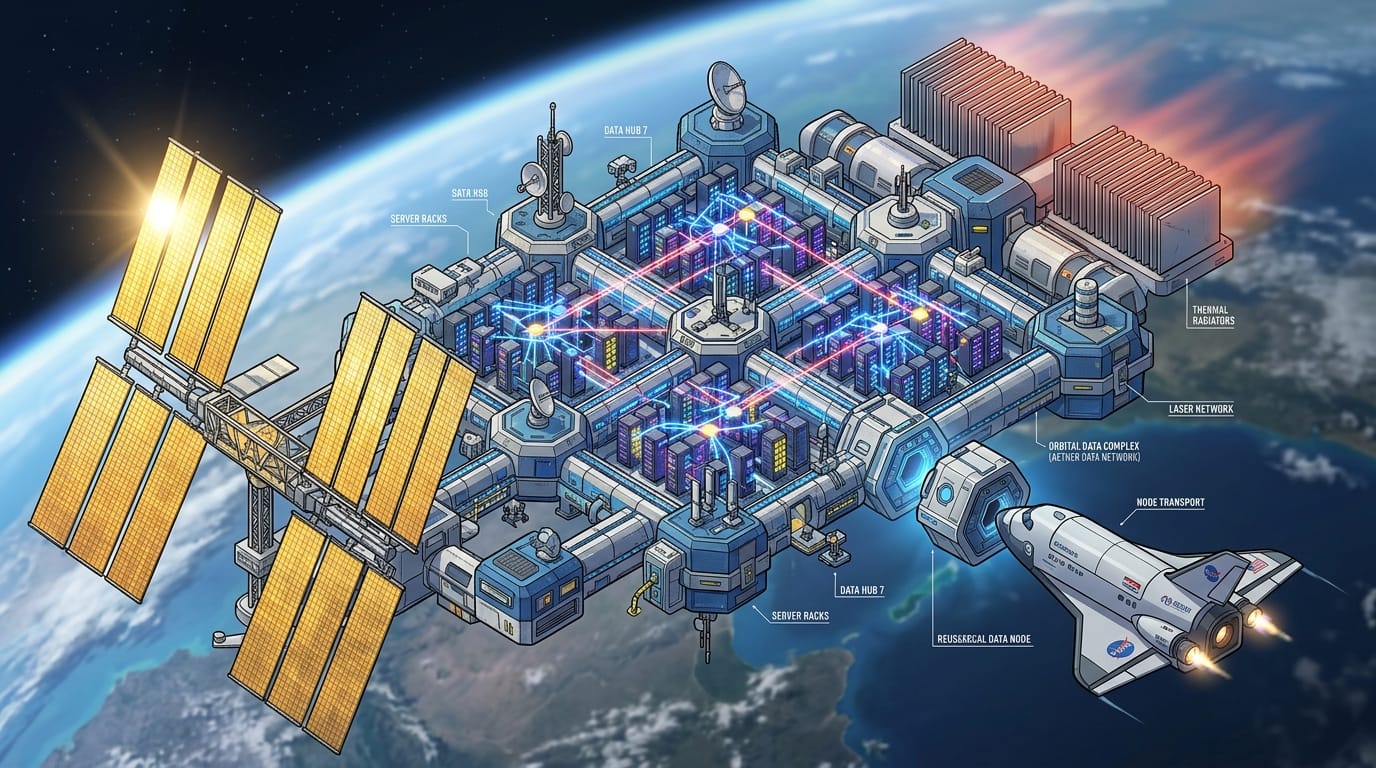
Have you stopped to look at the stars and felt that the future is up there? For decades, space was the scene of our dreams and exploration missions, but today it is becoming the “lifeline” of our digital lives. **
As you read this, the Artificial Intelligence that fascinates us so much is at the limit of its strength on Earth. Energy consumption is voracious, water to cool servers is in short supply, and our power grids are under unprecedented pressure.
It’s not just a question of chips; it is a survival challenge for the planet. For this reason, giants like SpaceX, Google and Nvidia have stopped looking at the ground to look in Earth orbit for the infrastructure that allows us to continue innovating without depleting our home.
Orbital advantages: Infinite solar energy and radiation cooling
Surely you’ve asked yourself: why carry server racks thousands of kilometers high? The short answer is that the Earth is getting smaller and hotter.
On our planet, an average data center consumes millions of liters of water a year just to keep from melting. In the vacuum of space, the game changes completely.
By placing these infrastructures in sun-synchronous orbits, the satellites receive sunlight almost uninterruptedly, generating up to eight times more annual energy than any panel on the surface.
But the most fascinating thing is the thermal management. While down here we struggle with fans and air conditioning, in orbit heat is dissipated by thermal radiation.
It is a clean process that does not compete for vital resources such as fresh water or agricultural land. Basically, we are moving the AI “fever” to a place where extreme cold and constant sun work in our favor.
Three strategies for the same sky: SpaceX, Google and Nvidia
Not everyone looks at space with the same eyes. In this race, each giant has chosen a different route so that the digital infrastructure stops being terrestrial:
SpaceX: The commitment to massive scale
Elon Musk does not think about isolated satellites, but rather about constellations of up to a million interconnected nodes. Their competitive advantage is clear: they are the owners of “transportation.”
By dramatically reducing launch costs, SpaceX seeks to create a distributed computing network that will, within a few years, cheaper and more efficient than building any building on Earth.
Google: Validation and precision with “Suncatcher”
Unlike SpaceX’s aggressive scale, Google prefers scientific caution. With their Suncatcher project, they plan to launch prototypes in 2027 equipped with their own TPU chips (Tensor Processing Units).
Their approach is incremental: validate that the hardware we already use down here can survive extreme radiation before scaling up.
Nvidia: Intelligence at the “edge” of space
Nvidia doesn’t want to operate the satellites, it wants to be the brains inside them. With their Vera Rubin Space-1 platform, they are committed to space Edge Computing.
The idea is that the data is processed right there, in orbit, so that only useful information comes down to Earth, saving time and energy on unnecessary transmissions.
The challenge of latency and laser communications
You may be wondering if sending our data into space won’t make the internet desperately slow. It is a logical doubt: distance is usually the enemy of speed. **
However, the solution they are implementing does not depend on the underwater fiber optic cables that we are used to, but on light itself traveling through a vacuum.
Using laser optical links, these orbital data centers can communicate with each other at speeds of several terabits per second, eliminating much of the friction they would encounter in Earth’s atmosphere.
By combining this technology with direct processing in orbit, information does not have to make constant round trips for simple tasks.
Thus, spatial AI not only promises to be more sustainable, but aspires to compete in performance with terrestrial facilities, making this enormous physical distance, thanks to the physics of light, practically imperceptible to your digital daily life.
Critical challenges: Space debris, regulation and astronomy
Launching thousands of servers into space raises dilemmas that we are only beginning to solve. The most obvious is space junk: what happens when a node in these constellations reaches its useful life or fails?
Congestion in low orbit is a real concern that has already generated friction, such as Amazon’s petition to the FCC to stop SpaceX’s plans, alleging that they could speculatively saturate the satellite environment.
Also, there is the impact on science. Astronomers warn that this “swarm” of digital infrastructure could forever alter our view of the night sky, making it difficult to observe the universe.
We also cannot forget the vulnerability of the hardware; Although Google’s chips seem to hold up well, the constant bombardment of radiation and micrometeorites requires an extreme modular architecture.
If something breaks up there, there is no technician who can come and fix it, forcing us to rethink security and resilience from a whole new perspective.
Beyond Earth: The new home of our digital mind
We are facing the beginning of an invisible but profound migration. Data centers in space are not just an engineering feat, but the necessary response to a planet that can no longer sustain the weight of our digital ambition alone.
By moving AI processing to orbit, we not only free up critical ground resources, we usher in an era of truly global and autonomous infrastructure.
The success of this bet will depend on our ability to balance innovation with space ethics, ensuring that, by looking for solutions in the stars, we do not end up darkening our own sky.
The future is no longer under our feet, but above our heads.
This post is also available in: