
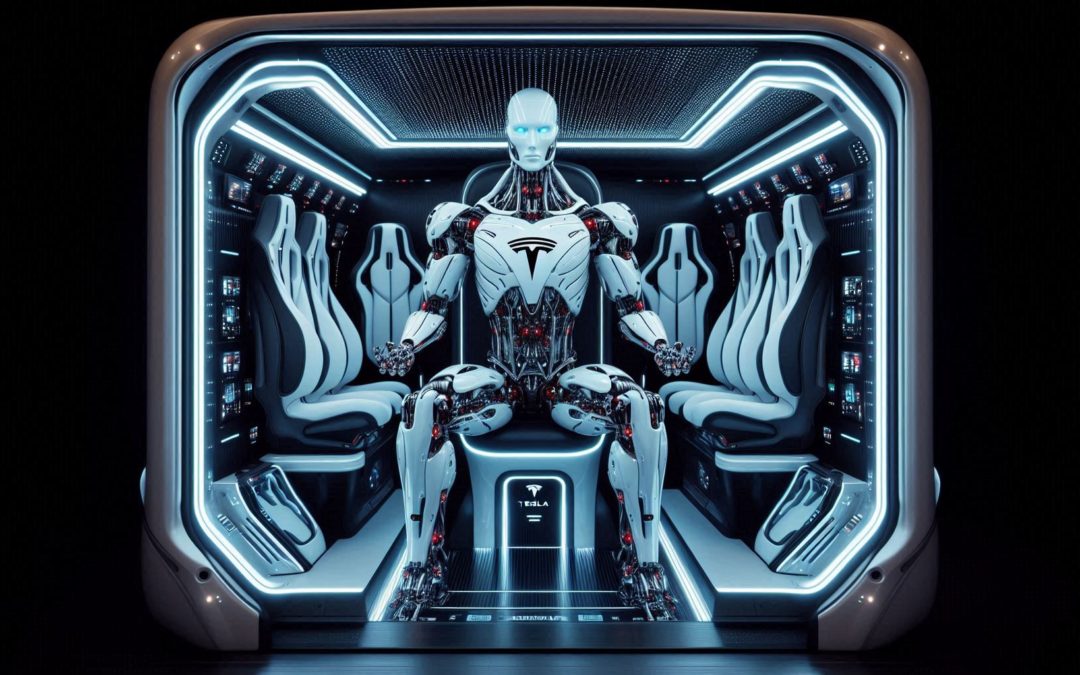
The recent Tesla event, known as “We, Robot”, generated great expectations about the technological innovations that Elon Musk’s company was going to present.
Held at the Warner Bros. studios in Hollywood, the event promised to showcase significant advances in the field of artificial intelligence (AI), especially with the introduction of the robotaxi and Optimus humanoid robots.
However, despite the initial enthusiasm, the event left many with a feeling of disappointment, both due to the lack of technical details and the nature of the demonstrations, which seemed more geared towards spectacle than a true display of technological progress.
Below, you’ll learn key aspects of the event, attendees’ reactions, and the impact on Tesla stock. But as a “spoiler”: it was not as good as Elon Musk would have wanted.
The Robotaxi: An uncertain future?
The robotaxi was, without a doubt, one of the most anticipated presentations. Musk had promised that autonomous driving and robotaxis services would be the next big step in Tesla’s evolution.
At the event, a functional prototype of the robotaxi was shown, which at first seemed like an important advance. In addition, the company surprised the public by presenting a “Robo-van”, a vehicle designed to function as a minibus or commercial vehicle.
However, despite these revelations, attendees and analysts were disappointed by the lack of details on how Tesla plans to deploy these vehicles on a commercial level.
Little data was provided on the current state of autonomous driving technology, nor was there any in-depth explanation of how Tesla plans to deal with regulatory challenges, which is crucial for the future of robotaxis.
Although Elon Musk offered some optimistic numbers, such as the estimate that eliminating the driver could reduce transportation costs by 60% to 80%, no concrete market projections or information on possible partnerships or financing plans to scale this service were provided.
In this sense, the event left more questions than answers, worrying both analysts and investors.
The Optimus robots: An advance that is more theatrical than real
Although the Robotaxi was the most anticipated, the real protagonist of the event was the humanoid robot Optimus.
Musk presented several units of these robots that apparently moved autonomously between attendees, serving drinks, playing rock-paper-scissors and performing other simple tasks.
They even went so far as to interact verbally with guests, something that initially seemed like an impressive achievement in the field of AI-powered robotics.
However, first impressions were soon tempered by the revelation that the robots were not acting completely autonomously.
Although it was suggested that these robots were powered by AI, it was confirmed that the Optimus were remotely operated by humans who, using special suits, controlled their movements.
In fact, one of the attendees recorded a robot operator admitting on video that they were still assisted by people and were not completely autonomous. This discovery was interpreted by some as a publicity stunt.
Josh Wolfe, co-founder of Lux Capital, commented that although the use of technology to teleoperate robots was impressive, it was dishonest to present it as if the robots acted independently.
Others, such as content creator Jeremy Judkins, expressed disappointment at Tesla’s lack of transparency in this regard, highlighting that the company did not make it clear that the robots were controlled by humans, which caused confusion among the public.
The impact on Tesla shares
The lack of technical details and the theatrical nature of the event not only drew criticism from attendees, but also had a negative impact on Tesla stock.
After the event, the company’s shares fell 8.8%, which marked one of Tesla’s worst trading days after a major event in recent years.
The drop was more than nine percentage points higher than the performance of the S&P 500 index on the same day, reflecting the level of disappointment among investors.
Analysts such as Gary Black, co-founder of Future Fund Active ETF and a Tesla shareholder, noted that Musk did not offer enough explanation about how Tesla plans to move from supervised driver assistance systems to true unsupervised autonomy.
Furthermore, although the presentation of the robotaxi and the Robo-van attracted some attention, the lack of a clear plan for their commercial implementation left many feeling that the event did not meet expectations.
Despite everything, some analysts, such as John Murphy of BofA, maintained a somewhat more optimistic stance, suggesting that Tesla may need additional capital to finance the development and large-scale production of robotaxis and robots.
However, this type of speculation only reinforces the idea that the event left many unknowns unresolved.
An event that did not convince
Tesla’s “We, Robot” event had the potential to be a watershed moment for the company, especially in its foray into robotics and artificial intelligence.
Although Tesla’s advances in robotics are undeniable, the lack of transparency and the absence of a clear plan to implement its innovations raised doubts among the public and investors.
Investors and the public alike expect real progress. Although Elon Musk remains a key figure in technology, his vision of the future must be backed by concrete facts to maintain market confidence.
In short, the event showed more potential than tangible progress, and that wasn’t enough for many.
This post is also available in: