
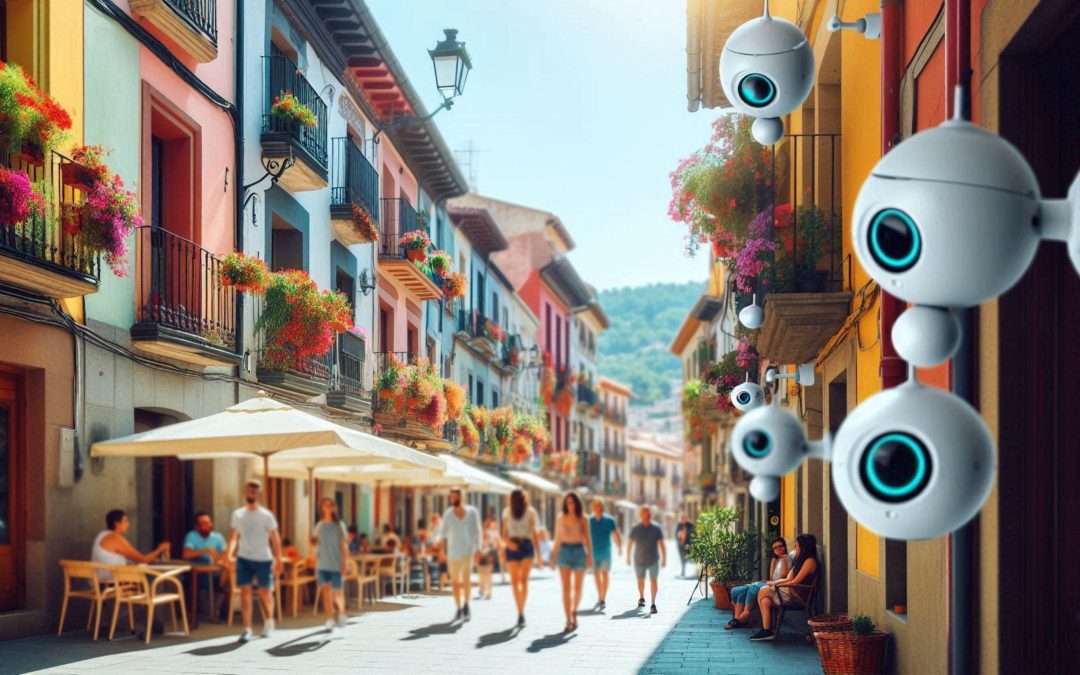
The video surveillance of the future is here, and artificial intelligence (AI) plays a crucial role in this technological revolution.
AI surveillance cameras not only provide clear and continuous images, but also offer a series of advanced functionalities that significantly improve security in both homes and businesses.
In this article, we will explore how these cameras work, where they are being installed in Spain and the limitations that exist for their use. In addition, we will tell you how to choose the best AI camera for home use, so you can join this trend.
How do AI surveillance cameras work?
Traditional surveillance cameras are already powerful tools for security, but by adding artificial intelligence (AI), they become even more sophisticated and effective devices. These are the features that distinguish AI cameras from traditional systems.
Threat detection and analysis
One of the main advantages of AI cameras is their ability to analyze images in real time. Without human intervention these cameras can automatically identify suspicious behavior and immediately alert owners or authorities.
For example, if a person approaches a specific area or if unusual movement is detected at a particular time, the camera can send an instant alert to the owner’s mobile or security control center. They can also detect fires by analyzing smoke columns.
Facial and object recognition
Another notable feature of AI cameras is their ability for facial and object recognition. These cameras can identify and track specific individuals, which is especially useful in environments such as airports, train stations, and mass events.
Additionally, they can recognize objects such as abandoned packages or weapons, and generate automatic alerts when they are detected. This not only improves security, but can also be used for data analysis.
Integration with other security systems
AI surveillance cameras can be easily integrated with other security systems, such as alarms, access controls, and building management systems.
This integration allows for a coordinated and more effective response to incidents. For example, if a camera detects an intruder, it can automatically activate security lights, lock doors, or send a signal to the police.
The ability to work in conjunction with other systems makes security more robust and efficient.
Reduction of false alarms
AI cameras are designed to differentiate between important events and false positives. This means they can ignore irrelevant movements, such as passing animals or changes in lighting conditions, and focus only on activities that actually require attention.
By applying AI, false alarms can be significantly reduced, improving the efficiency of the security system and reducing operating costs.
People counting and analysis of tourist flows
Cameras with Artificial Intelligence can incorporate people counting. This way, you can corroborate with numbers the areas with a large influx of tourists or the occupation of beaches, even making patterns by specific time slots or dates. In this same sense, it can help establish the route that tourists take through the city, the flows, establishing saturation schedules where appropriate.
Vehicle counting with Artificial Intelligence
From parking control to traffic analysis on urban roads can be carried out through the artificial intelligence of the cameras. These are solutions that many cities are implementing in their SmartCity plans.
Continuous improvement through machine learning
There are AI cameras that use machine learning algorithms (“Deep learning”) to continually improve their performance. As they collect more data, these systems can adjust and optimize their algorithms to increase accuracy and reduce errors.
This means that over time, cameras become smarter and more effective at detecting threats and reducing false alarms.
Where are AI cameras being installed in Spain?
The adoption of AI surveillance cameras is booming in Spain, covering both the residential and commercial sectors. Even many city councils, especially in large cities, are betting on this alternative to reduce surveillance costs and increase effectiveness.
AI cameras in public spaces
The DGT has installed 232 surveillance cameras with advanced technology to monitor traffic violations throughout the country. These AI cameras can automatically identify vehicles that exceed the permitted speed or commit other violations, sending alerts to the appropriate authorities.
In Madrid, 56 cameras with AI have been installed to manage traffic. These cameras not only help control traffic flow, but can also detect violations and improve road safety.
Barcelona has adopted a similar system to manage bus lanes. AI cameras in this city allow for more efficient monitoring of public transport, ensuring that dedicated bus lanes are used correctly.
During the April Fair, Seville deployed 30 state-of-the-art cameras to improve security. These AI cameras were able to identify suspicious behavior and alert authorities in real time.
In Granada, a video surveillance system developed by Innovasur uses AI cameras to detect and alert about graffiti on official buildings.
AI cameras in business
From retail stores that want to prevent theft to large factories that need to monitor large areas, AI-enabled cameras are becoming an essential tool for security management.
Thousands of supermarkets in Spain already have smart cameras. These cameras not only improve security, but can also analyze customer behavior to optimize product layout and improve the shopping experience.
Home AI cameras
More and more homeowners are installing these systems to protect their properties.
AI cameras not only provide security against theft, but also offer additional functions such as monitoring children and the elderly, ensuring that family members are always safe.
Are there limitations when installing AI cameras in Spain?
The implementation of these cameras has generated some controversies, especially regarding privacy. For example, in León, ALSA workers protested against the installation of cameras with advanced technology in the station and on buses, arguing that they violate their privacy.
With the imminent entry into force of the new Artificial Intelligence Law, clear guidelines have been established for the legal use of these cameras, ensuring that citizens’ privacy rights are respected.
The ability of AI cameras to recognize faces and analyze behaviors can be seen as an invasion of privacy. Manufacturers usually modify the software to adapt to each regulatory framework, so some functions may not be available in Spain.
It is crucial that systems are used ethically and in accordance with applicable data protection laws, such as the European Union’s General Data Protection Regulation (GDPR).
How to install an AI camera at home?
Installing an AI surveillance camera at home may seem complicated, but with the right product, it is a simple and accessible process. TP-Link Tapo Cameras with AI are a great option for those who want to introduce and try an AI camera in their home without spending a lot. We have tried it and we liked how it works.
From less than 100 euros, these cameras can identify and follow people who move within their field of vision, in addition to detecting the activity of pets, sending immediate alerts. It can also recognize vehicles, which is useful if you have a garage or driveway that you want to keep an eye on.
The Tapo C125 can identify packages left at your door, alerting you when deliveries arrive. And also detect loud or unusual sounds, such as a baby crying or the sound of breaking glass, and send you alerts so you can take action quickly.
Other features include night vision and two-way audio (it has a built-in microphone and speaker). Finally, videos recorded with the camera can be stored on a microSD card of up to 512 GB, without having to pay any subscription.
Installation is very simple and is done following the instructions in the Tapo app (available for Android and iOS). Another great advantage is that the use of AI in its cameras is not associated with any monthly subscription.
Are AI cameras really the future of surveillance?
AI cameras represent a significant advancement in surveillance technology. Their ability to analyze images in real time, recognize faces and objects, and differentiate between important events and false positives makes them extremely effective.
However, increasing regulation and privacy concerns pose significant challenges to the widespread adoption of AI cameras.
In many countries, including Spain, stricter laws on the use of surveillance technologies are being implemented to protect the privacy of citizens.
These regulations may limit where and how AI cameras can be used. In addition, there is a risk of abuse or misuse of these technologies, which could lead to greater surveillance and control over the population.
This post is also available in: