
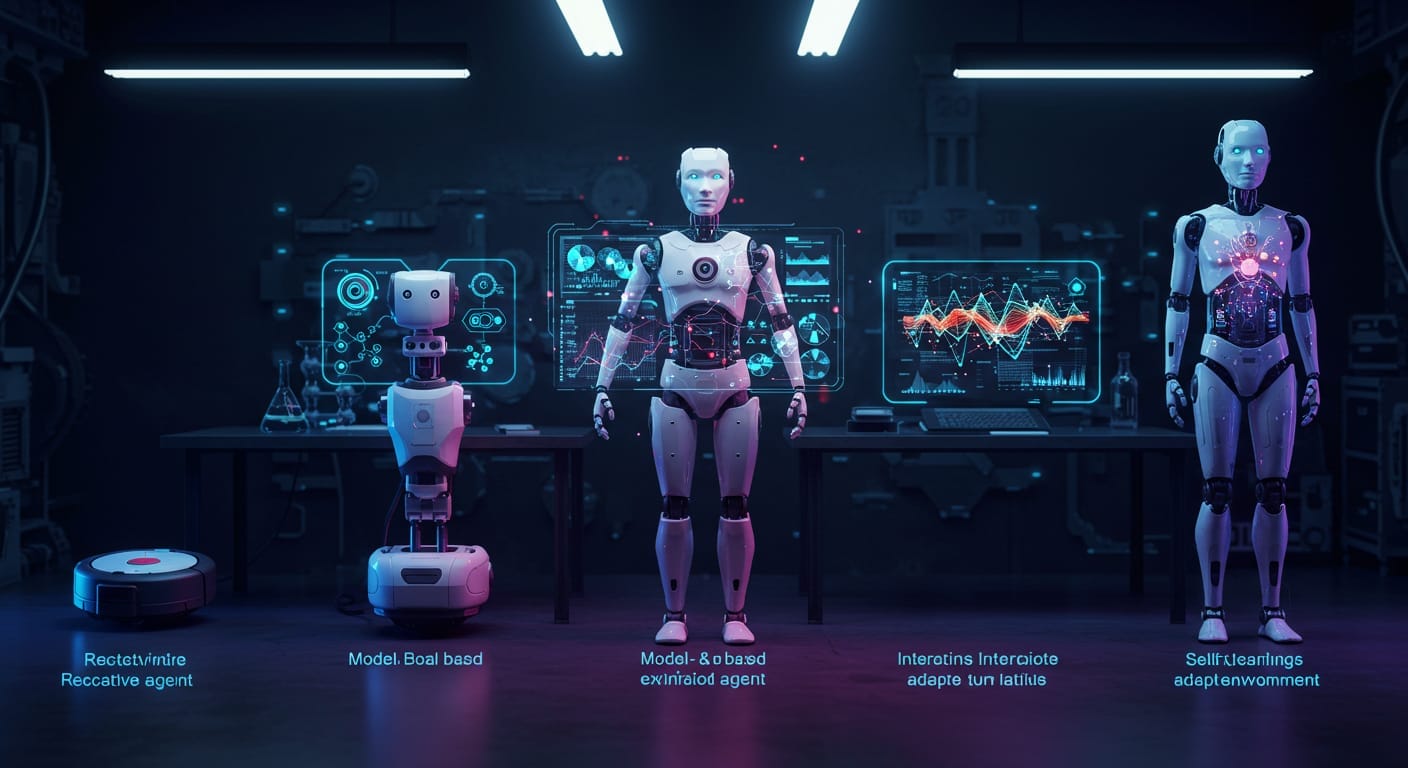
Artificial intelligence (AI) agents are autonomous entities that perceive their environment (whether physical or virtual) through sensors and act on it through actuators to achieve specific objectives.
In a physical agent, the sensors can be cameras, microphones or proximity detectors, and the actuators, motors or speakers. In a software agent, sensors are input data (such as text, clicks, or activity logs) and actuators are their outputs (responses, recommendations, or actions in a system).
A common mistake when starting out in this field is confusing the term operator with a type of agent. In reality, an operator is an elementary action that an agent performs, such as “open a door”, “move left” or “send a message”. They are the basic blocks with which agents build more complex behaviors.
With this clear foundation, we can explore the classification of agents proposed by Russell and Norvig, which ranges from simple systems to others capable of reasoning, planning and learning from experience.
Simple reactive agents
They are the most basic. They follow rules like “if X happens, do Y.” They lack memory and do not consider future consequences: they react only to what they perceive at the moment.
How they work: using predefined condition-action rules.
What they are for: simple tasks in fully observable environments.
Real example: a thermostat that turns on the heating when the temperature drops below a threshold, or a robot vacuum cleaner that recoils when it hits an obstacle.
Model-based reactive agents
They are a key improvement: they maintain an internal model of the environment. This allows them to act even when not all information is immediately observable.
How they work: they update an internal state based on past and present perceptions.
What they are for: tasks in partially observable environments.
Real example: an advanced Roomba vacuum cleaner that builds a map of the room, remembers areas already cleaned, and locates obstacles.
##Goal-based agents
These agents don’t just react: they plan. They evaluate different sequences of actions to achieve a specific objective.
How they work: they apply search and planning algorithms.
What they are for: problems that require finding routes or strategies.
Real example: applications like Google Maps or Waze. Your goal is to get home, and the agent calculates the best route considering traffic, distances and closures. If conditions change, recalculate the plan.
Utility-based agents
They go one step further: they not only seek to achieve a goal, but do it in the best possible way. They use a utility function that measures the quality of the result, balancing factors such as risk, cost or time.
How they work: they compare alternatives based on their expected utility.
What they are for: Complex decisions with multiple variables.
Real example: an autonomous car. It’s not enough to reach your destination: you must do so while maximizing safety, comfort, energy efficiency and speed.
Learning agents
They are the most advanced: they improve with experience. They incorporate a learning mechanism that analyzes the results of their actions and adjusts their future behavior. This is the type of AI agents with the most development these days.
How they work: they apply machine learning and reinforcement learning techniques.
What they are for: dynamic and changing environments.
Real example: Netflix or Spotify recommendation systems, which learn from your habits to suggest content that is increasingly tailored to your tastes.
The future: emerging agents
Beyond this classification, the evolution of AI shows us new trends:
- Agents based on language models (LLM): such as ChatGPT with tools or plugins, capable of reasoning and adapting to multiple tasks.
- Multi-agent systems: where different agents collaborate or compete, as in Waymo’s traffic simulations to train autonomous vehicles.
These developments reflect a clear path: from simple reaction to continuous adaptation and complex reasoning.
AI agents, in all their forms, show how a set of rules, objectives and learning can be transformed into systems capable of tackling everything from routine tasks to open and changing problems.
Understanding its types (and the role traders play as fundamental stocks) is the first step in exploring the future of artificial intelligence and its real-world applications.
This post is also available in: