
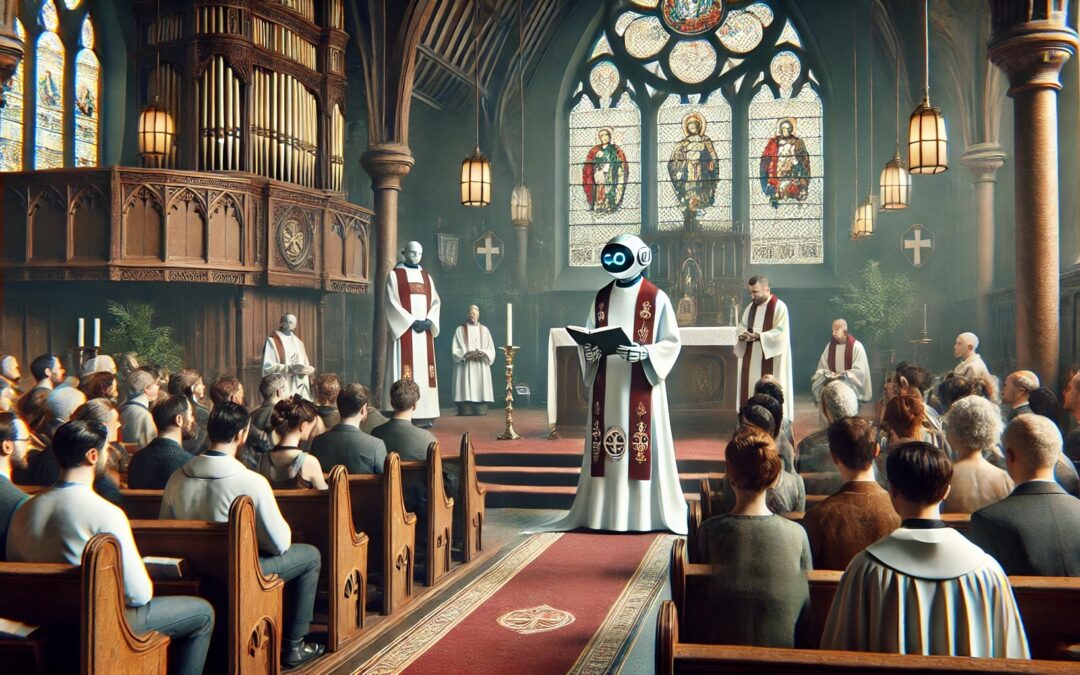
Without a doubt, Artificial Intelligence (AI) has found a privileged place in the daily lives of many people. From virtual assistants to chatbots, AI has become a ubiquitous tool that offers quick solutions.
However, in the midst of this technological fascination, an intriguing question arises: why do many people turn to AI as if it were some kind of religion?
This phenomenon becomes even more interesting when we observe atheist individuals, they have left behind traditional beliefs, only to place their trust in algorithms and machines.
Through their interactions with AI, they seek answers, guidance and comfort in an uncertain world. Learn the reasons behind this emotional and existential dependence, as well as the parallels between faith in AI and religious beliefs.
Public perception of AI as a solution to complex problems
As AI technologies have become more sophisticated and accessible, many people see them as tools that can solve everything from simple everyday tasks to life challenges.
This phenomenon has led to a kind of veneration towards AI, where it is expected to act as an infallible guide in times of uncertainty.
Instead of turning to friends, family, or authority figures for advice, many people turn to AI systems, relying on their objectivity and logic to make important decisions.
The feeling that AI can unravel the mysteries of life, solve emotional problems or even foresee the future is similar to religious faith, where answers to existential questions are sought.
AI parallels with religion
Both religion and AI offer answers to existential questions that overwhelm us. Just as traditional religions provide comfort in times of doubt, many are turning to AI for solutions to difficult decisions.
The idea that a machine can provide clear and direct answers is similar to the search for divine wisdom in sacred texts.
Users of AI tools often form online groups where they share experiences, discuss strategies, and validate each other’s reliance on these technologies.
Faith in AI also reflects a projection of hope in technology as a savior, a concept similar to the hope for redemption in many religious traditions. **
This dependence can lead to an almost religious veneration of machines, where AI is expected to not only solve problems but also offer a sense of purpose and meaning.
Why are many atheists prone to this inclination towards AI?
For those who have abandoned traditional religious beliefs, the search for answers to existential questions does not disappear; it simply transforms.
In this context, AI is presented as an attractive alternative that promises logical and data-driven solutions, eliminating the ambiguity and dogma that are often associated with religions.
Furthermore, atheists tend to value rationality and empirical evidence, principles that AI embodies through its operation. AI’s ability to process information may be more reliable than metaphysical explanations.
In a world that often feels devoid of transcendent purpose, interacting with AI can offer a sense of accompaniment and understanding, similar to what many find in religious communities.
Is this dependence on AIs healthy?
On the one hand, AI can offer quick and efficient solutions to everyday problems, making the lives of many people easier. However, this dependency can also be detrimental if it becomes the only source of guidance.
When people begin to prioritize machine responses over human advice, they risk eroding interpersonal relationships and the development of critical decision-making skills.
Furthermore, blind trust in AI can lead to misinformation and the adoption of inherent biases in algorithms. The lack of critical thinking when accepting an AI’s responses can be fertile ground for manipulation.
It is also essential to consider the emotional impact of this dependency. If AI becomes a substitute for human connection, people may experience feelings of loneliness and alienation.
Maintaining a balanced relationship with AIs
The dependence on AI in everyday life raises the need to establish a balanced relationship with these technologies. While AI offers efficient solutions, we must remember that it cannot replace human connection or critical judgment.
Encouraging interaction with AI as a complementary tool, rather than a substitute, will allow us to reap its benefits without sacrificing our interpersonal relationships and decision-making skills.
In doing so, we can navigate a path that integrates technological innovation with our humanity, ensuring that AI remains an ally in our search for answers and not an object of devotion.
Maintaining this balance will not only enrich our lives, but will also protect the essence of our interactions and values.
This post is also available in: