
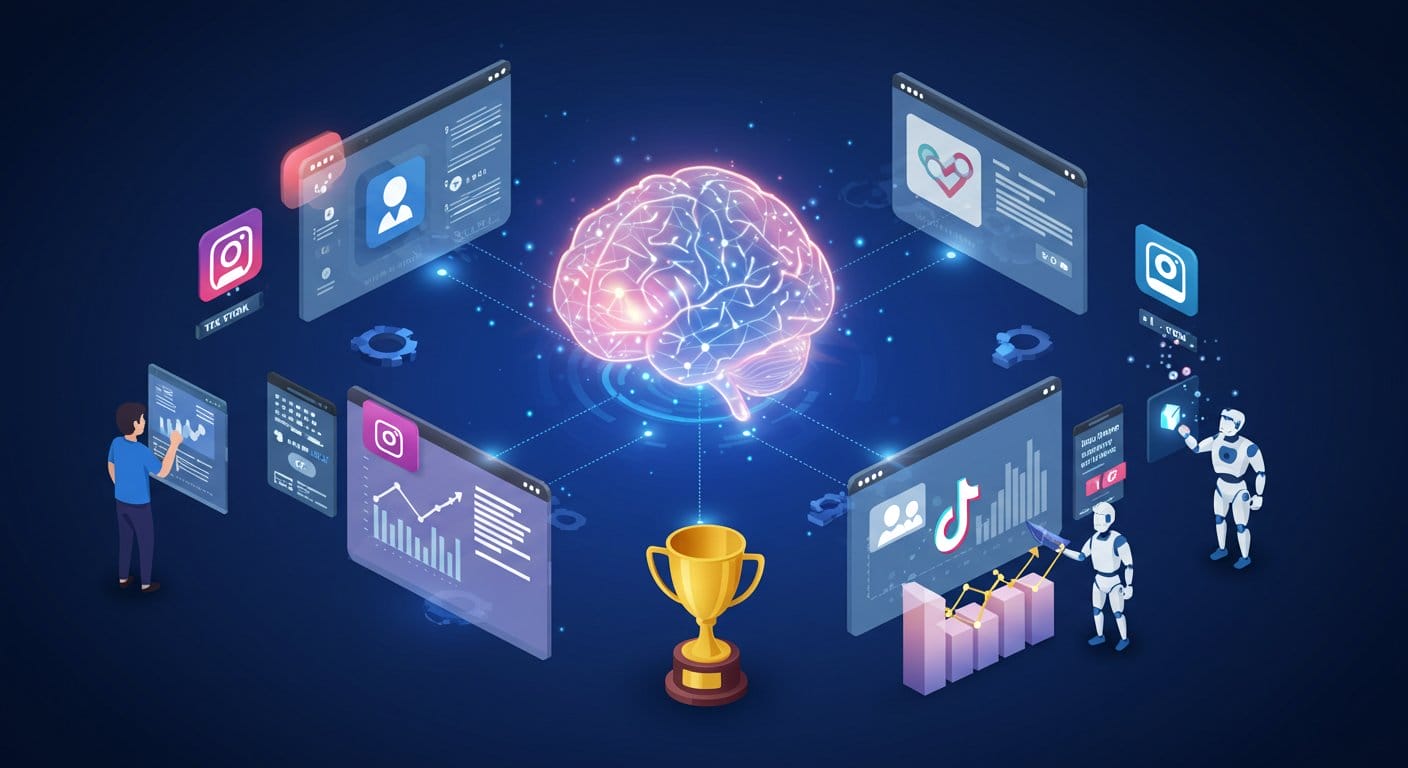
Artificial intelligence (AI) has gone from being a futuristic promise to becoming an essential tool in digital marketing. In 2025, its influence is redefining brands’ strategies, allowing them to personalize experiences, optimize campaigns and improve results in real time.
This article explores how AI is transforming the marketing landscape, with a special focus on real success stories that illustrate its impact on campaign planning, execution and analysis, particularly on social networks.
AI as the Heart of Digital Marketing
According to the Top Digital Trends 2025 report by IAB Spain, AI tops the list of technologies that are setting the course for the sector, especially in areas such as personalization, automation and data analysis.
Thanks to its ability to process large volumes of information in real time, brands can better understand their consumers, anticipate their needs and offer messages tailored to each individual.
But how does this materialize in practice? Through concrete examples, we will see how companies of different sizes and sectors are using AI to optimize their marketing strategies, with measurable results in their commercial objectives.
Generative AI in content creation
One of the most promising advances is the use of generative AI to produce content. This technology creates texts, images and videos automatically, reducing costs and accelerating creative processes.
Success Story: Panenka, ChatGPT and Midjourney
An interesting example comes from Panenka, a Spanish football magazine that leveraged artificial intelligence for a creative campaign on Book Day 2023: Which team would be the legends of our literature?
Using ChatGPT they created content that linked famous Spanish writers with soccer teams. For example, ChatGPT suggested that Cervantes would fit in with Real Madrid while Góngora would do the same for Atleti.
To execute the ideas they turned to Midjourney, a generative image AI, which created visual illustrations of these pairings. This material, shared on social networks, aroused notable interest among followers, generating debates and increasing the visibility of the brand.
The relevance of this example lies in its simplicity and how it shows that AI is not only for large corporations, but also for brands with limited resources looking to stand out in a competitive market.
The combination of ChatGPT and Midjourney allowed Panenka to produce an inventive and visually appealing campaign on a minimal budget, demonstrating that AI-powered creativity can generate impact without the need for large investments.
Large Scale Automation and Personalization
AI makes it possible to automate repetitive processes and personalize content on a scale that would be impossible manually, maximizing the impact of each interaction.
Success Story: ASOS and personalized advertising
ASOS, the well-known British fashion brand, is a benchmark in the use of AI for campaign execution. They implemented personalized ads on social networks based on the analysis of users’ purchase history and online behavior.
AI technology identified relevant products for each customer, resulting in a 300% increase in click-through rates and a 200% increase in conversions.
This case highlights how AI-powered personalization can transform the effectiveness of ads, making every euro invested go further.
Real-time data for strategic decisions
Analyzing results is essential to measure the success of a campaign and adjust course if necessary. Here, AI offers tools that provide detailed, real-time insights, allowing brands to be more agile and effective.
Success Story: Buzz Radar and IBM Watson
Buzz Radar, a company specializing in data analysis, turned to IBM Watson to evaluate the performance of social media campaigns in real time. The AI identified emerging trends and patterns, allowing its clients to adjust their strategies on the fly.
This approach not only improved results, but also saved millions of dollars by optimizing ROI. It is a clear example of how AI converts raw data into actionable strategic decisions and of Predictive AI in marketing.
Success Story: Sephora and Virtual Trials with AI
Sephora, the well-known beauty chain, has integrated AI and augmented reality in its strategy with the Sephora Virtual Artist. This tool allows users to try makeup virtually from their mobile, analyzing facial features to apply products such as lipsticks or shadows in real time.
Customers share these “looks” on social networks such as Instagram or TikTok, generating organic interaction. In Turkey, this technology increased online sales by 35%, offering a personalized experience that gives confidence to buy.
This case shows how AI not only attracts new customers, but also builds loyalty by integrating fun and usefulness into social platforms.
AI as a strategic partner
The success stories presented here show that AI not only optimizes processes, but also generates measurable results: greater ROI, more customers and greater loyalty.
However, as Reyes Justribó, general director of IAB Spain, highlights, “AI must be a human complement, enhancing our capabilities by automating tasks and offering valuable insights.”
In an increasingly competitive digital environment, adopting AI is not an option, but a strategic necessity. The combination of technology and human creativity will be the key to success in the marketing of the future.
This post is also available in: