
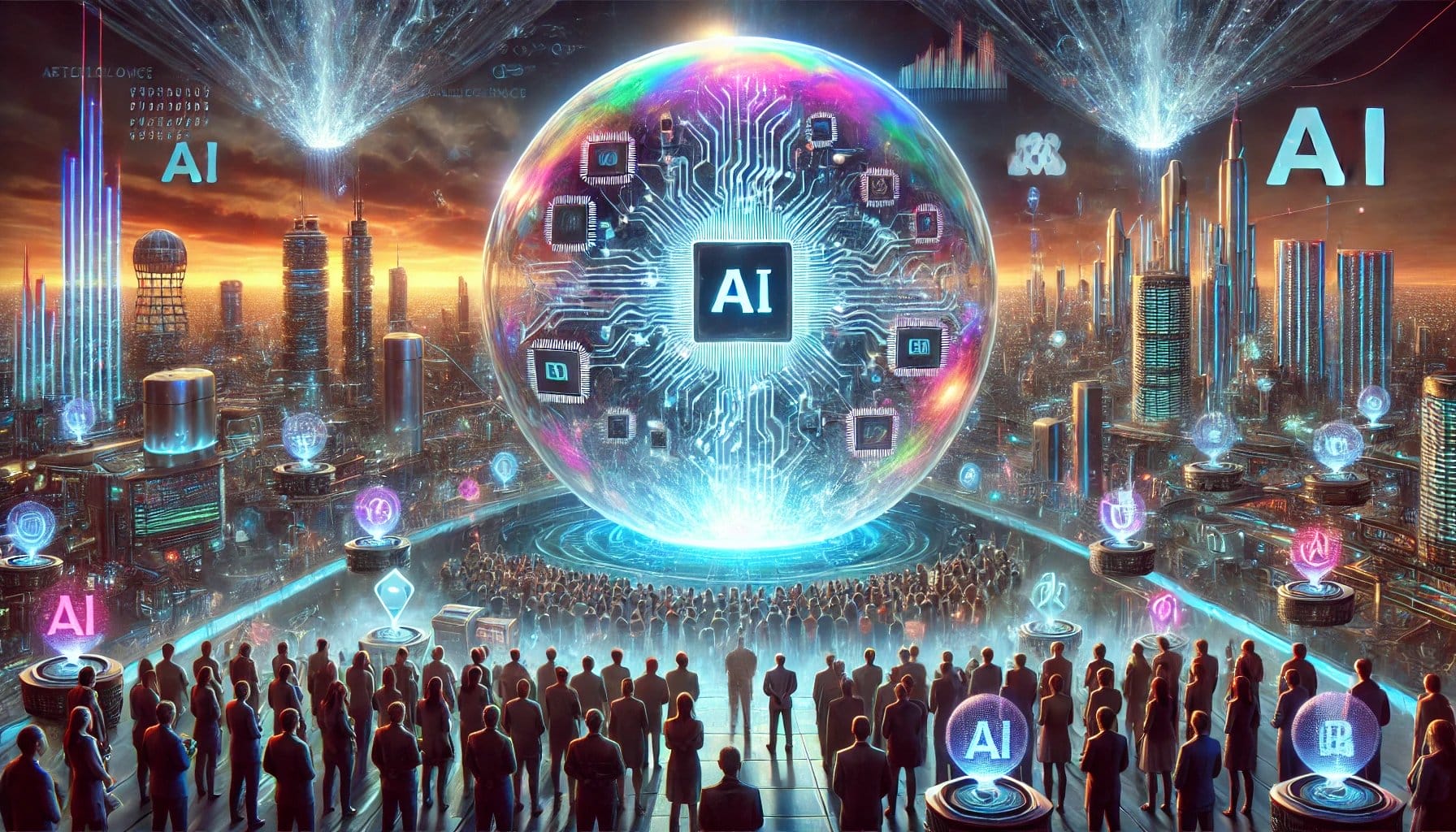
In recent years, Artificial Intelligence (AI) has burst into our daily lives. From virtual assistants to systems that promise to revolutionize entire industries, AI has generated unprecedented enthusiasm, attracting million-dollar investments and making optimistic headlines around the world.
However, some experts warn that this explosive growth could be artificially inflated, comparing it to economic bubbles of the past, such as the dot-com bubble of the late 1990s.
But what is an economic bubble? It occurs when the value of an asset (in this case, AI companies and technologies) soars above its real value due to speculation, and then collapses when expectations are not met.
Let’s explore the reasons behind these warnings and analyze the main arguments in this debate, from exorbitant valuations to scientific doubts.
High valuations versus low income
One of the main signs of a possible bubble is the gap between the valuations of AI companies and the revenue they generate. Many startups in the sector, such as OpenAI or xAI, have reached valuations of billions of euros thanks to massive financing rounds.
However, his current income does not justify those figures. David Cahn of Sequoia Capital estimated in June 2024 that the AI industry would need to generate $600 billion annually (about €570 billion) to support current investments, a goal that still seems distant.
The technology giants are not far behind either. Microsoft, Google and Amazon are investing colossal sums in AI, especially in infrastructure such as data centers and specialized chips.
However, proportional benefits have yet to materialize, raising questions about whether these valuations are based on expectations rather than tangible realities.
Speculative investments driven by hype
The rise of AI is not only due to its technical potential, but also to a hype that has captivated both investors and the public. According to PitchBook, in the last quarter of 2024, 43% of the $74.6 billion invested in technology startups (about €70.8 billion) went to AI companies.
This influx of venture capital has inflated valuations, but many experts fear these investments are speculative and do not reflect sustainable growth.
Xun Wang, chief technology officer at Bloomreach, warns that “the hype has created a narrative that does not always align with technical reality.” This disconnect between promises and achievements is reminiscent of past tech bubbles.
Difficulties in monetizing AI
Monetizing AI has proven more complicated than expected. While tools like ChatGPT have made waves, turning that fascination into sustainable income is a challenge.
Gary Marcus, cognitive scientist and AI critic, notes that many generative AI products face performance issues and rely on unrealistic expectations. If these limitations are not addressed, he warns, the sector could be headed for collapse.
Both large technology companies and startups are looking for viable business models. However, investors, who have bet heavily on AI, are beginning to grow impatient with the lack of returns**, adding pressure to a sector already overloaded with promises.
Massive expenses with uncertain returns
Big technology companies have allocated astronomical sums to AI. It is estimated that Microsoft, Meta, Alphabet and Amazon will invest more than $320 billion (about €304 billion) in 2025 in AI and data center projects.
However, these disbursements do not guarantee immediate benefits. FICO’s Scott Zoldi estimates that less than 10% of organizations manage to implement AI effectively and warns of a 30% chance of a significant decline in the sector.
Sequoia Capital also warns that current expenses are unsustainable without massive revenue to support them, raising concerns about long-term viability.
Decrease in hype and scientific skepticism
Initial enthusiasm for AI is starting to deflate. In 2024, several studies have questioned its real capabilities.
A paper published on arXiv points out that generative models, although impressive at generating text, fail in tasks that require deep reasoning or advanced logic.
These limitations are changing the perception of investors and the public, generating greater skepticism.
This pattern is reminiscent of other technologies that have gone through cycles of hype and bust, such as cryptocurrencies or virtual reality. As skepticism grows, the sector faces the challenge of proving it can live up to expectations.
Lack of profits and concern among investors
The absence of tangible benefits is beginning to worry investors. Alphabet, for example, plans to increase its investment in AI by 29% in 2025, but its shareholders are concerned about the lack of revenue growth in its cloud division, key to monetizing AI.
Jeremy Grantham, a renowned investor, has compared this situation to past technology bubbles and predicts possible losses if the sector does not adjust its course.
A capital-intensive technology with slow returns
AI requires massive investments in servers and energy to train models, but returns take years to arrive.
Wocstar Capital’s Gayle Jennings-O’Byrne warns that “we won’t see quick profits” in this sector. In an environment where investors seek immediate profits, this slowness could lead to a withdrawal of capital, accelerating any adjustment in the market.
Where is AI going?
The warnings about a possible bubble in AI are clear: inflated valuations, excessive hype, monetization difficulties and scientific doubts present a risky panorama.
However, AI could become a transformative technology in the long term, like the internet was after the dot-com bubble. The key is to manage expectations and turn promises into realities.
For now, experts invite us to cautiously observe this phenomenon that mixes innovation and risk.
This post is also available in: