
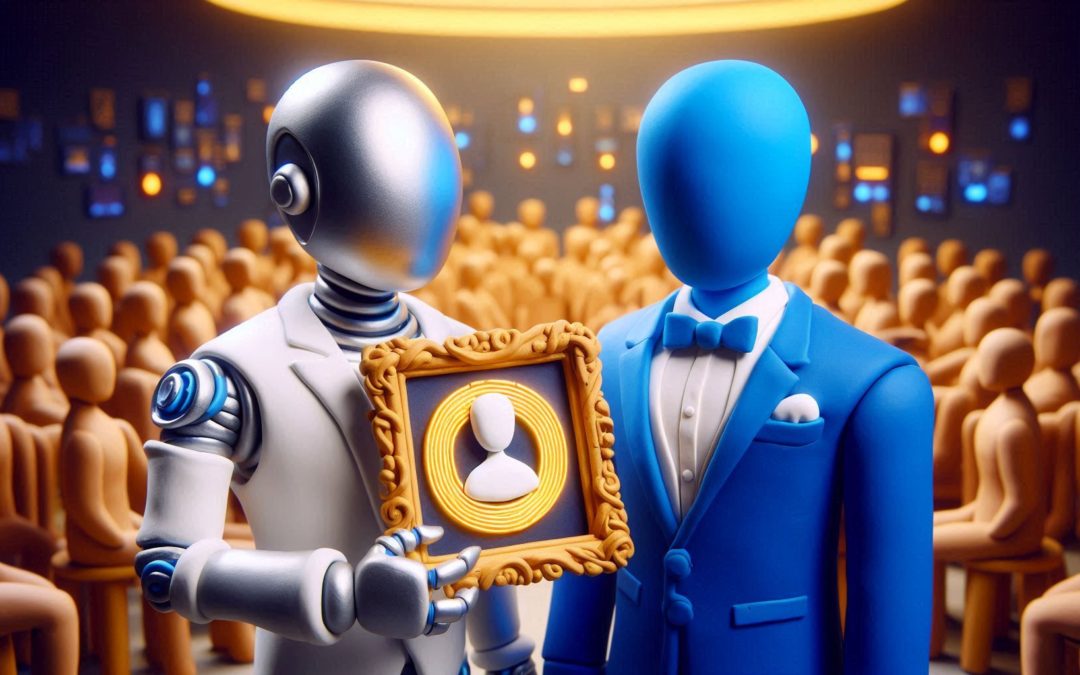
This year, artificial intelligence (AI) has taken an important step by starring in the Nobel Prizes in Physics and Chemistry, unleashing both admiration and debate.
The election of the Swedish Academy has ignited a discussion about whether advances in AI fit into these traditional disciplines or if we are seeing the emergence of a more interdisciplinary approach to science.
Could these awards set a trend in the future?
The winners: pioneers in AI applied to science
At the Nobel Prize in Physics, Geoffrey Hinton and John Hopfield were awarded for their work in artificial neural networks, research that dates back to the 1980s and that took concepts from physics to develop models that drove the advancement of modern AI.
A day later, AI shone again at the Nobel Prize in Chemistry. Demis Hassabis, director of DeepMind, John Jumper and Professor David Baker received the award for their work in predicting protein structures.
While Baker developed RoseTTAFold, a protein prediction tool, Hassabis and Jumper stood out for creating an AI system capable of solving a decades-old problem in the field of molecular biology.
These applications of AI in chemistry and biology demonstrate its ability to address complex problems with great precision.
The controversy: Is AI within the field of physics?
These awards have not been without controversy. Researchers such as Jonathan Pritchard, an astrophysicist at Imperial College London, expressed skepticism, suggesting that the Academy has been carried away by the AI hype.
The criticism is not based on denying the importance of these achievements, but on questioning whether they correspond to the traditional categories of Nobel Prizes.
In his words: “I like machine learning as much as anyone, but it’s hard to see this as a physics discovery.”
Some specialists, such as the CEO of MindBigData, David Vivancos, argue that AI is closer to computing than physics, since its operation has more to do with processes in “the mind of the computer” than with tangible physical phenomena.
Large-scale designer proteins
In the case of the Nobel Prize in Chemistry, the application of AI seems to fit better. The 2024 Nobel Prize in Chemistry was awarded to Baker, Hassabis and Jumper for their innovations in the computational design of proteins.
David Baker has pioneered the use of artificial intelligence algorithms to design entirely new proteins.
Their tool, RoseTTAFold, has revolutionized the way scientists can predict the three-dimensional structure of proteins, which is crucial for understanding their function and developing new drugs.
For their part, Demis Hassabis and John Jumper, through AlphaFold2, have achieved similar progress.
These advances allow scientists to design specific proteins for particular functions, which can lead to more effective treatments for diseases.
Impact on medicine and biology
Using AI to predict protein structures can lead to the development of new drugs, gene therapies, and innovative approaches to treating diseases.
Additionally, this award highlights the growing interconnection between computer science and the life sciences.
The collaboration between these fields has allowed advances that were previously unthinkable, demonstrating the importance of interdisciplinarity in scientific research.
Professor Andy Cooper, from the University of Liverpool, highlighted that AI has opened up new possibilities in biology and medicine, thanks to the abundance of well-structured data that allows the training of algorithms.
Towards an interdisciplinary future?
The controversy highlights a central question: should we rethink the traditional boundaries between scientific disciplines?
Professor Virginia Dignum, an AI expert at Umeå University in Sweden, suggests that perhaps it is time to modernize the Nobel Prizes to recognize that the most significant advances come from combining different disciplines.
According to Dignum, great discoveries no longer belong exclusively to one field, but require broad and interdisciplinary approaches. This approach is evident in AI, a technology that transcends scientific boundaries.
From improving accuracy in medical research to managing traffic systems in real time, AI is becoming an “accelerator” of human knowledge, expanding researchers’ ability to analyze large volumes of data, predict outcomes and generate new hypotheses.
AI as a data analysis tool
The fact that AI is being recognized at the Nobel Prizes suggests a trend that could consolidate in the coming years. As Demis Hassabis noted, although the role of AI today is limited to data analysis, its impact is undeniable and will continue to grow.
Furthermore, these awards represent a sign of openness on the part of the scientific community, showing its willingness to accept new forms of discovery and interdisciplinary collaboration.
However, Hassabis was also clear that, despite advances, creativity and hypothesizing remain human tasks.
In this sense, AI acts as a support, not as a substitute for the researcher. This distinction will be crucial in the future, allowing technology to be used as a complementary tool rather than displacing human minds.
A necessary change in science
The 2024 Nobel Prizes mark a milestone in recognizing advances in artificial intelligence within fields such as physics and chemistry, reflecting the growing impact of technology on our society.
As AI becomes a fundamental tool for addressing scientific challenges, the lines between disciplines are likely to blur even further.
These awards also invite us to reflect on how science is defined in the 21st century. Perhaps it is time to reform the Nobel categories and adopt a more modern and inclusive perspective, in which the intersection between technology and science is valued.
This edition of the Nobel Prize not only celebrates the achievements of the present, but also points towards a future in which artificial intelligence and science will work hand in hand, expanding the limits of what is possible.
This post is also available in: