
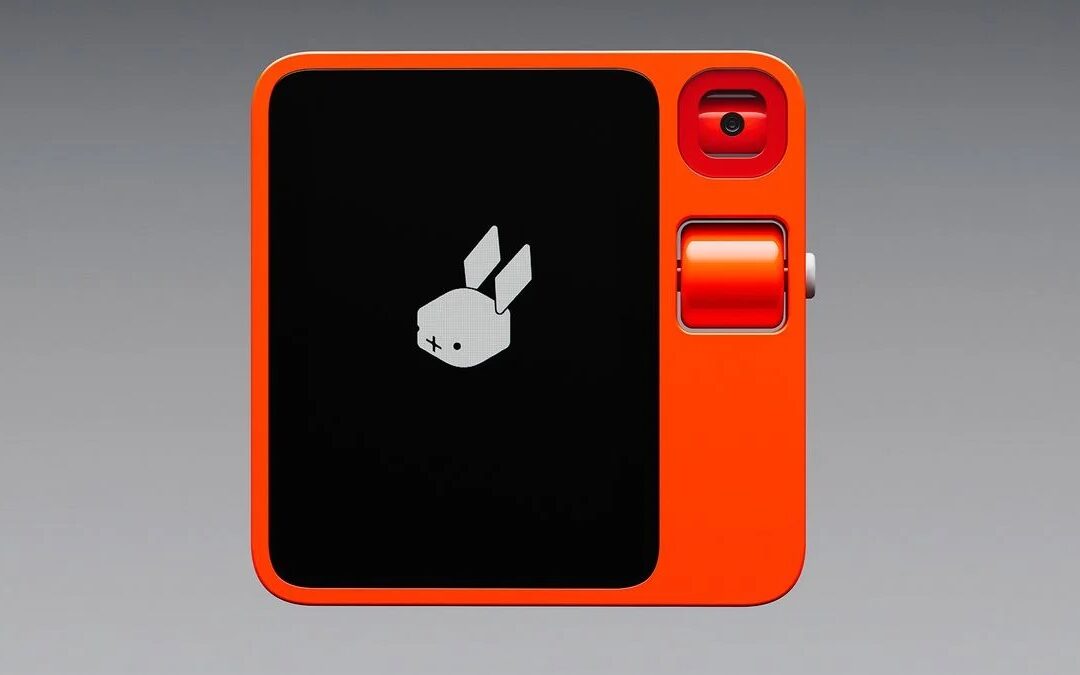
In the context of artificial intelligence, the Rabbit R1 emerges, a device designed to be an independent personal assistant, capable of executing a variety of actions with just voice commands.
Imagine a device the size of your palm that you can take with you everywhere and that you can ask from booking an Uber to suggesting what to cook based on what you have in the refrigerator.
This is the promise of the Rabbit R1, the first product from the American startup Rabbit, backed by LAM (Large Action Model) technology. But does this device really meet initial expectations?
Learn in detail about the Rabbit R1: its features, functionalities, market reception and future perspectives. Will this device be the future of human interaction with technology or just another unfulfilled promise in the world of consumer AI?
What is Rabbit R1 and how does it work?
The Rabbit R1 is an artificial intelligence-based device designed to be an independent personal companion, capable of performing a variety of actions using voice commands and without relying on a mobile phone.
Its goal is to simplify daily tasks and improve the user experience when interacting with technology. It works using a technology called Large Action Model (LAM), developed by the American startup Rabbit.
This AI model allows Rabbit R1 to understand and execute specific actions in different applications, without the need for a transient representation, such as text. Some of the Rabbit R1’s features include:
- You can request a ride on Uber or book accommodation on Airbnb, among other service-related actions.
- Play music according to user preferences.
- Provides information about people, places, events, etc.
- Offers recipe suggestions based on ingredients available at home, using its camera to recognize the contents of the refrigerator.
The Rabbit R1 has a camera that allows it to recognize the environment and respond exactly to user requests. In addition, it is equipped with WiFi and 4G connectivity, allowing it to function without the need for a mobile phone.
Features of the Rabbit R1
These are the features that this device offers:
- Compact design: The Rabbit R1 has an ergonomic and compact design, making it easy to take with you everywhere.
- Independent operation: This device works independently, meaning it does not need to be connected to a mobile phone to perform actions.
- Integration with popular applications: Thanks to LAM (Large Action Model) technology, the Rabbit R1 can interact with a variety of popular applications without the need for a transient representation, such as text.
- Voice Interaction: The Rabbit R1 is equipped with advanced voice recognition capabilities, helping it understand and respond to user commands accurately.
- Various functions: You can perform a wide range of actions, such as booking an Uber, playing music, getting information about people or places, providing directions, and suggesting recipes based on available ingredients.
- Integrated camera: The device has an integrated camera that allows it to recognize the environment and respond accurately to user requests, such as suggesting recipes based on the ingredients available in the refrigerator.
- Wi-Fi and 4G Connectivity: It is equipped with Wi-Fi and 4G connectivity, allowing you to connect to the Internet and perform online actions without the need for a mobile phone.
- Attractive price: The Rabbit R1 starts at $199, making it accessible to a wide range of users.
Reception and reviews of the Rabbit R1
Although the Rabbit R1 promises to be a standalone personal companion capable of performing a variety of actions using voice commands, some experts have expressed reservations about its functionality.
And, although the device has an attractive design and offers interesting functionalities, its execution and maturity still have room for improvement.
Experts such as YouTuber Marques Brownlee have shared negative reviews about the Rabbit R1 after testing it. Brownlee called the device “barely analyzable” and expressed doubts about its operation and usefulness in its current state.
Additionally, the Rabbit R1 has been compared to other similar devices, such as the Humane AI Pin, which has also received criticism for its functionality and maturity.
It has also been noted that smartphones continue to be leaders in terms of functionality and artificial intelligence capabilities. The Rabbit R1 is also criticized in terms of expectations generated and the reality of its operation.
Having a better Rabbit R1 will take more time
The Rabbit R1 represents a step forward in integrating artificial intelligence into consumer devices, but its mixed reception suggests there is still room for significant improvements.
Additional time may be required to develop and refine these technologies to achieve desired effectiveness and exceed user expectations.
With continued advancement in the field of AI and feedback from experts and users, it is likely that we will see significant improvements in future iterations of devices like the Rabbit R1.
Therefore, the success of these devices will depend on their ability to meet market expectations, in order to provide a satisfactory and hassle-free user experience.
This post is also available in: