
Just a few months ago, it seemed that Generative Artificial Intelligence was going to devour the entire world, and what’s more, it was going to do it almost free for us. We opened our social networks and marveled at photorealistic videos generated from nothing.
We become accustomed to having hyperintelligent assistants solving complex problems for a monthly subscription of 20 euros, a price that barely rivals what we pay for a couple of streaming platforms.
However, behind this façade of technological magic and hyperbolic promises, a much harsher economic reality hides: the income statement does not add up.
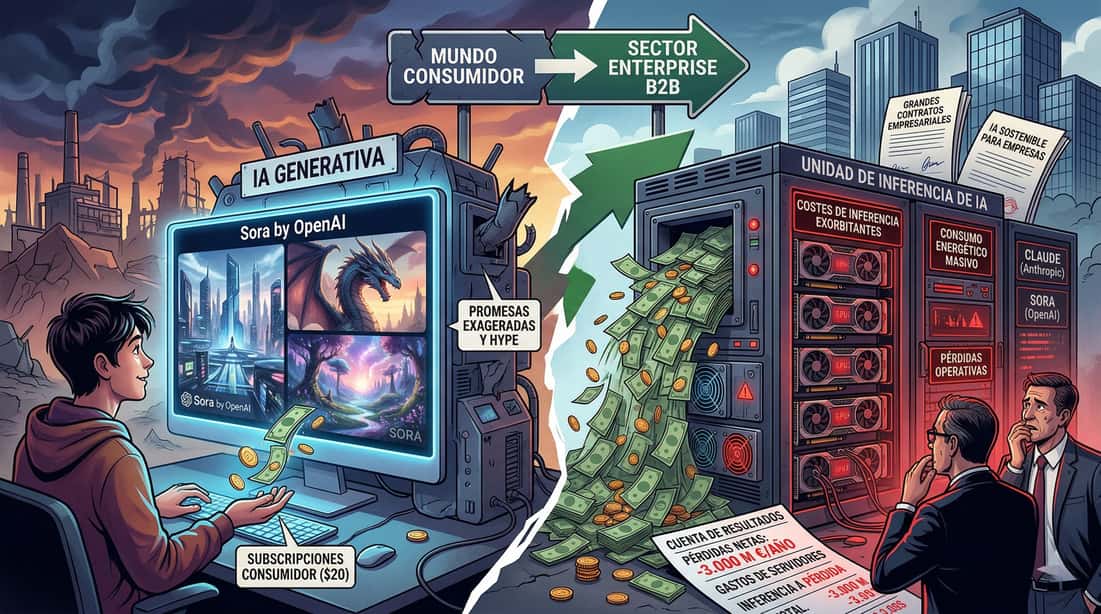
Today we face a true moment of maturity in the sector. The recent and abrupt cancellation of Sora by OpenAI and the red numbers dragged down by giants like Anthropic (creators of Claude) force us to ask ourselves an uncomfortable question:
Is the current AI model sustainable, or are we living in a temporary bubble subsidized by venture capital? Let’s look at why it costs companies so much more to serve AI than they charge for it, and what this means for the future.
The Fall of Sora: When generative video breaks the bank
When OpenAI introduced Sora the promise was revolutionary: creating hyper-realistic videos from simple text instructions. However, months after its public launch, the project was shut down.
The reason? Far from being a technical failure, it was classified as a true “financial drain.” Generating video is exponentially more complex than generating text; in fact, it requires 10 to 50 times more computing power.
While generating a word (a token) takes milliseconds, rendering a video clip with the quality of frontier models requires tens of minutes of non-stop processing on very expensive graphics cards (GPUs).
The day-to-day figures are scary. According to analyst estimates, maintaining Sora cost approximately $1 million a day in pure computing, and other sources raise the figure to peaks of $15 million on days of high demand.
If we boil it down to unity, each 10-second clip generated in production cost OpenAI between $1.30 and $9.74. At this dizzying pace of cash burn, the commercial adoption of the product was a bucket of cold water.
Are the “dabblers” to blame?
Although the tool reached an initial peak of 1,000,000 monthly active users (MAU), retention was disastrous and quickly fell below 500,000. The average user was a “dabbler” (someone who comes in, plays for a while, and leaves the service), generating viral content quickly but without providing the sustained value needed to justify sky-high subscriptions.
Faced with projected revenues (lifetime) of only about $2,100,000 compared to tens or hundreds of millions in expenses, the board’s decision was drastic. OpenAI not only closed Sora, but canceled a $1,000,000,000 deal with Disney in one fell swoop and redirected its team toward corporate projects.
Claude’s mirage: Your client costs you thousands of euros
If you thought the problem was exclusive to video, look at what is happening in the field of text and programming.
Anthropic, the company behind Claude, perfectly illustrates the great current dilemma: inference (the cost of running the model every time you ask it a question) has become the largest recurring expense in the industry.
In January 2026, Anthropic had to make a painful downward revision to its 2025 gross margin projection, moving it from 50% to 40%. The reason? Inference costs on Google and Amazon servers exceeded initial estimates by 23%.
And the most paradoxical thing is that this occurs in a context of record income , going from about 9 billion dollars annualized at the end of 2025 to projecting between 14 to 19 billion in the first quarter of 2026.
Your AI provider is burning money
The structural problem is evident: the subscription price does not even come close to covering the real cost of the service. Currently, Anthropic (and also OpenAI) are selling access to AI below its production cost at certain levels to gain market share, something that is only possible thanks to massive injections of venture capital.
A heavy user, especially those who use tools like Claude Code or the Opus version for programming, can consume thousands of dollars in computing power per month.
In exchange, the company only receives the $200 for its Pro subscription. This dynamic generates projections of operating losses (“cash burn”) of about $3 billion annually for Anthropic, which could accumulate tens of billions in losses until 2029.
Why is AI a financial black hole?
The short answer is that we are pushing the global technological infrastructure to the limit. There are several key factors that explain this brutal escalation in costs:
- Abysmal modal difference: As we mentioned, one hour of generated video can be equivalent to the processing cost of millions of text tokens. Explosive and insatiable demand: In 2026, the number of tokens generated globally on a daily basis already exceeds all written human production. In addition, new models based on deep reasoning chains multiply consumption between 10 and 40 times for each query we make.
- Hunger for energy and cooling: These frontier models run in huge data centers that consume gigawatts of energy. As more processors are needed, the costs of electricity bills and cooling systems rise uncontrollably.
- Hidden operating costs: It is not enough to have the servers. The operating expenses of maintaining equipment, software, and redundancy systems add 3 to 10 times more expense to the pure processing base.
To put it in perspective: In the first nine months of 2025 alone, OpenAI burned between $8.67 billion and $8.8 billion on inference alone, a figure that’s almost double its revenue in that same period.
The inevitable shift towards the “Enterprise” world
What we are witnessing with the fall of Sora is not the end of Artificial Intelligence, but his transition to the adult stage. It is a pivot forced by the free market: the average consumer, unfortunately, is not profitable.
Leading companies have understood that the real business will not come from millions of entertainment subscriptions, but from the enterprise (B2B) sector. We are talking about high-level corporate contracts, the integration of autonomous agents and tools designed for business productivity.
OpenAI is already redirecting its efforts under Fidji Simo towards corporate productivity in view of a future IPO, and Anthropic is confident of reaching its break-even point in 2028 based on the profitability of large companies.
For creators, developers and the average user, this means that the era of “cheap and all-powerful AI” could be coming to an end.
Exaggerated promises to replace entire industries overnight have collided head-on with the limits of physics, energy, and the bottom line. At the end of the day, no technology can eternally defy the laws of economics.
This post is also available in: