
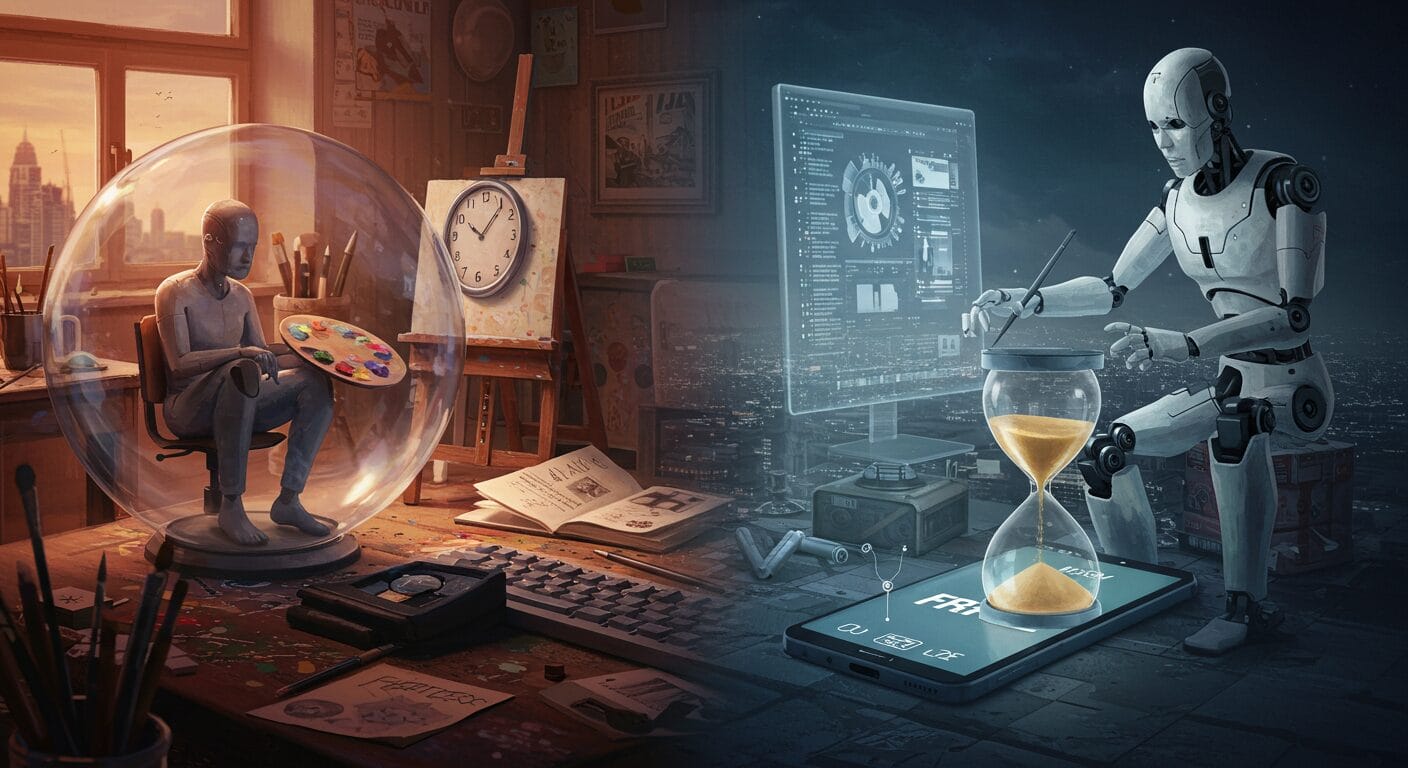
Imagine that tomorrow artificial intelligence did absolutely everything for you: write your messages, paint your paintings, even decide what to read or how to learn. Sounds tempting, right? More free hours, less stress…
But now ask yourself another question: What would you do with that “extra” time if, by delegating so much, your life started to feel empty?
AI promises to liberate us, but by automating tasks that have given meaning to existence for centuries, we risk becoming spectators of our own lives. Do we really want to save time if the price is losing what makes us human?
Discover the ethical dilemma behind efficiency, the irreplaceable experiences that AI will never be able to replicate, and how to use technology without it robbing us of what is most valuable: the pleasure of living, not just existing.
The promise that artificial intelligence offers
We live in an era where artificial intelligence is presented as the great savior of our time. Their offer is real: delegate tedious, repetitive or complex tasks so we can focus on what really matters.
Who wouldn’t want an algorithm to organize email or even suggest what to read or watch? Technology companies promise a future where AI frees us from everyday burdens, giving us that precious commodity: free time.
But here the first crack appears. While it is true that tools such as virtual assistants or chatbots can optimize processes, are we really using that “earned” time in meaningful activities?
The data suggests otherwise: a recent Stanford University study found that 70% of people who use AI for work tasks end up filling that time with more work or passive content consumption.
What do we lose by automating the human?
Artificial intelligence optimizes processes, but each task we delegate has an invisible cost:
Learning
When an AI summary “saves” us from reading an entire book, we lose more than information: we sacrifice internal debate, unexpected connections between ideas, and even the pleasure of underlining revealing phrases.
A Harvard study confirms that active learning generates 60% more retention than content pre-digested by algorithms.
Creativity
Painting, writing or composing music are not just final products, but processes that shape our brain.
Neuroscientists like David Eagleman warn: “Outsourcing creation weakens the neural networks responsible for innovation.” AI can imitate styles, but it will never replicate that unique spark of an idea born of human effort.
Authentic Connection
A handwritten note with errors, a photo without filters or a conversation without algorithms involved are acts of vulnerability that bind us.
As philosopher Sherry Turkle warns: “Every technological shortcut brings us closer to efficiency, but further away from real intimacy.”
The paradox of “liberated” time
The promise of AI sounds perfect: it gives us hours of freedom… but at what cost? Statistics reveal an uncomfortable truth: 72% of users who automate tasks with AI end up filling that time with more work or passive consumption of social networks.
A social experiment in Japan showed that employees who used AI to reduce their work hours reported greater stress. The pressure to “take advantage” of that free time led them to overload themselves with new self-imposed obligations.
If historically we have used technological advances such as washing machines or computers to work more instead of live better, what makes us think that with AI it will be different?
The problem is not in technology, but in our inability to value creative leisure and the simple act of existing without producing. As philosopher Byung-Chul Han wrote, “free time is not a gift if we don’t know what to do with it.”
How to use AI without losing our essence
Artificial intelligence is a powerful tool, but like any technology, its value depends on how we use it. The secret is to find the balance between taking advantage of its benefits and preserving what makes us human.
Apply the principle of conscious selection
Automate the repetitive, but protect activities that fuel our creativity and human connections. An Oxford study suggests that those who follow this approach report 40% higher life satisfaction.
Create “AI-free zones” in our daily lives
Spend time doing analogue activities like reading physical books, taking walks without app tracking, or having conversations without checking your phone.
Analyze if we need help from AI
We must systematically ask ourselves: “Is this automation bringing me closer to the life I want to live?” When we delegate tasks to AI, we not only save time; we are making a decision about what kinds of experiences we consider valuable.
Let’s really enjoy our free time
Artificial intelligence has given us more free hours, but fewer reasons to enjoy them. The real challenge is not how to save time, but how to fill it with meaning.
Instead of letting AI decide what to do with our lives, let’s reclaim the art of using technology to free ourselves from the trivial and reserve energy for what really matters. Read for pleasure, talk without distractions, waste time without guilt.
The final paradox is this: only when we stop seeing free time as a resource to be optimized, will we be able to fully enjoy it. AI can give us empty minutes; It is we who must turn them into memorable moments.
Time well spent is not measured in productivity, but in experiences that make us feel human. The best use for AI? May it help us remember how to savor life.
This post is also available in: