
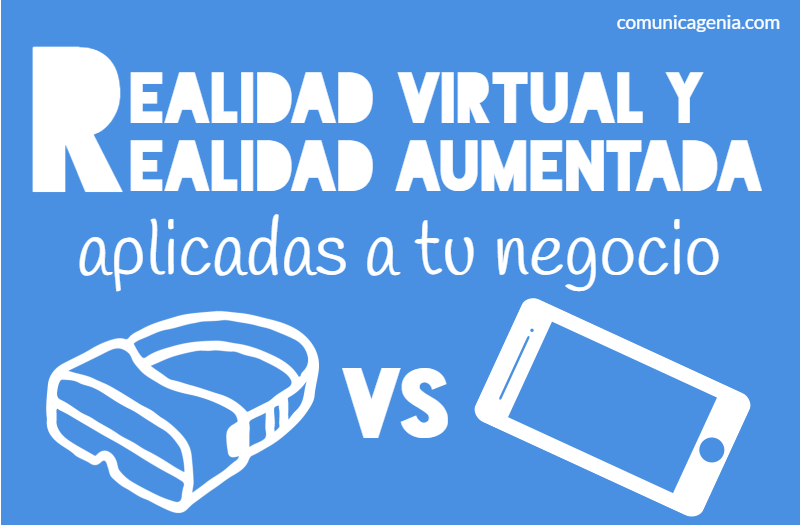
As you may already know, new technologies and marketing always go hand in hand. Today we want to talk to you about two new technologies that people sometimes confuse, but that have many differences. We are talking about augmented reality and virtual reality.
What is virtual reality?
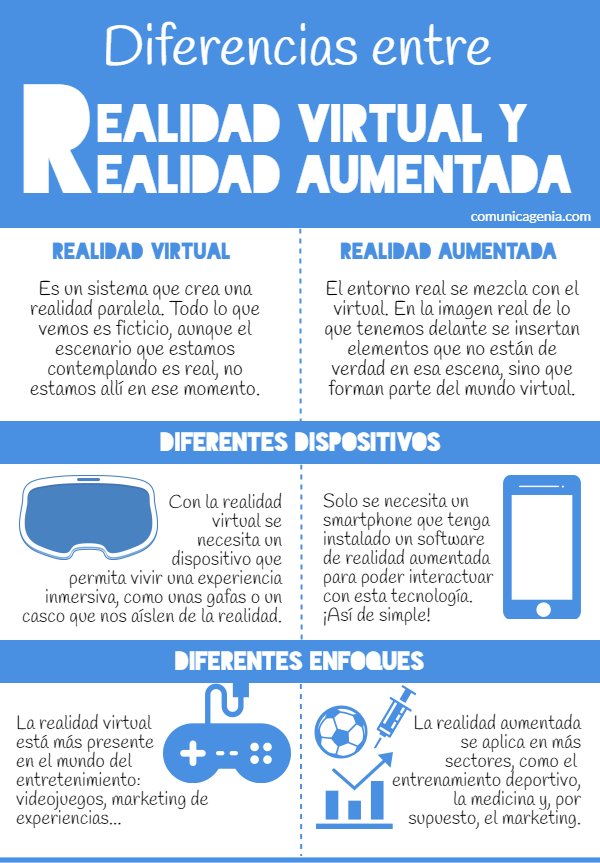
We can define virtual reality or VR as a system that creates a parallel reality. By using a device, the customer can see a series of illusions in real time. In virtual reality, everything the customer sees is fictitious.
What is augmented reality?
In contrast, in augmented reality or AR, the real environment is mixed with the virtual one. To do this, a webcam is used like the one we all carry on our mobile phone on a certain object. The software will detect what object it is and will show us information about it, allowing us to interact with that object. The clearest example of augmented reality is the video game Pokémon Go.
Differences between augmented reality and virtual reality
1. Different devices
In order for the customer to experiment with virtual reality in your business, you will need to have a device that serves both to isolate themselves from the real world and to see the images you want to show them.
In augmented reality, on the other hand, it is enough for the customer to have a smartphone or you offer one for them to start interacting.
2. Augmented reality has more options in the world of marketing and business
While this isn’t to say that virtual reality doesn’t have applications in the world of marketing, augmented reality offers a greater variety of options in the world of marketing.
3. Different approaches
While virtual reality is very focused on the entertainment sector, augmented reality is already applied in fields such as medicine, sports or, as we have already mentioned, marketing.
Examples of use of augmented reality and virtual reality
Augmented reality can be used in the store itself, allowing the customer to know data about a product, such as manufacturing materials, technical data or what sizes and colors the product is in.
Another good way to use augmented reality is to send a printed catalog to your customers so that they can expand the information using their mobile camera with augmented reality software.
On the other hand, an example of the use of virtual reality would be to offer the customer the possibility of getting to know your establishment without having to leave their home. This is already applied in some sectors such as hotels and also to show vehicles.
More Related Articles

The Hidden Cost of Vibecoding: Why “Cheap” Code Can End Up Costing You Dearly
You've probably already seen our articles discussing vibecoding (or vibe coding) and dissecting fascinating tools like Claude Code. In case you are just joining this trend, here is some context: this phenomenon, whose term was popularized by Andrej Karpathy in...
Microsoft Copilot Health: The AI that translates your medical history and wearable data into plain language
Have you ever felt that knot in your stomach when opening an envelope with lab results or reading a clinical report full of terms that seem to be written in another language? You are not alone. That mix of uncertainty and anxiety is a universal experience when we try...

Sora’s reality check: The end of exaggerated promises and the hidden costs of AI
Just a few months ago, it seemed that Generative Artificial Intelligence was going to devour the entire world, and what's more, it was going to do it almost free for us. We opened our social networks and marveled at photorealistic videos generated from nothing. We...
This post is also available in: