
DEFINITIVE GUIDE & MONOGRAPH • INFERENCE AND PRIVATE SOVEREIGNTY
AI on Premises: Private Inference, Tools and Hardware
Technical sovereignty, absolute privacy, and total control: The practical guide to downloading, running, and mastering open language models on your own hardware without relying on the cloud.
Why send the most sensitive data of your company or your personal projects to third-party servers when you can run cutting-edge models on your own computer? Local inference is no longer the exclusive domain of systems engineers. Today, any professional or organization can deploy powerful language models (LLMs), computer vision and document RAG systems with complete confidentiality and zero recurring cost.
The 4 Great Advantages of Local Inference
🔒
Privacy and GDPR
Your contracts, medical records, code and notes never leave your machine nor are they used to retrain third-party models.
💸
Zero Fees and No APIs
Eliminates monthly subscriptions of $20/month per user and the uncertainty of variable billing for consumed tokens.
⚡
100% Autonomous and Offline
Work on airplanes, areas without connectivity or critical environments without fearing service outages from cloud providers.
🛡️
Sovereignty without Censorship
Open models with verifiable weighings, without unpredictable corporate filters or silent degradation of capacities.
1. Essential Software: From Terminal to Private RAG in One Click
You no longer need to compile code or deal with complex libraries. These open source tools and desktop applications make running AI locally as easy as installing a traditional program.
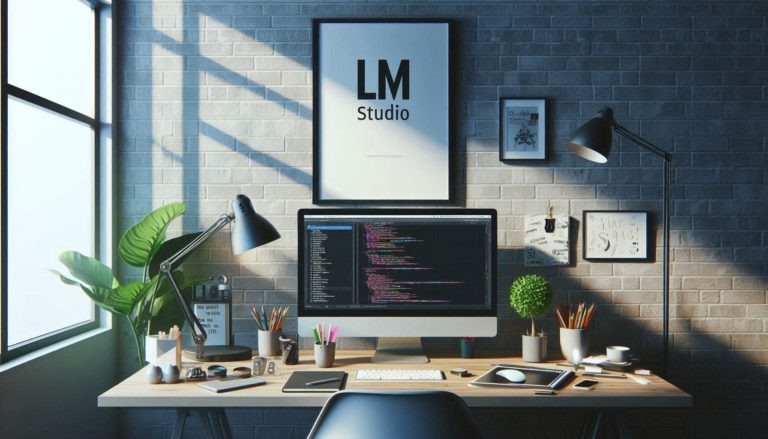 ENTORNO DE ESCRITORIO
LM Studio: The most visual way to chat with LLMs
Discover and download quantized models directly from Hugging Face, manage inference parameters, and build a local server compatible with the OpenAI API.
 RAZONAMIENTO AVANZADO
DeepSeek on Local: Download and Use Step by Step
How to run DeepSeek weights and distillations using Ollama or LM Studio for offline programming, math, and logic tasks.
 RAG EMPRESARIAL PRIVADO
AnythingLLM: Check your Documents without Leaks
The all-in-one solution for indexing entire folders of PDFs, DOCXs and spreadsheets with local embeddings and accurate citations to the original sources.
 AUTOMATION & WEBUI
Pinokio AI: Install Complex Environments in 1 Click
The browser that automates Git terminals, Conda environments, and Python dependencies to run Stable Diffusion, Whisper, ComfyUI, and FaceFusion without errors.
 BASE DE CONOCIMIENTO LOCAL
Surfsense: The Private Alternative to NotebookLM
Create your second digital brain and centralize notes, web pages and documents with hybrid search and local synthesis generation on your computer.
2. Hardware Guide: The Golden Rule of VRAM, GPUs and NPUs
In artificial intelligence, the video memory (VRAM) of the graphics card is the critical factor. If the model and its context fit completely in the VRAM, the answer is immediate; If it overflows the general system RAM, the processing speed drops drastically.
8GB VRAM
Models 3B to 8B quantized to 4 bits (LLaMA 3.2 3B, Qwen 2.5 7B Q4). Ideal for beginners and basic assistants.
12GB VRAM
8B to 14B models with expanded context windows (8k to 16k tokens) without bottlenecks on RTX 3060/4070.
16GB VRAM
The professional sweet spot: DeepSeek-R1 Distill 14B, Qwen 14B and RAG streams with thousands of pages on RTX 4080 / Mac M-Series.
24GB+ VRAM
High-end workstations (RTX 3090/4090): 32B and 70B models for advanced code and fine-tuning.
 2026 BUYING GUIDE
Is it worth investing in an AI PC in 2026?
We analyze the ROI against cloud subscriptions, key components (board, PCIe bandwidth, power supplies) and recommended configurations by budget.
 ARQUITECTURA & SILICIO
Nvidia: The Dominant AI Ecosystem
Why Tensor cores and the CUDA library are the undisputed industry standard for running models without technical incompatibilities.
 CHIPS NEURONALES INTEGRADOS
Processors with NPU: The New Standard
What the integrated neural processing units (Intel Core Ultra, AMD Ryzen AI, Snapdragon X) provide compared to dedicated graphics cards.
3. Open Models and GGUF Format: Quantization Explained
The original models are trained with 16-bit floating point weights (FP16), requiring up to 2 bytes per parameter. GGUF format quantization mathematically compresses these weights to 4 or 5 bits (like the Q4_K_M standard), reducing memory consumption by 70% with a loss of precision of less than 1%.
| Recommended Model | Parameters | Format / Quant. | Recommended VRAM | Main Specialty |
|---|---|---|---|---|
| LLaMA 3.2 3B | 3.2B | GGUF Q4_K_M | 4 – 6GB | Lightweight laptops, quick summaries and ranking |
| Qwen 2.5 7B | 7.6B | GGUF Q4_K_M | 8GB | High quality multilingual, programming and general tasks |
| DeepSeek-R1 Distill 8B | 8.0B | GGUF Q4_K_M | 8 – 10 GB | Deep analytical reasoning, mathematical logic and auditing |
| DeepSeek-R1 Distill 14B / Qwen 14B | 14.7B | GGUF Q4_K_M | 12 – 16GB | Development of advanced software and complex autonomous agents |
| Qwen 2.5 32B / LLaMA 3.3 70B | 32B – 70B | GGUF Q4_K_S | 24GB+ | Capacities comparable to GPT-4o for corporate production |
4. Professional Applications: From Professional Secret to Sovereign Company
Local artificial intelligence is the only viable alternative for sectors subject to professional secrecy and rigorous data protection regulations.
⚖️
Legal Firms and Consulting
Mass audit of contracts, analysis of jurisprudence and preparation of reports without client information touching external servers.
🏥
Clinics and Health Sector
Systematization of medical records, consultation notes and scientific literature under strict compliance with the RGPD and medical secrecy.
💻
Development and Software Teams
Proprietary code autocompletion, refactoring and debugging with local coding models without exposing intellectual property.
🏭
SMEs and Industrial Companies
Interactive corporate knowledge bases on machinery manuals, internal procedures and operational attention on a local network.
Frequently Asked Questions about AI on Local
Can I run a powerful LLM if I don’t have an NVIDIA graphics card?
Yes. Apple Mac computers with Apple Silicon processors (M1/M2/M3/M4) have ultra-high-speed unified memory that allows large models to run without a dedicated card. On PCs with a conventional x86 processor, you can also run models on the CPU using LLaMA.cpp, although the build speed will be noticeably slower.
What is the difference between using Ollama and LM Studio?
Ollama works mainly as a back-end service optimized for the terminal and to integrate with other applications or extensions via local API. LM Studio is a graphical desktop application designed for users who prefer to search for models, adjust parameters, and chat visually without using the console.
Is it legal to use open source models like LLaMA or DeepSeek in companies?
Yes. Models like LLaMA 3 (Meta community license for organizations with less than 700 million monthly active users) and DeepSeek (permissive MIT license) allow free commercial use, including integration into internal and customer-facing products without paying royalties.
Do you need to deploy local AI servers or stations in your company?
At ComunicaGenia we design and implement private artificial intelligence architectures, specialized workstations and local knowledge bases (RAG) for organizations that demand absolute confidentiality and sovereignty over their data.
This post is also available in: