
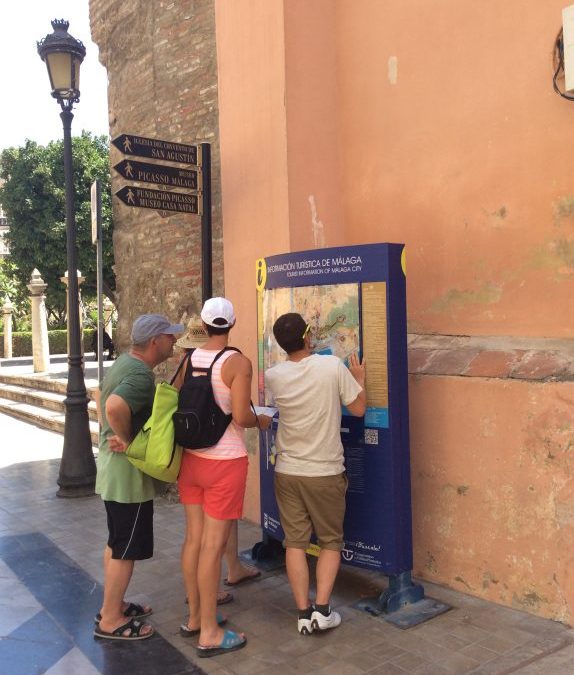
Malaga City Council has renewed the QR code service applied to tourist information that has been provided for several years by the technology company ComunicaGenia. Using an intelligent platform, which can detect the user’s language or mobile operating system, personalized information is provided. The application of these QR codes has been carried out on different elements. From outdoor signage such as museum totems or triangular totems of points of cultural interest, to brochures or applications for social networks.
About tourist signage in Malaga in 2019
The Tourism Department has reinforced Malaga’s tourist signage through new additions and a process of unifying the image of different types of indicators in the city.
As explained by the Councilor for Tourism and Promotion of the City, María del Mar Martín Rojo, “Malaga already has almost a thousand signs distributed in 367 points of the capital. The aim of giving part of these signs a common visual identity is to strengthen a global and more homogeneous idea of the diversity of the city’s offer, maintaining the richness of the variety of our resources, but at the same time making them a recognisable and identifiable whole”.
Thus, Malaga’s tourist signage comprises ten different types of indicators that include hotel signs; pedestrian signs; museum totems; totems indicating the address of tourist information offices; prisms that reveal unique architectural elements; gliding monoliths; road traffic signs from museums and points of interest; horizontal panels; the signage of the Malaga Nazarene and an additional route whose installation is in the final phase. Specifically, the indicators of the tourist information offices, the prisms and the gliding monoliths have been renewed, which now form a set with a common corporate image with the totems that mark the city’s museums. The specific tourist signage for the capital’s museums is brought together under the umbrella of the brand ‘Málaga, City of Museums’. It consists of 36 milestones located in the vicinity of the entrances to the different museum spaces that include, as a novelty, cross-information of all the centres. In this way, in addition to serving as a descriptive support for each exhibition space, these signs propose itineraries with a detailed list of all the museums that make up the network, provide information on the estimated walking time to each of them and on municipal public transport
ideal. All this highlights the diversity and value of the city’s museum offer. The Malaga Nazarena route, on the other hand, is a plan of pedestrian urban itineraries prepared jointly with the Association of Holy Week Brotherhoods to give prestige and permanently highlight the brotherhood universe that the capital of Malaga treasures.
The prisms mark architectural elements of the city that, due to their historical, cultural or ethnographic value, are likely to attract the attention of tourists and visitors, such as the canton guard of the Alameda Principal, the Atarazanas Market, statues of characters such as the Cenachero or Ibn Gabirol; or historical elements, buildings and urban environments worthy of interest such as the garum salting pools, the Zea Salvatierra Palace and the Town Hall, among others.
These milestones provide information in nine languages: Spanish, English, French, Portuguese, German, Italian, Mandarin Chinese, Russian and Japanese.
These physical information supports contain QR codes in line with the digital strategy of the Tourism Area. These elements allow the download of multimedia content to mobile devices. This is the case of the gliding monoliths, information panels with a large map of the city, which provide information on the network of museums and offer a list of monuments and unique buildings. The QR codes included in these landmarks allow you to download the official Malaga Tourism app, the audio guide, the city map and the ‘Mira Málaga’ brochures – with adapted plans to get to know the city in 8 hours, in 2 days or in 3 days – as well as specialised publications on the capital’s beaches. in nature tourism, in museums or in monuments.
More Related Articles
Copilot on WhatsApp: Discover how to use Microsoft AI in this messaging app
Can you imagine having a personal artificial intelligence assistant on your WhatsApp, ready to help you whenever you want? Whether to resolve doubts or generate ideas, Microsoft Copilot's connected system has arrived in the most popular messaging app in the world to...

DeepSeek Janus: The first multimodal models to challenge the dominance of OpenAI and Stability AI
In a world where big companies like OpenAI and Google are leading the way in artificial intelligence, Chinese startup DeepSeek has emerged as an innovative surprise. With artificial intelligence models that combine efficiency, low cost and outstanding performance, the...
Copilot Voice: The new AI voice tool offered by Microsoft
Imagine having a fluid and natural conversation with your computer, as if you were talking to a friend. Not rigid commands or robotic responses, but real dialogue, with interruptions, emotional tones and coherent responses. This is no longer science fiction: it is...
This post is also available in: